


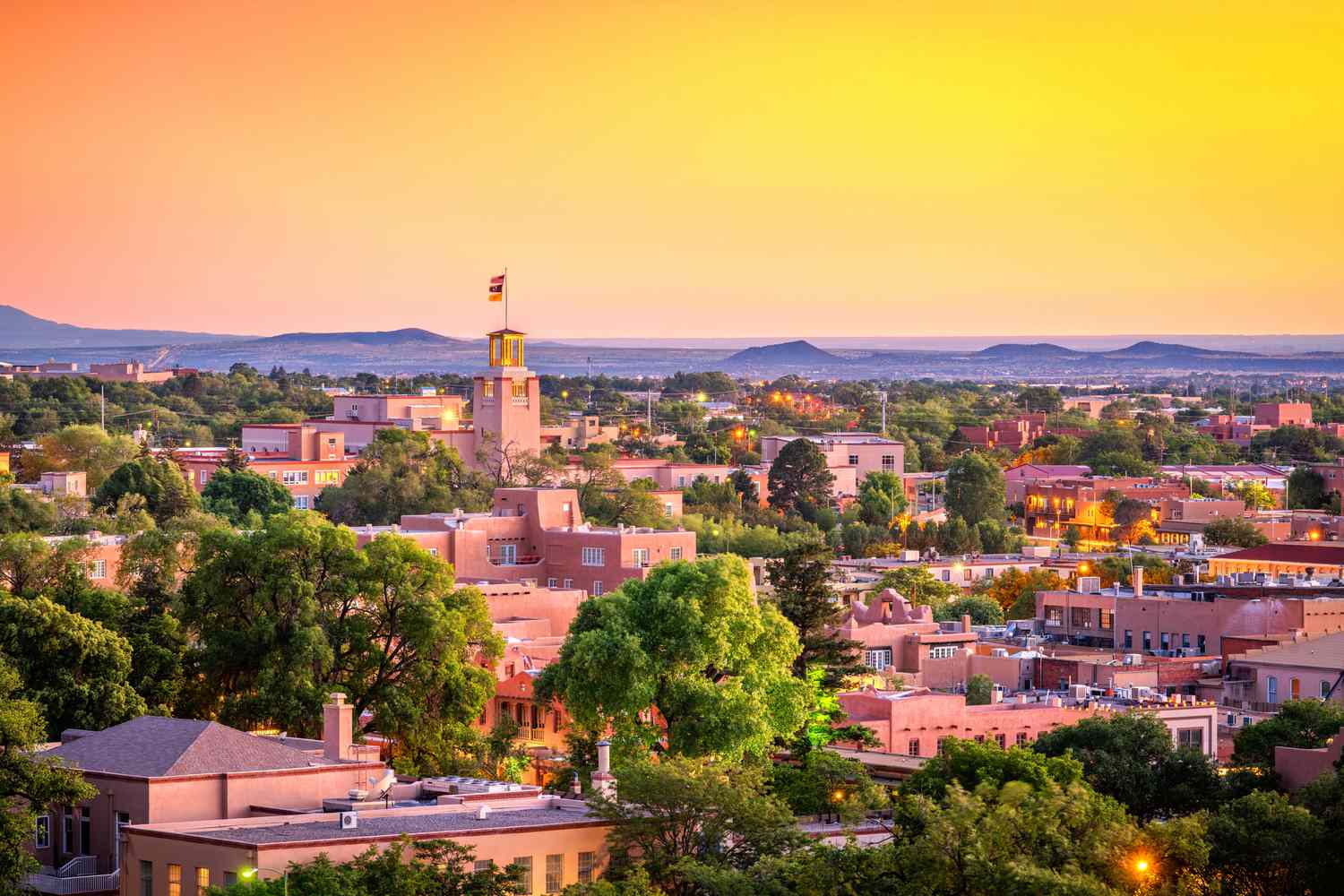
- Explore New Mexico’s rich history at sites like San Miguel Chapel and Taos Pueblo, steeped in cultural significance.
- Marvel at the natural beauty and adventure opportunities of White Sands National Park and Rio Grande Gorge.
- Immerse yourself in art and culture at Santa Fe Plaza and Meow Wolf, which offer diverse experiences for visitors.
For a true taste of the American Southwest, consider a trip to New Mexico. The state is known for its rich Indigenous history, vast landscapes (ranging from towering dunes to subterranean caves), remarkable archaeological sites, national landmarks (including cliff dwellings, adobe buildings, and centuries-old churches), and an incredible arts and culture scene. Suffice to say, there’s no shortage of places to visit in New Mexico, no matter what you’re into. We reached out to local experts for their top recommendations in the Land of Enchantment, from sprawling national parks to tiny towns and everything in between.
Santa Fe Plaza
benedek/Getty Images
Santa Fe Plaza is both a beloved tourist attraction and a popular gathering place for locals. Located in downtown Santa Fe, the site was established by the Spanish in the early 17th century and is renowned for its Puebloan architecture. The bustling spot hosts a slew of events throughout the year, including the Traditional Spanish Market, and the surrounding area is home to dozens of eclectic restaurants, shops, museums, and hotels. During the holidays, the plaza is decked out in twinkling lights, making it even more magical.
Turquoise Trail National Scenic Byway
grandriver/Getty Images
The 50-mile Turquoise Trail National Scenic Byway—named for the precious stone the Pueblo mined here centuries earlier—links Santa Fe and Albuquerque. As such, it makes for an excellent day trip from either city. The historic route winds through old mining and ghost towns such as Madrid, Golden, and Los Cerrillos. Carve out some time to stop at the Casa Grande Trading Post, the Cowgirl Red vintage and art store, and the Tinkertown Museum. Leave time for a ride on the Sandia Peak Tramway to soak up postcard-worthy mountain views.
Meow Wolf
Courtesy of Meow Wolf
While there are five other Meow Wolf locations scattered throughout the West, New Mexico’s outpost is the original and a must-visit. The kaleidoscopic House of Eternal Return in Santa Fe is an immersive, otherworldly art installation featuring rooms that virtually transport you to different realms. The playful exhibit is sure to delight art lovers of all ages.
Santuario de Chimayo
Diana Robinson Photography/Getty Images
Marama Nengel, chef concierge and experiences host at Bishop’s Lodge, Auberge Resorts Collection, recommends taking an afternoon trip to Santuario de Chimayo, located about 27 miles from Santa Fe. Thousands make the pilgrimage to this picturesque adobe church, a National Historic Landmark, each year. It’s best known for its holy dirt, which is believed to have healing properties. According to Nengel, no trip here is complete without a visit to the Centinela Traditional Arts gallery to see eight generations of Trujillo weavers. When hunger calls, tuck into some Southwestern fare at the romantic Rancho de Chimayo.
Old Town Albuquerque
Alex Potemkin/Getty Images
With its narrow, winding streets and adobe architecture, Old Town Albuquerque oozes small-town charm. While much has changed since its 1706 establishment, this dynamic destination has remained the city’s heart. Despite its tiny 10-block radius, Old Town is packed with more than 100 independent restaurants and boutiques. It also hosts dozens of annual events, including a car show, live music performances, and the world-famous Balloon Fiesta.
White Sands National Park
Mary Robnett/Travel + Leisure
Spanning 275 square miles, White Sands National Park is the world’s largest gypsum dune field, and it looks and feels like an entirely different planet. The wave-like, powder-white dunes resemble mounds of snow, and visitors can hike or sled down them any time of year. It’s also worth noting the park is home to a handful of white-hued animals—such as mice, lizards, crickets, spiders, and moths—that have changed color over time to adapt to the environment.
Couse-Sharp Historic Site
Visit New Mexico
Angelisa Murray, CEO of guided tour operator Heritage Inspirations in Taos, describes the Couse-Sharp Historic Site as a “true gem” and one of her favorite museums. Here, you’ll find the former homes and art studios of the Taos Society of Artists founding members Joseph Sharp and E.I. Couse. “Our guests can see the actual moccasins and pottery that Couse painted … and journey back in time to get a real feel of Taos in the early 1900s,” she says.
Abiquiú
Mary Robnett/Travel + Leisure
“Abiquiú is one of my favorite small towns to take our guests,” says Murray. The town, which was settled by the Spanish in the mid-18th century, looks and feels like it was plucked out of a classic Western. Visitors may even recognize it from fan-favorite flicks like “Indiana Jones and the Kingdom of the Crystal Skull,” among others. However, it’s also famous for being the home of the renowned American artist Georgia O’Keeffe. Don’t leave without visiting the Georgia O’Keeffe Home and Studio and Ghost Ranch (the artist’s summer home, about 20 minutes northwest). Murray also recommends popping into one of the state’s oldest general stores, Bodes, which “offers an otherworldly experience for the intrepid traveler,” she says.
Bandelier National Monument
JHVEPhoto/Getty Images
Known for its magnificent mesas, canyons, and Ancestral Pueblo dwellings, this national monument spans more than 33,000 acres of rugged landscape, making it a must-visit for history buffs and nature lovers alike. The 1.4-mile Pueblo Loop Trail winds through various archaeological sites and is a popular hike. If you’re looking for more thrills, hop on one of the ladders along the route to climb into small human-carved alcoves. Alternatively, experienced hikers may opt to tackle the challenging Frijoles Canyon and Rim Trail (eight miles one way).
Indian Pueblo Cultural Center
The Washington Post via Getty Images
For a firsthand look at Pueblo culture, head to the Indian Pueblo Cultural Center in Albuquerque. Set on roughly 80 acres, the center is owned and operated by the 19 Pueblos of New Mexico. On-site offerings include a museum, exhibition galleries, murals by Pueblo artists, and the Indian Pueblo Kitchen, which serves freshly prepared Native American cuisine. Stock up on souvenirs, which include a wide selection of traditional and contemporary crafts, jewelry, pottery, and rugs, among other treasures. Be sure to check the events calendar before you go.
Puye Cliff Dwellings
CampPhoto/Getty Images
Located in Los Alamos, this National Historic Landmark was once home to 1,500 Puebloans. It’s no surprise, then, that the site boasts stunning Pueblo architecture and well-preserved cliff and cave dwellings. The panoramic valley views are pretty impressive, too. It’s worth noting that guided tours are available Thursday to Monday between 8:30 a.m. and 4 p.m.
El Rancho de Las Golondrinas
Education Images/Universal Images Group via Getty Images
This living history museum is located near downtown Santa Fe, but its rural surroundings make it feel like it’s worlds away. Translating to “Ranch of the Swallows,” El Rancho de Las Golondrinas showcases striking adobe buildings on a 500-acre site. In the 18th and 19th centuries, the ranch provided a respite for those traveling between Mexico City and Santa Fe on El Camino Real. The site is open for general admission only from June through October.
Sangre de Cristo Mountains
Daniela Duncan/Getty Images
Hans Loehr, adventure program supervisor at the Four Seasons Resort Rancho Encantado Santa Fe, says the Sangre de Cristo Mountains offer something for everyone, including scenic trails for hikers of all levels. “Guests can enjoy exploring forests of aspen, ponderosa, and pinyon-juniper and meadows filled with colorful wildflowers, relaxing near alpine lakes, bagging some high mountain peaks, and pausing to take in breathtaking views from ridgetops and mountain summits,” he says.
Rio Grande Gorge
Mary Robnett/Travel + Leisure
Stretching nearly 50 miles, the magnificent, 800-foot-deep Rio Grande Gorge is considered the Grand Canyon of New Mexico. Soak in sweeping views of the rugged landscape from the Rio Grande Gorge Bridge, which, at 650 feet, is one of the country’s highest bridges. It’s also a popular spot for hiking.
San Miguel Chapel
Michael Warren/Getty Images
Located along the Old Santa Fe Trail in the Barrio de Analco Historic District, this Spanish colonial mission church stakes its claim as the oldest in the United States. While initially constructed in 1610, it has since been rebuilt twice (most recently in 1887). Prepare to be dazzled by the adobe architecture; the interiors are equally spectacular, with centuries-old wooden beams and the 780-pound San Jose bell, which has its own fascinating history.
Carlsbad Caverns National Park
milehightraveler/Getty Images
This national park and UNESCO World Heritage Site is located in the Chihuahuan Desert in the southern part of the state. The enchanting attraction is home to over 119 caves. Travelers can easily spend the entire day exploring these captivating caverns, admiring the mystical stalagmites and stalactites and looking out for wildlife like bats and cougars. Don’t miss the Big Room, the largest cave chamber by volume in North America. The 1.25-mile trail leading to it is a relatively easy trek.
Taos Downtown Historic District
Mary Robnett/Travel + Leisure
Despite its small size, Taos packs in plenty of charm and character. What’s more, this storied mountain town is known for its many galleries, scenic hiking trails, and, in the winter, world-class skiing. At the center of it all is the Downtown Historic District, where you’ll find the 1796-era Taos Plaza. Here, locals and visitors alike gather to listen to live music, shop at farmers markets, and attend art events. An abundance of shops, galleries, and restaurants can also be found within easy walking distance.
Taos Pueblo
Kathleen Messmer/Travel + Leisure
Located about three miles from Taos Plaza is the Taos Pueblo, which is both a UNESCO World Heritage Site and a National Historic Landmark. The Pueblo has been inhabited for more than a millennium, and many of the adobe structures appear the same as when the Spanish first arrived in New Mexico in the 1500s. Hlauuma (north house) and Hlaukwima (south house) are the location’s most famous buildings, and they’re considered the oldest continuously inhabited communities in the country.
Read the full article here