


We were 10,000 feet above the Pacific, in a tiny Cessna that seemed like it should have been flying much lower than that, when the clouds cleared and Lady Elliot Island appeared below us like an emerald in a sapphire sea. The pilot, Jonathon Rae, a young Aussie with a dashing mustache, looked down and grinned. “Keep your eyes out as we approach,” he said. “There’s every chance we might see a few manta rays.”
Six passengers, including me, pressed their faces to the windows. It was true: mantas love Lady Elliot Island, and their 16-foot wingspans make them easily visible from the air. Here at the southern tip of the Great Barrier Reef, you’re practically guaranteed to see them. Descending toward this pristine coral cay, you might spot any number of creatures silhouetted against the reef—minke whales, humpbacks, bottlenose dolphins, loggerhead turtles, tiger sharks. And that’s even before you go beneath the surface.
My plan was simple: when we touched down, I would get into the water immediately. As someone obsessed with all things aquatic, I’d been longing to visit the Great Barrier Reef, not only to make a pilgrimage to the earth’s largest living structure—so monumental that its 1,400-mile-long form can be seen from space—but to find out more about its state of health.
Sean Fennessy/Travel + Leisure
The world’s corals are in real trouble, imperiled by pollution, overfishing, coastal development, and the big one: global warming. Since 2016, the Great Barrier Reef has endured an unprecedented six mass bleaching events, which occur when ocean temperatures spike, causing corals to expel the algae that live inside their tissue. Without these organisms, which provide the corals with food and bestow their stunning colors, the reef becomes a boneyard. Bleached corals can recover, but only so many times. And only if they get a break from the heat.
Was the Great Barrier Reef okay? I’d read contradictory headlines, ranging from obituaries—large sections of Australia’s great reef are now dead—to celebrations—parts of great barrier reef record highest amount of coral in 36 years. The strange reality, as I would discover, is that both of those statements are true. Yet neither fully represents the truth, because the Great Barrier Reef is not a single entity. It’s an intricate ecosystem the size of Germany, composed of some 3,800 individual coral reefs, 600 islands, and 300 coral cays, each as unique as a fingerprint. As such, it’s impossible to sum up its condition in a single sentence. I wanted to see the bigger picture: to immerse myself, to learn, to be enchanted, and to find out whether the reef will survive to enchant future generations.
I started my journey in Brisbane. It’s the capital of Queensland, the state that occupies Australia’s northeastern quadrant, most of its coast bordering the Great Barrier Reef. The city felt sporty and happy, attuned to the outdoors. People hopped on ferries that ran like taxis on the Brisbane River, biked along waterfront paths. After two days at the Calile—a hotel so radiantly stylish that a shopping district of Australian designer boutiques has blossomed around it—I found myself at the front desk asking to make a booking for July 2032, when Brisbane will host the Summer Olympics. Despite its hipness, the Calile felt soothing, with its chilled organic wines and linen robes and a palette of dusty rose, light oak, and matte gold that had an almost Xanax-like effect.
Sean Fennessy/Travel + Leisure
After a 90-minute flight from Brisbane, the scene that greeted me at Lady Elliot Island was …different. Climbing from the plane, I caught a strong whiff of guano, and the culprits were everywhere: gulls, terns, and noddies, cackling and whizzing overhead. The island is just a few feet above sea level and measures less than a quarter square mile. At first glance, the Lady Elliot Island Eco Resort looked like a summer camp. Most accommodation is in cabins, and the place was buzzing with activity: Staff in polo shirts and shorts checked clipboards, scuba divers picked up tanks, and families were fitted with snorkeling gear. A group of female free divers strolled by in shorty wet suits, carrying their long, attenuated fins.
My planemates and I were swept off on an orientation tour. There was a lot to take in. The eco-resort operates within a highly protected area of the Great Barrier Reef Marine Park, a kind of living laboratory where the ocean can restore itself. The property is almost entirely solar-powered and has its own desalination plant. Everything is recycled. Food scraps? Composted into soil. Glass bottles? Ground up to make sand. Wastewater? Irrigation. You won’t find single-use plastic here, or a cell signal, or a chocolate on your pillow. There’s no fine dining, no fluffy robes. What you will find—I was starting to get it—is a chance to communally explore the Great Barrier Reef in a way that actively helps it.
Orange-and-white clown fish peered from rust-red anemones; neon-green parrotfish nibbled at bubblegum-pink brain coral.
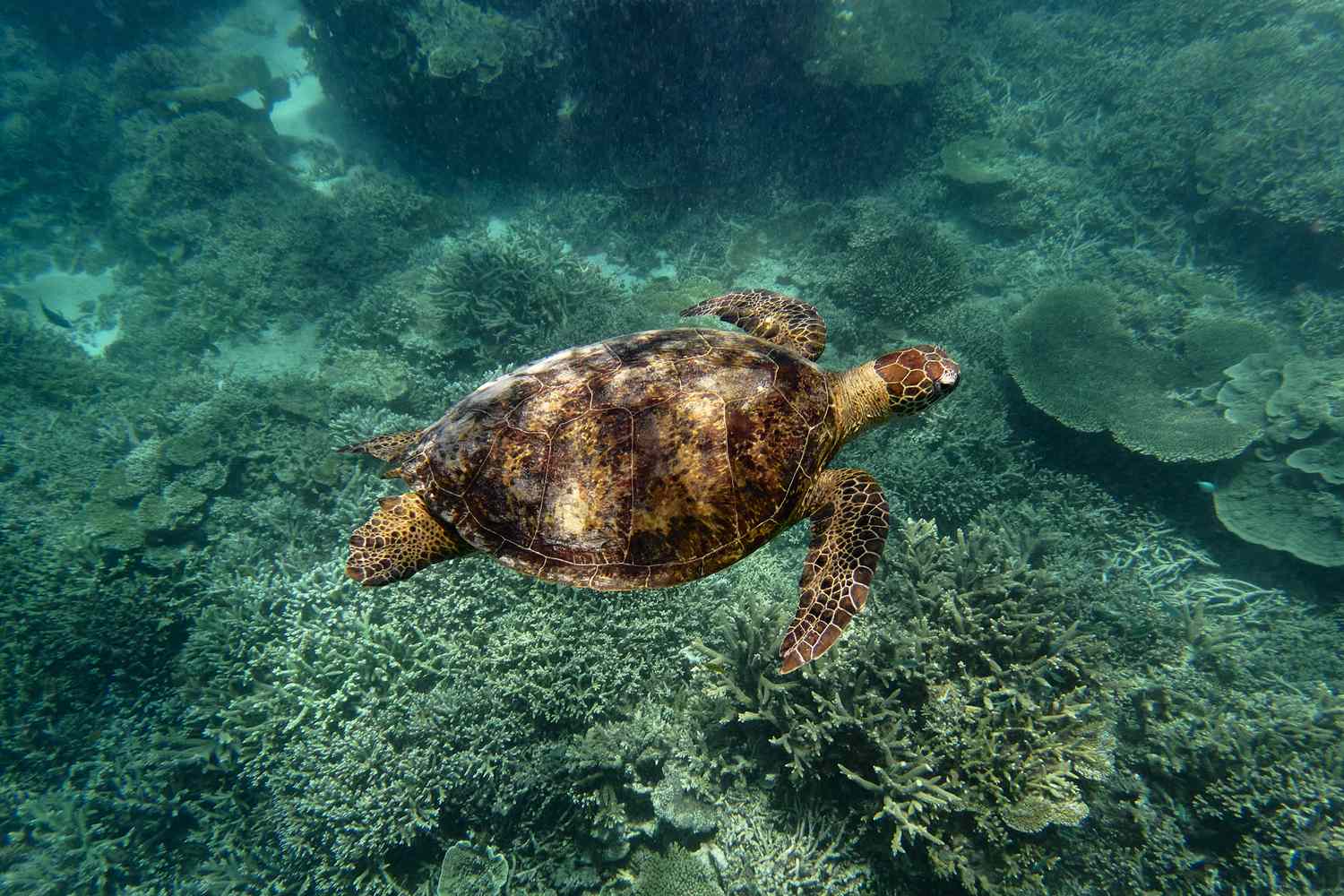
First-timers take a guided snorkeling tour to get an overview of the surrounding waters, and within an hour I was floating in 30 feet of ocean, face-to-face with a pack of barracudas. But it was the scenery that made me gasp into my snorkel. There were towers of coral, exuberant in shape and color. Orange-and-white clown fish peered from rust-red anemones; neon-green parrotfish nibbled at bubblegum-pink brain coral. A sea turtle cruised by with a cloud of yellow tangs cleaning its shell: it looked like the fish were riding on the turtle’s back. A school of big-eye trevally swirled in a vortex. In decades of undersea exploration, I’d never seen such an explosion of marine life. Lady Elliot felt like a time capsule where we could witness the ocean as it used to be.
Sean Fennessy/Travel + Leisure
Our master reef guide, Naoko Okui, sleek in a dive hood with a braid down to her waist, called out species as we snorkeled along. “I want to show you something interesting,” she said, pointing to an ominous-looking barbed creature perched on a coral slab. “That’s a crown of thorns starfish.” I’d heard of this species—a serial killer of corals. It’s native to the region but lately its numbers have exploded, requiring intervention. Looking at it, I could see the problem. One side of the slab was purple; the other side was bone-white. The crown of thorns sat like the Death Star in the middle, eating the coral alive. A single one wasn’t cause for worry, but elsewhere legions of them have destroyed vast swaths of reef. Overfishing is thought to be one reason for the plague: the starfish now have fewer predators.
An average day at Lady Elliot has a tempo, with the details dictated by the tides. You can sign up for dives, snorkeling excursions, reef walks, or sustainability tours. You can sun on the beach or explore on your own. You can become a citizen-scientist for Project Manta, diving to take photos of the unique markings on rays’ bellies. More than 1,200 mantas have been identified in the waters around the island—knowledge that helps researchers understand the population ecology of this threatened species.
Sean Fennessy/Travel + Leisure
At sunset, guests wind down at Lighthouse Beach with drinks and snacks served from a catering wagon. Next, everyone crowds into the dining hall, where meals are served buffet-style. The time after dinner is for listening to nature talks, watching ocean documentaries, or generally hanging out with a deep indentation in your forehead, courtesy of your scuba mask. Needless to say, there is no TV.
On my second night I was eating dinner outside when a pretty seabird sidled up and pecked me, hard, on the ankle. A staffer shooed it away. The bird was a buff-banded rail, she told me, “but we call them buffet bandits.” I didn’t mind—I found the birdlife captivating (if noisy: earplugs are provided on every bedside table). With 100,000 seabirds in residence during nesting season, Lady Elliot is one of the reef’s most important breeding sites. It wasn’t always this way. In the 19th century, guano miners razed the place, removing most of the topsoil and leaving behind barren rock. Island custodians began restoring the vegetation in the 1960s—work that continues in the resort’s nursery. Now the birds’ favored nesting habitats, the native pisonia trees and octopus bushes, are back.
As planned, I spent my entire day in a wet suit. First I free dived on a sunken schooner, accompanied by guitarfish, lemon sharks, giant stingrays, and dozens of eagle rays. Later I snorkeled through a maze of corals in the lagoon. I was startled to run into a flowery cod in four feet of water, an ambush hunter that can grow to the size of a steamer trunk. The fish was equally startled by me. It took off, its eyes bulging with surprise.
As I was leaving I saw a boy in a wet suit, maybe six years old, marching into the lagoon with his snorkeling gear. He was alone, and the image stayed with me because it summed up Lady Elliot perfectly. The kid was stoked—you could see it. He wasn’t on his phone playing video games. He was at large on an island full of wild animals, and I knew that he would remember that feeling for the rest of his life. That boy would go home with an emotional connection to the Great Barrier Reef, determined to protect it.
Sean Fennessy/Travel + Leisure
From Lady Elliot I flew north to Townsville, the gateway to the northern Great Barrier Reef, and then took a helicopter for about an hour to Orpheus Island. It is part of the Palm Island group, which consists of 12 islands; only two are inhabited. “The beauty of this area is there’s nobody out here,” the pilot told me through his headset. “No Jet Skis, no tour operators. The reef’s in really good condition.”
After an hour’s flight, we touched down at Orpheus International Heliport, which consists of a helipad on the front lawn of Orpheus Island Lodge. I jumped out of the Ferrari-red chopper and was met with a glass of champagne. Then I was introduced to the head chef, who asked about food preferences so he could plan my personalized menu for the next three days. (All food and drink is included at Orpheus—unless you order exotica like a Lagavulin 16-year single malt or the 2003 Dom Perignon. Which they have.)
Here was yet another flavor of hospitality: call it five-star castaway. Orpheus is seven miles long and a mile and a half at its widest, lushly forested and gently hilly, with the resort tucked in above a fringe of white-sand beach. It’s a pocket paradise, hosting only 28 guests. That intimacy of scale is echoed in the architecture, which blends seamlessly into the landscape. I settled into my suite, feeling as though I were visiting a friend’s beach house, if that friend were Nicole Kidman. The décor is light, airy, and elemental—wood, stone, bamboo—the aesthetic embodiment of a long exhale. I felt like taking a nap, but rallied at the sight of the 25-meter, black-tiled pool. After a full day of travel, its silky water was a tonic.
Sean Fennessy/Travel + Leisure
In the morning, dive instructor Sarah Poborsa, skipper Heath Kiernan, and I left Orpheus in the resort’s speedboat and headed out to sea. Our destination was a cluster of coral pinnacles called Rib Reef, on the Great Barrier Reef’s outer edge. “Rib is our favorite,” Poborsa enthused. “It’s a beautiful mix of hard and soft corals. There’s a trench between the—oh hey, look! Dolphins!” It was a pair of bottlenoses, always a good omen.
After 90 minutes, Kiernan cut the engine. We’d arrived, but we were floating in an unbroken expanse of blue. I was confused: where was Rib Reef? Then a shadow appeared to starboard, and I realized that it was right below us.
Poborsa and I jumped in. Adjusting my mask, I ducked underwater—and swooned. Rib Reef was a riot of corals gleaming in crystal-clear water: giant plates, gorgonian fans, corals like roses, camellias, flowering trees. Every eyeful was a universe, a cosmos squeezed into a teacup. It was so outlandishly beautiful that I had to work to control my breathing.
Sean Fennessy/Travel + Leisure
We wound between pillars of coral, stopping to marvel at a river of lunar fusiliers—hundreds of shimmery turquoise fish—streaming below us. We watched a lionfish, with its showy candy-cane-striped fins, float down a wall. We saw orange-lined triggerfish, teardrop butterfly fish, spotted unicorn fish, and a slinky little epaulette shark, gold with adorable black spots. Two big fish shot by like titanium torpedoes. “Spanish mackerel,” Poborsa said, smiling. “They’re so cool.”
Time became elastic; two hours passed like 20 minutes. I was tailing a Maori wrasse when I heard Poborsa shout: she’d seen something. I looked down and saw four bumphead parrot fish meandering by. At up to five feet long and a hundred pounds, bumpheads are among the largest reef fish. They have blocky green bodies, buck teeth, and bulbous foreheads daubed with a hot-pink racing stripe. It was a rare sighting, like watching aliens out for a stroll. Poborsa and I hovered, delighted, and we followed the bumpheads as they swam, until their tails vanished into the blue.
IN 2024, THE OWNERS of Orpheus Island Lodge opened a second retreat nearby, a private island called Pelorus. Chrissie Williams, the general manager of both properties, drove me over in a Zodiac. We traced Orpheus’s shore, crossed a narrow strait, and arrived at a five-bedroom beach house fronted by jade-green water brimming with corals. “People say Orpheus is quiet,” she noted, “but Pelorus is a whole other level.”
Sean Fennessy/Travel + Leisure
We toured the property, which is pure barefoot luxury: a place you’d go if you wanted absolute privacy, loved watersports, and had excellent taste. Oceanfront pool, private chef, top-of-the-line everything—you’d never know you were totally off-grid. Orpheus and Pelorus are solar-powered; both take sustainability seriously. The resorts contribute to a marine research station and a nonprofit called Reef Keepers.
On our way back, Williams detoured slightly. “The biggest piece of coral on the Great Barrier Reef is right here,” she said, pointing to a hulking beige boulder visible just beneath the surface. I was doubtful. How could we have measured every coral colony? But it was likely true: the 17-foot-tall, 34-foot-wide coral, named Muga Dhambi (Big Coral) by local Aboriginal leaders, is estimated to be 430 years old. This majestic elder had survived centuries of cyclones and bleaching events.
Scientists now know that some corals are more heat-tolerant, and there’s evidence that others can adapt. But the details are complex. In Townsville, I’d visited the Australian Institute of Marine Science, a global leader in using advanced technologies to protect vulnerable reefs. One of the program’s research directors, Line Bay, had walked me through its labs, where projects are under way to breed hardier corals and seed them onto the Great Barrier Reef at scale. It’s a labor-intensive effort with collaborators that include the Australian government, universities, businesses, nonprofits, Indigenous ranger groups, the general public—even the McLaren Formula 1 racing team. “Their process engineers are really interested in this problem,” Bay told me. “They shave off milliseconds in the pit, right? They’ve helped us create gadgets that will streamline our process so it becomes more efficient.”
Sean Fennessy/Travel + Leisure
Researchers are also studying ways to cool the most endangered parts of the reef, like spraying salt water into clouds to deflect sunlight. “If it could work, it would be a massive bonus in the short term,” Bay said. Researchers are also banking DNA, creating a kind of reef edition of Noah’s Ark. These strategies could buy time for corals, she stressed, but none of them was a silver bullet: “We need to stabilize greenhouse-gas emissions. And we need to stabilize the world’s temperatures. It’s the most important thing we can do for our coral reefs, and for humanity, full stop.”
I helicoptered on to Cairns, where I caught another Cessna that took me north to Lizard Island. From the air, aquamarine shoals ran all the way to the horizon, and for the first time I got a glimpse of the Great Barrier Reef’s vast scale. The reefs in the north are exquisite, but many have suffered during recent mass bleachings.
Lizard Island has an intriguing history. In August 1770, Captain James Cook rowed there under duress: his ship, the Endeavour, had become trapped in what he called a “labyrinth” of coral. Desperate to find an escape route, Cook climbed to the island’s highest point. He spied a passage and successfully took his ship through it, but not before naming the island after its population of yellow-spotted monitor lizards. Never mind that Lizard Island already had a name: Jiigurru. The Aboriginal Dingaal people had been using the island as a sacred ceremonial site for about 6,000 years.
Sean Fennessy/Travel + Leisure
In his wildest dreams, Captain Cook couldn’t have envisioned the namesake resort that anchors Lizard Island now. Cook and his men had worried about scurvy; my biggest vitamin C concern would be which blend of fresh juice to choose with breakfast. Grapefruit, melon, and pear? Or cucumber, lemon, apple, and ginger?
I did, however, have another problem. The weather wasn’t cooperating with my dive plans. I’d come specifically to visit the Cod Hole, a renowned spot where a posse of giant potato cod preside over epic walls of coral. I had been dreaming about meeting these friendly, piano-size fish. But the wind was blowing 30 knots and was forecast to blow even harder, and upon arrival at Lizard Island’s front desk I was informed that all boat operations had been canceled, and would likely stay that way for a while.
If you have to be shorebound, it may as well be at one of Australia’s most sublime resorts. My room overlooked Anchor Bay, a stretch of water so blue it seemed to vibrate. Unpacking quickly, I put on my bathing suit and lit out for a sunset swim. It was only later that I saw the heading “Crocodiles” in the guest directory, followed by a warning to “Avoid swimming at dawn, dusk, and dark, and always swim with a buddy.”
Sean Fennessy/Travel + Leisure
Over the next two days I swam around the island (well after dawn and before dusk) and snorkeled on a nearby reef full of giant clams. Their big, frilly mouths opened to reveal kaleidoscopic color schemes—electric lime, violet, and yellow—and no two were alike. I saw burly snappers, a curious blacktip reef shark, and corals that appeared to be holding their own, though they were paler than others I’d seen.
As I turned to leave I noticed a sea turtle resting against the corals. Such shy wonder: the Great Barrier Reef is majestic on even its tiniest scale. Each coral is a minuscule animal—only when millions of them come together do they make a reef. Now, with their survival threatened, we must come together to help them. I remembered Dr. Bay’s quiet intensity when I asked how she felt about our chances of saving corals. “I think we’ve just got to give it all we have,” she’d replied.
To experience the Great Barrier Reef is to become part of it, to take its fate personally. I had told Bay that I had learned this, and she had agreed: “People should come and see the wonder and the beauty. I think knowing it means that you care.” Tread lightly, minimize your footprint—but come. Despite its losses, the Great Barrier Reef still has more living coral than other reefs worldwide. I like to think of it as the ocean’s love letter to Earth. Consider this story a postmark.
A version of this story first appeared in the February 2026 issue of Travel + Leisure under the headline “Jewel of the Sea.”
Read the full article here