


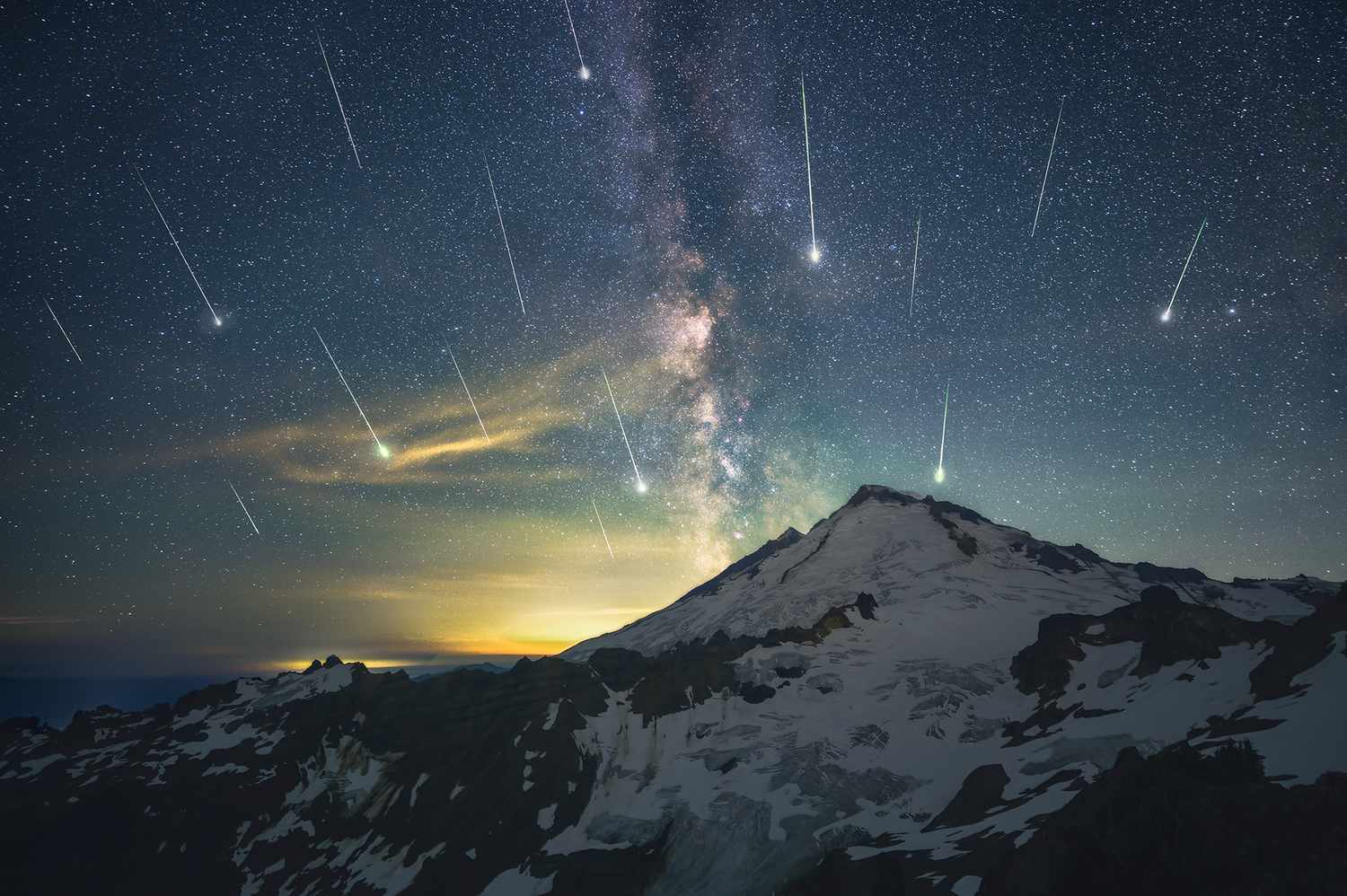
Most natural spectacles require packing a bag and logging miles in pursuit, but the meteor showers set to light up the night in 2026 demand little more than patience, an open dark sky, and a comfortable chair. Below are nearly a dozen worth circling on the calendar, with each offering a low-effort, high-reward reason to trade a little sleep for one of nature’s most entertaining night sky events.
April 15-29: The Lyrid Meteor Shower
Peak: April 21-22
Moon Impact: None
Created from debris streams left behind by Comet Thatcher (which last circled the sun in 1861), the Lyrid meteor shower averages between 10 to 20 fireballs per hour. The display is best viewed in the Northern Hemisphere, but Southern denizens should still be able to see several under dark skies. Fortunately, a waxing crescent moon will set just after midnight on April 22, making the early morning hours ideal for viewing the Lyrids.
For the best viewing, find Vega, one of the brightest stars in the night sky. It lies in the constellation Lyra (the Harp) and marks the radiant of the shower. While a particularly strong display isn’t expected until 2042, the Lyrids are known for surprise outbursts (sometimes producing up to 100 meteors per hour), so it’s well worth taking time to look up.
April 15-May 27: The Eta Aquariids Meteor Shower
Peak: May 5-6
Moon Impact: High
Characterized by very fast, streaking fireballs, the eta Aquariids favor Southern Hemisphere viewers (50 meteors per hour), but can also be spotted in the Northern Hemisphere (10 meteors per hour). The celestial debris fields responsible for this nighttime show come courtesy of Halley’s Comet, which last came our way in 1986 and will do so again in 2061. The peak of the eta Aquariids on the morning of May 6 will unfortunately coincide only five days after a full moon – creating viewing conditions unfavorable for all but the brightest fireballs. To spot them, look to the radiant in the constellation Aquarius near the star Eta Aquarii.
July 3-Aug. 15: The Alpha Capricornids Shower
Peak: July 31
Moon Impact: High
Originating from Comet 169P/NEAT, the Alpha Capricornids are known for producing infrequent, but spectacular, slow-moving fireballs. For this year’s peak in the early hours of July 31, only the most dramatic of the Capricornids will drop jaws, as a wanning gibbous moon (98 percent illumination) will spoil dark skies. Wake up early, grab a blanket, and look to the constellation Capricornus for the radiant of this shower.
July 12-Aug. 20: The Southern Delta Aquariids Meteor Shower
Peak: July 30
Moon Impact: High
With peak rates of up to 25 meteors per hour, the Southern Delta Aquariids are best viewed from the Southern Hemisphere. Unfortunately, these meteors tend to be faint, making them especially vulnerable to interference from the nearly full moon on July 30. If you do spot a bright fireball, it may actually belong to the Alpha Capricornids, which peak around the same time. Even so, it’s worth keeping your fingers crossed and looking toward the southern sky after midnight, where the radiant lies in the constellation Aquarius.
July 14-Sep. 1: The Perseids Meteor Shower
Peak: Aug. 12-13
Moon Impact: None
Impacted severely in 2025 by a nearly full moon, the peak of the Perseids returns for 2026 under a new moon and exceptionally dark skies. Barring weather conditions, this should allow even the faintest shooting stars to be seen at rates between 50 to 75 meteors per hour. A coinciding total solar eclipse on Aug. 12 for viewers in Iceland, Greenland, and Spain may even allow for some Perseids to be seen by day.
No matter where you’re looking up, gaze toward the constellation Perseus in the early hours of Aug. 12/13 to catch the radiant of this celebrated shower.
Oct. 6-10: The Draconids Meteor Shower
Peak: Oct. 9
Moon Impact: Low
While every other meteor shower on our list favors early risers, the Draconids take the opposite approach with ideal viewing conditions right around dinnertime. That’s because its radiant, in the head of the constellation Draco the Dragon, is at its highest point in the sky just after nightfall. Even better, the peak of this shower, which should produce on average between 8 to 10 meteors per hour, will arrive under dark skies thanks to a meager waning crescent moon.
If the convenient nighttime viewing isn’t enticing enough, EarthSky is once again hinting the Draconids’ debris stream Earth passes through in 2026 could be dense enough to create what is known as a “meteor storm.” The last time this happened was in 2018, with observers in Europe reporting a brief surge of more than 100 meteors per hour.
Sep. 26-Nov. 22: The Orionids Meteor Shower
Peak: Oct. 23
Moon Impact: Variable
Like the Eta Aquariids in spring, the Orionids originate from debris left behind by Halley’s Comet. At peak activity, the shower can produce 10 to 20 meteors per hour—with many leaving long, glowing trails and occasionally dazzling fireballs. Although a waxing gibbous moon (93 percent illuminated) will interfere early on the 23rd, it will set a few hours before dawn, opening a brief window for unobstructed viewing. For the best chance of spotting Orionids, look toward the shower’s radiant in the constellation Orion.
Sep. 23-Dec. 2: The Taurids Meteor Shower
Peak: Nov. 5-9
Moon Impact: None
The Taurids are a long-duration meteor shower composed of two separate debris streams: the South Taurids and the North Taurids. Meteors from these showers tend to be slow-moving and occasionally very bright, with a boost in activity in late October earning the nickname “Halloween fireballs.” Peaks for both showers will occur in early November and should give you a shot to spot as many as 10 shooting stars per hour. Enhancing the Taurids’ characteristic brightness against dark skies will be a new moon on Nov. 9. Look towards the constellation Taurus in the early morning hours for this shower’s radiant point.
Nov. 3-Dec. 2: The Leonids Meteor Shower
Peak: Nov. 17-18
Moon Impact: Low
Known for its potential to ignite celestial downpours, the Leonids are characterized by fast, bright meteors, with rates of between 14 to 20 per hour during peak. The shower’s parent body, Comet 55P/Tempel-Tuttle, completes a single orbit around the sun every 33 years, injecting fresh material into debris streams responsible for this annual display. While rare, the meteor storms created can be hard-to-imagine, with an 1833 event responsible for as many as 100,000 shooting stars per hour.
While we haven’t seen anything on that scale since (with the last decent storm in 2001), this is still a great shower to catch under clear, cool skies. A first quarter moon (53 percent illumination) will block the faintest of Leonids on Nov. 17, but will set and give way to dark skies after midnight. Look to the shower’s radiant in the constellation Leo.
Dec. 4-Dec. 20: The Geminids Meteor Shower
Peak: Dec. 13-14
Moon Impact: Low
The sometimes colorful, always beautiful Geminids will hit their peak on Dec. 14, with a waxing crescent moon giving way to dark skies and exceptional viewing conditions. Away from light pollution, stargazers can expect a show of as many as 100 to 120 shooting stars per hour.
Though the shower radiates from Gemini, its meteors can appear anywhere above you, flashing brilliant colors without lingering trails. Conditions are expected to be excellent for the days before and after peak, so grab a warm drink and a blanket, settle into a chair, and enjoy one of the most dazzling meteor displays of the year.
Dec. 13-Dec. 24: The Ursids Meteor Shower
Peak: Dec. 21-22
Moon Impact: High
Peaking near the winter solstice, the Ursids meteor shower is a modest display that averages about 10 meteors per hour. While this normally wouldn’t entice stargazers to brave the cold weather, what makes the Ursids so intriguing is their unpredictability. Some annual displays, such as those in 1946 and 1986, averaged close to 100 meteors per hour. A nearly full moon will spoil all but the brightest Ursids, but if you’re feeling lucky, head out after midnight and look towards the direction of the Little Dipper (Ursa Minor) to spot this shower’s radiant.
Read the full article here