


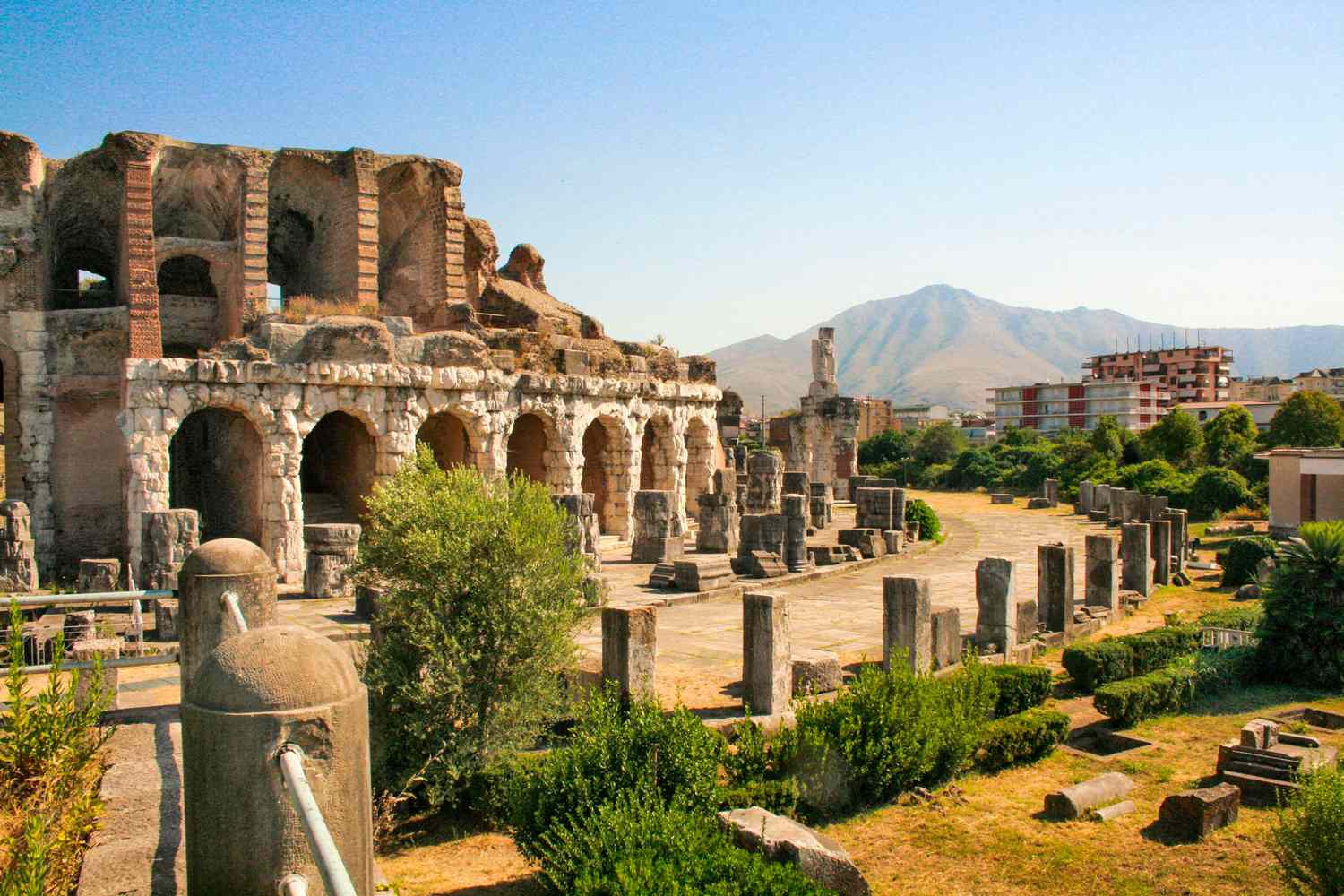
Once again, I had lost my husband under an ancient arena. On a clear day last September, Darius, an archaeologist, disappeared into a maze of crumbling stone corridors under the Amphitheater of Capua, the second-largest arena in antiquity after Rome’s Colosseum. This is our normal. Often, we head into an archaeological site together—crawling through aqueducts, exploring acropolises—and Darius doesn’t come out for hours.
Capua was one of the first stops on our five-day journey tracing the ancient Via Appia, dubbed “the Queen of Roads” by the Latin poet Statius. Built between 312 B.C. and the fourth century A.D., it was Italy’s first superhighway, beginning just south of the Colosseum and ending in the port of Brindisi, Puglia, with monuments like military outposts and mausoleums holding prominent figures (such as early popes) along the way. In 71 B.C., 6,000 of the soldiers who followed the slave-turned-rebel Spartacus were crucified along this very route. In 2024, UNESCO added the road that carried an empire to its World Heritage list. “The Appia was built by the Roman military one mile at a time as they conquered city after city,” Darius told me. “A 335-mile statement of confidence—and control.”
Over the 25 years we’ve lived in Italy, Darius and I have visited fragments of the road, walking, driving, and even biking it. Some stretches still appear in their original form, ancient stones and all. The most famous is the eight-mile sweep of original basalt that begins at the third Roman milestone, the Mausoleum of Cecilia Metella, and is shared today by walkers, cyclists, and the cars of those who have homes there. Some segments have been absorbed by cities, as in the main piazza in Terracina, while other portions surface as mere fragments, or are preserved within archaeological parks. But the majority has been paved over by a modern asphalt highway, the Strade Statale 7 Via Appia (SS7), which makes an excellent route for a history-filled road trip.
We recently decided to follow the whole road, starting from our home in the Regola neighborhood of Rome.
From Left: Universal Images Group North America LLC/Alamy Stock Photo; Courtesy of Vista Ostuni
Day 1: Terracina and Sperlonga
We set out from the southern end of the Circus Maximus in Rome’s historic core, where today only grassy ruins remain—the official starting point of the Via Appia. About 12 miles into the drive, the SS7 joins a spectacular stretch of asphalt laid directly over the ancient roadbed. The route, flanked for some 30 miles by umbrella pines, leads right into Terracina.
We’ve been going to this beach town for years; Darius for the history, and me for the deep-fried, cream-filled doughballs known as bombas. Around 406 BC, almost 100 years before the Via Appia was built, the Romans expanded southward and reached the limestone cliffs that skirt the coastline, and—in true Roman fashion—crowned them with a temple. At nearly 745 feet above sea level, the vast arches of the Temple of Jupiter Anxur, from the first century BC, still command the shore.
On this visit to Terracina, where a 50-foot stretch of the original road remains, we explored the Capitolium, a first-century BC ruin just behind the main piazza, then doubled back to the remains of a Roman theater. Much of this structure was hidden for decades beneath apartment blocks, but in the past 10 years, excavations have peeled back the layers.
In nearby Sperlonga, we detoured off the Via Appia for lunch at Capricci di Mare, a beachside restaurant and our usual haunt for spaghetti alle vongole garnished with bottarga, before stopping at the seaside Villa of Tiberius, one of the region’s most beautiful archaeological sites. In the early first century, Tiberius expanded his family’s beachside home into an opulent complex, adding more rooms, richer frescoes, and marble decorations. He even transformed a natural cave into a lavish dining hall that opens directly onto the sea, where shallow pools once rippled with fountains. It is shadowy, and theatrical in scale, almost like a stage set. Tiberius filled it with a sculptural tableau depicting the life of Odysseus, fragments of which we saw later at the adjacent museum.
We drove on to Caserta, a town about two hours southeast from Terracina, known for its royal palace. The building was home to many kings of Naples in the 1800s, including the Bourbon kings of the Kingdom of the Two Sicilies, the largest and wealthiest of Italy’s pre-unification states. The Grand Hotel Vanvitelli, a 250-room, modern take on early-20th-century grandeur, all Neoclassical nods and polished marble, was our home for the night. But our primary objective in visiting Caserta was to eat at Cambia-Menti, a pizzeria with an open kitchen where award-winning chef Ciccio Vitiello curates a pizza tasting menu. We opted for a fior di latte margherita with spicy salami, a classic marinara, and a buffalo-mozzarella margherita, all of which exceeded our (already high) expectations.
Paolo Reda – REDA/Alamy Stock Photo
Day 2: Capua and Benevento
From Caserta, we followed the SS7 to ancient Capua, known today as Santa Maria Capua Vetere. To enter the city, we drove through the second-century Arch of Hadrian—proof we were still on the Queen of Roads. Capua once thrived as a Roman stronghold; Spartacus trained and fought in its amphitheater.
“You can actually feel the magnitude,” Darius said as we walked through its arches. “What it meant to build something this big.” Like the Colosseum, the amphitheater was a monumental travertine-and-brick structure, once seating 50,000 people. The tiers have long since crumbled, but the sense of power remains. On that day, it was nearly empty, giving Darius the luxury of freely exploring the hypogeum, an underground tangle of corridors that once housed gladiators and their weaponry.
In the town of Benevento, an hour east, we ate pasta pomodoro at Roseto all’Arco, a modern trattoria mere feet from the Arch of Trajan—Darius’s favorite monument along the route. Reaching an impressive 52 feet, the limestone structure is covered in Parian marble, with sculptural relief panels that tell the story of the emperor’s life and military exploits. Darius read the friezes like a comic book, detailing historical events and mythological allegories.
Day 3: Ostuni, Taranto, and Brindisi
The sweet spot toward the end of our Appia adventure was Vista Ostuni, a 14th-century convent refashioned into a hotel. From the outside, it resembles a palazzo more than a convent; while inside, it’s a cloister of contemporary design, highlighted by ecclesiastical cross-vault ceilings and hanging textiles. On our first night, Darius and I toasted Ostuni with Negronis at the rooftop bar, from which we could see the city’s white walls layered in the distance.
Driving southwest across the heel of Italy’s boot, we hit the Ionian coast, where industrial plants contrast sharply with the white-sand beaches that lead into Taranto. The city was founded by the Spartans in 706 BC and became a maritime powerhouse. Then the heart of the Greek community, it was the last stronghold to resist Rome. “Taranto was the key to controlling the entire south,” Darius explained. “The Romans took it in 272 BC and never looked back.”
Taranto is made up of two contrasting parts: the old city, on a small island, connected by a swing bridge to the modern city on the mainland. In the labyrinthine old city, we found two Doric columns, standing lonely beside a block of palazzo-style buildings. These massive pieces of limestone, each roughly 30 feet tall, once anchored the Temple of Poseidon; now, they are all that’s left of the Spartan colony.
Heading east, we stopped at Muro Tenente, a somewhat desolate archaeological site set among olive groves, where a short stretch of the Via Appia is preserved. This spot is part of a developing green space and bike network that will highlight sites along the route, formally reconnecting this part of the ancient road with the city of Brindisi.
“There are all these new archaeological stopping points that weren’t even accessible 10 years ago,” Darius told me. “It’s like the Appia is still being uncovered, mile by mile.”
We followed the final stretch into Brindisi, heading straight to the F. Ribezzo Archaeological Museum for a walk through its galleries of bronze statues, ancient anchors, amphorae, and other salvage from Roman shipwrecks. At a tiny piazza near the water, two magnificent Corinthian columns stand atop a staircase as honorific harbor monuments. While we recognized their symbolic importance at the end of the Via Appia, no one else seemed to be paying attention to them. Darius and I sat on the steps overlooking the Adriatic, taking in the flow of people along the promenade, before getting behind the wheel again. Like so many ancient travelers before us, it was time to return to Rome.
A version of this story first appeared in the March 2026 issue of Travel + Leisure under the headline “All Roads Lead to Rome.”
Read the full article here