


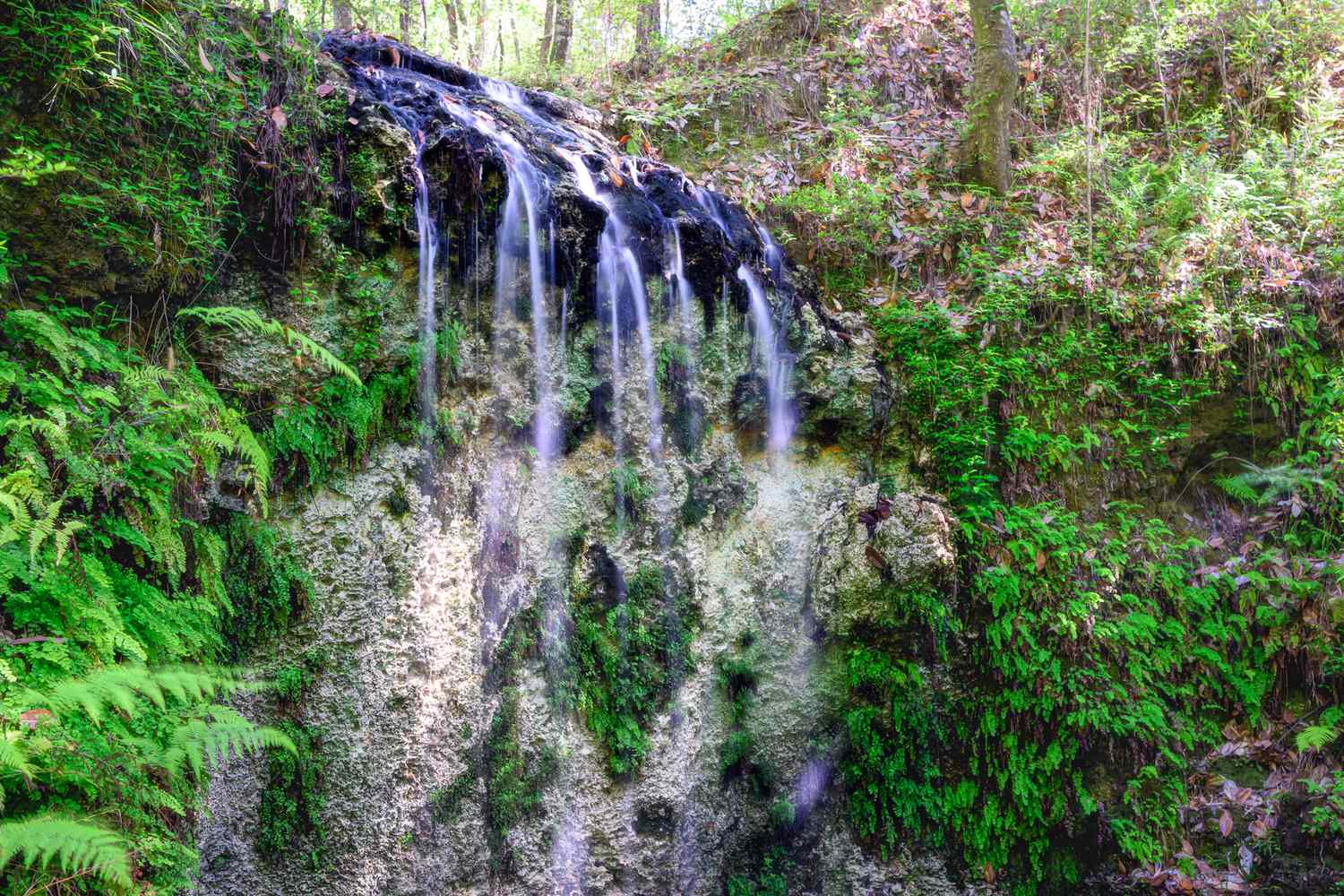
Falling Waters State Park has long been a favorite destination for my family. I’ve taken my kids hiking and camping here countless times, roasting hot dogs and s’mores over the campfire and marveling at Florida’s highest waterfall together. Towering pines and fern-covered sinkholes line the Sinkhole Trail, guiding visitors to a view that never fails to inspire awe: a 73-foot cascade disappearing into the depths of a 100-foot cylindrical pit. Its final destination remains a mystery, a reminder of the hidden wonders Florida holds.
“The State Park designation protects these huge sinkholes in this area,” says Glenda Wilson of the Chipley Garden Club. Wilson’s decades-long stewardship of the park’s butterfly garden highlights the care and dedication that help this park thrive. She explains that the native plants—black-eyed Susans, purple coneflowers, Queen Anne’s lace—require hands-on attention, from planting to watering, ensuring that both the flora and the local butterfly populations flourish.
Beyond the waterfall and butterfly garden, Falling Waters offers a quiet retreat just a few miles south of I-10. Families can picnic lakeside, swim, fish, or explore interpretive programs hosted by park rangers in the amphitheater. Hiking here is a gentle immersion into North Florida’s lush landscape, where trails wind past historical remnants: the state’s first oil well, a 19th-century grist mill, and evidence of Native American civilizations dating back 5,000 years.
Planning Your Visit
Visit Florida
Falling Waters State Park is open 8 a.m. until sundown, 365 days a year, making it an easy destination for a day hike, picnic, or overnight stay. If you plan to arrive after sunset, the park asks that you call 850-638-6130 to receive the gate combination and instructions. “Water and good walking shoes are must-haves,” Wilson says. “And if you’re coming out to see the butterflies, wait until after 10 a.m.—the dew on their wings prevents them from flying early in the morning. By late morning, you’ll see a lot of butterflies buzzing around.”
Admission is $5 per vehicle carrying two to eight people, $4 for a single-occupant vehicle, or $2 for pedestrians, bicyclists, and extra passengers. Camping here starts at $18 per night plus tax. For overnight stays, the campground features 24 sites, each equipped with a picnic table, water, electric service, and a burn ring perfect for a night around the campfire. A full-service bathhouse and dump station make stays convenient, and reservations can be made up to 11 months in advance through the Florida State Parks reservations website or by calling 800-326-3521.
How to Get There
Falling Waters State Park is conveniently located just off Interstate 10 near Chipley, Florida, making it an easy stop for travelers exploring the Panhandle. From Tallahassee, the park is about a 90-minute drive west, while visitors coming from Pensacola can reach the park in roughly two and a half hours.
TerryKelly/Getty Images
Best Time to Visit
The ideal time to explore the park is spring or early fall, when the weather is comfortable, and the forest is at its most vibrant. “Just being able to get out and feel the warmth and see the greenery is a treat,” says Wilson. During these seasons, wildflowers bloom along the trails, butterflies flit through the garden, and the waterfall is often at its fullest, making hikes, picnics, and evenings around the campfire particularly enjoyable.
Best Things to Do
Visit Florida
Birding and Butterfly Watching
Over 100 species of birds have been spotted here, from red-headed woodpeckers and summer tanagers in the uplands to gray-cheeked thrush and ovenbirds hiding in the leafy underbush. “Visit the butterfly garden,” says Wilson, pointing to the Joyce Carter Butterfly Garden near the start of the paved trail to the waterfall. The garden, established and maintained by the Chipley Garden Club for more than 25 years, now features new signage highlighting 32 butterfly species, the butterfly life cycle, and even a photo of the waterfall by club member Cheryl McCall. Visitors can spot ruby-throated hummingbirds in spring, zebra swallowtails in summer, and enjoy the colorful native wildflowers that thrive thanks to year-round care.
Hiking
Falling Waters State Park features three short nature trails that wind through dense forests, past 100-foot-deep sinkholes, and over gently sloping terrain unique to North Florida. The Wiregrass Trail leads visitors to Florida’s tallest waterfall, with two viewing platforms: a lower platform where you can feel the cool mist as water plunges into the hidden cave below, and an upper platform offering sweeping, panoramic views of the cylindrical sinkhole. Trails meander past the butterfly garden, under a canopy of southern magnolias and hardwoods, and over a mix of boardwalks, dirt paths, and concrete walkways. Interpretive signs and self-guided kiosks explain the park’s karst topography, native plants, and wildlife, while guided ranger tours are available by prior notification. “I like the walking trails. I like to see the native plants and the signage they have telling you what kind of tree it is,” says Wilson, highlighting the educational as well as scenic value of these hikes.
Fishing and Swimming
The park’s two-acre freshwater lake offers peaceful fishing spots. While you may not catch record-breaking bass, it’s ideal for a relaxing afternoon. Watch for green herons at the lake edge and gray catbirds in the lakeside shrubs. A Florida freshwater fishing license is required for anyone over 16. The lake features a white-sand beach, a swimming area with a sand bottom, showers, picnic tables, and shaded benches—perfect for cooling off on warm Florida days.
Campfire Circles
The campground hosts evening programs on local flora, fauna, and geology. Rangers offer slide shows and interactive talks, and visitors can gather around campfires to learn about the park’s history and natural features.
Must-see Wildlife and Natural Features
Visit Florida
Falling Waters State Park is a haven for wildlife enthusiasts and nature lovers alike. While birding is a major draw, the park is also home to deer, foxes, fox squirrels, lizards, turtles, and the occasional snake. The park’s karst landscape, underlying much of the Florida Panhandle, supports a rich diversity of life and plays a crucial role in recharging the Floridian aquifer. Expansive tracts of upland pine and hardwood forests frame the trails, while the seepage slopes host carnivorous pitcher plants, terrestrial orchids, and other rare species. Near the waterfall and sinkhole, a terrestrial cave system provides habitat for bats and cave crickets, offering a glimpse into the hidden ecosystems beneath the surface.
At the heart of the park lies Florida’s tallest waterfall, tumbling 73 feet into a 100-foot-deep, 20-foot-wide cylindrical sinkhole. The rocky walls reveal limestone formations deposited 20 to 30 million years ago when the region was underwater. A protective layer of quartz sand and clay helped this area resist extensive dissolution, leaving Falling Waters perched atop one of the highest hills in the region at over 320 feet. Over time, surrounding landscapes have lowered as limestone dissolved, giving the park its dramatic sinkholes and unique topography.
The park’s living features are equally fascinating. The Joyce Carter Butterfly Garden alone hosts 32 species, including giant swallowtails, monarchs, buckeyes, spicebush, cabbage whites, cloudless sulfurs, and black swallowtails. “Our Florida native butterfly is the zebra swallowtail, and it is here in Florida the whole year round. In the fall, when the season starts, you see the cloudless sulfur and black swallowtails,” Wilson adds, underscoring the seasonal rhythms of the park’s insect life.
Read the full article here