


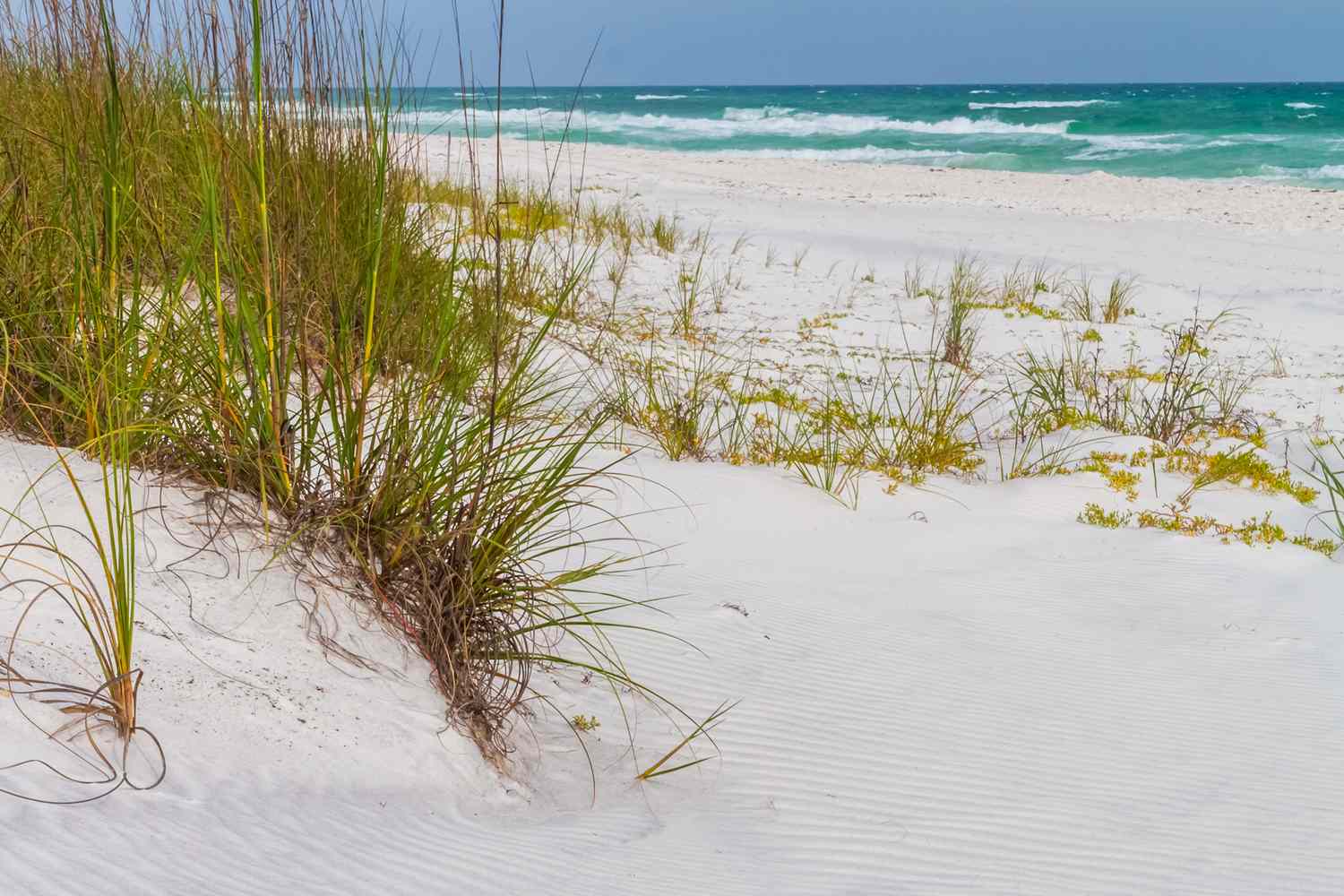
Soft morning light washes over the sugar-white dunes of Grayton Beach State Park, turning the Gulf into a sheet of pale emerald and casting long shadows across Western Lake’s glassy, brackish edge. Here, nearly 2,000 acres of protected shoreline, pine flatwoods, and rare coastal dune lakes create a landscape where the wild and human presence coexist in rare equilibrium.
Photographer, longtime local, and author of Where Waters Meet, Jonah Allen, says that balance is what defines Grayton. “What makes this area special is the fact that it’s not urban, it’s not suburban, and it’s not rural—it’s a combination of all three,” he says. “You have the Gulf, you have these coastal dune lakes, and you have Point Washington State Forest protecting so much of the land. All these natural barriers keep development in check, so it’s really easy to be immersed in nature in a lot of different ways.”
Grayton Beach feels like another world the moment you step onto its mile-long stretch of alabaster sand that never gets hot. Western Lake adds its own quiet pull, with paddlers slipping past marsh grass and ospreys circling overhead, while nearby trails wind through salt-twisted oaks and magnolias. Stay the night, and the park reveals an even deeper stillness. As Allen puts it, “This tiny stretch of 30A is surrounded by nature on all sides. That’s what makes it really, really special.”
Allen, who has spent the past five years photographing this area from the air, the land, and the sea, knows firsthand what makes Grayton Beach State Park a special place—along with the ins and outs of what first-timers should know and what not to miss.
Planning Your Visit
Kristina Blokhin/Adobe Stock
The park is open daily from 8 a.m. until sundown, 365 days a year, and it’s free for all state park pass holders, but it has a capacity limit and will close once that is reached. If you don’t have a park pass, entry is just $5 per vehicle, or you can purchase a pass here and enjoy all 175 Florida state parks. Though welcome in some areas of the park, pets must be leashed and under control at all times.
If you’re hoping to stay the night, plan ahead. “Grayton Beach State Park is one of the most sought-after parks to reserve in Florida,” says Allen. “You’ve got to be on it—super far in advance.” The park’s 59 campsites, considered among the nicest along the Gulf Coast, accommodate tents and RVs up to 40 feet. Each site includes water and electricity, and some offer sewer hookups. Four sites are accessible, and seasonal ranger programs add to the experience. Reservations can be made up to 11 months ahead through the Florida State Parks website or reservation line: 800-326-3521.
Cabins book up quickly as well. Nestled in the pine woods just minutes from the beach, the park’s 30 two-bedroom duplex cabins—two of which are accessible—sleep up to six people and offer the perfect blend of comfort and unplugged simplicity. Each comes with central heat and air, a full kitchen with basic cookware, linens, an outdoor grill, and a screened-in porch. A gas fireplace flickers to life from November through March, and the absence of televisions and phones encourages a deeper connection to the quiet surroundings. Guests should bring their own beach towels, chairs, and umbrellas. Each cabin allows up to two vehicles.
How to Get There
Kensley/Adobe Stock
Grayton Beach State Park sits along Scenic Highway 30A between Destin and Panama City Beach, easily reached by taking County Road 283 south from U.S. 98, then turning left onto 30A. Travelers can fly into either Destin-Fort Walton Beach Airport, about an hour west, or Northwest Florida Beaches International Airport, roughly 45 minutes east; both offer shuttles, taxis, and rental cars. Whether arriving by air or driving in via U.S. 98, which connects directly to Interstate 10, access to this stretch of coastline is straightforward and scenic.
Best Time to Visit
Jacob/Adobe Stock
Grayton Beach State Park is stunning year-round, but late fall through early spring offers the most peaceful experience. Allen favors this stretch from November to March for its soft light, cooler temperatures, and quiet, crowd-free mornings. “The beach is empty, the light is low, and the water turns this incredible shade,” he says. Fall and spring bring similarly mild days, while summer delivers long hours of sunshine along with heat, humidity, and peak visitation. For the best blend of beauty and breathing room, aim for the cooler months.
Best Things to Do in Grayton Beach State Park
Gerri/Adobe Stock
Paddle Western Lake.
“First and foremost, you’ve got to paddle,” says Allen. “Kayak or paddleboard on Western Lake—that’s non-negotiable.” Rent a kayak or NuCanoe from the ranger station or bring your own and explore quiet inlets and salt marsh edges, or, when conditions allow, paddle straight out to the Gulf.
Hike through dunes, marsh, and pine flatwoods.
Grayton’s 1-mile nature trail begins near the beach parking area and winds through shifting dunes, salt marsh, and the shade of twisted scrub oaks. For a deeper immersion, the 4.5-mile (9-mile round-trip) hiking and biking trail loops around the backwaters of Western Lake and through the coastal forest. Beyond the park, the paved path along 30A connects every beach community in South Walton for easy cycling between villages.
Snorkel the artificial reef.
Snorkelers will find a system of artificial reefs installed by the county off the coast of the park that has transformed the area into a haven for marine activity. “You can see eagle rays, sea turtles, sharks, dolphins—there’s so much life out there,” says Jonah. Summer brings migrations and mating seasons, making it one of the most active times to explore the reef.
Relax on the beach.
Of course, the simplest Grayton pleasure is also one of the best: a day on the sand. Settle in with a book, swim in the gentle Gulf, or linger for sunset. “Sit on the beach, read a book,” says Jonah. “And seeing sunset from Western Lake—that tree line is iconic.”
Must-see Wildlife and Natural Features
Kristina Blokhin/Adobe Stock
Grayton Beach State Park is one of Florida’s richest natural landscapes, home to coastal forests, rare dune ecosystems, and an impressive mix of wildlife. Visitors may spot Florida black bears, white-tailed deer, gray foxes, and a wide variety of birds moving through the pines, marshes, and shoreline. As part of the Great Florida Birding Trail, the park attracts bald eagles, osprey, and seasonal shorebirds like snowy plovers and red knots, which forage along the dynamic outfalls where lake water meets the Gulf.
But the true signature of Grayton Beach is its coastal dune lakes, a natural phenomenon found in only a few places worldwide. Within the park, Alligator Lake, Little Redfish Lake, and Western Lake sit just behind the dunes, fed by rainfall, groundwater, and streams. When water levels rise high enough, the sand berms breach, creating temporary outfalls where freshwater flows into the Gulf and saltwater pushes back in. The result is a constantly changing mix of brackish water that shapes both the landscape and the wildlife.
“Our dune lakes are incredibly dynamic, changing daily with the inflow and outflow,” says Allen. The lakes’ dark, tea-colored water—tinted naturally by tannins from surrounding pines—creates striking visual contrasts against the sugar-white sand and emerald Gulf. “People sometimes think the water looks dirty, but it’s actually pristine,” he adds. His aerial photography book traces the lakes’ life cycle as they fill, burst into the Gulf, and shift with the tides and seasons.
This rare ecosystem offers more than a beautiful view. Outfalls act as vital feeding grounds for shorebirds, and the quiet backwaters serve as nurseries for fish and other marine species. Exploring the dunes and lakes by foot or paddle gives you a glimpse into one of the most unusual and fragile natural environments in the country.
Read the full article here