


As I walked up to the ceremonial hut, flames licked the fat belly of a cauldron, sending curls of smoke into the humid air of the Yacutinga nature reserve, in Argentina’s northeastern corner. A medicine man crushed dried yerba mate leaves in a wooden mortar, then brushed them into simmering water, before mixing in embers from the fire and a heap of granulated sugar. Unlike the mate consumed across Argentina—and served in a gourd—this version, known as mate cocido, was smoky and sweet, and served in a teacup.
Mate is a sacred plant to the Guaraní—a group of Indigenous people from the surrounding region—and is used in religious rituals and for social bonding. I accepted the drink with gratitude and sipped it as a gesture of friendship.
The ceremony was a high point of my four-day visit to the Atlantic Forest, one of the world’s most diverse and fragile biomes. Once stretching 400,000 square miles across sections of Argentina, Brazil, and Paraguay, the forest has been reduced to 12 percent of its original size by deforestation, cattle ranching, and urban expansion. Even so, it is still home to thousands of threatened plants and animals, including the jaguar, tapir, and harpy eagle.
Kali Photography
My journey was organized by Yacutinga Lodge, a 21-room property located deep in the rain forest about 50 miles east of Iguazú Falls. Opened in 2000, the lodge sits on a 1,410-acre private nature reserve, and has an organic, Gaudí-inspired design: curved walls, stained glass, and natural materials that blend in to the jungle. I stayed in the Yatei Suite, which was set apart from the main building and surrounded by jungle. With its hardwood-log posts, sunflower-yellow plastered walls, and a skylight embedded with colored glass bottles, it felt like a plush, Hobbit-style bungalow.
After unpacking, I went to the rustic restaurant, tucked upstairs in the main building. The kitchen specializes in homestyle, regional cuisine, and my dinner that night included a chilled eye-round steak in a bell-pepper sauce, a grilled sirloin served in a Madeira sauce, and a Cabernet Sauvignon from the Alamos winery in Mendoza. Over dessert—pears poached in Malbec—I chatted with the three other guests doing the “Yacutinga Origins” program: a Danish sociologist and her 12-year-old daughter; and a semi-retired landscape architect from Canada.
After dinner, we joined our guide, Rodrigo García, on a nighttime walk on the Tajmar trail, one of the Yacutinga reserve’s 12 hiking paths. Following his flashlight, we dodged spider webs, spotted a cottontail rabbit hiding in a bush, and stumbled our way to a wooden observation platform. My shoes caked with jungle clay, I breathed in the humid air—a blend of rotting leaves, fungi, and wet bark—and marveled at the full moon casting its ghostly glow over the jungle. It was a stunning introduction to the rain forest.
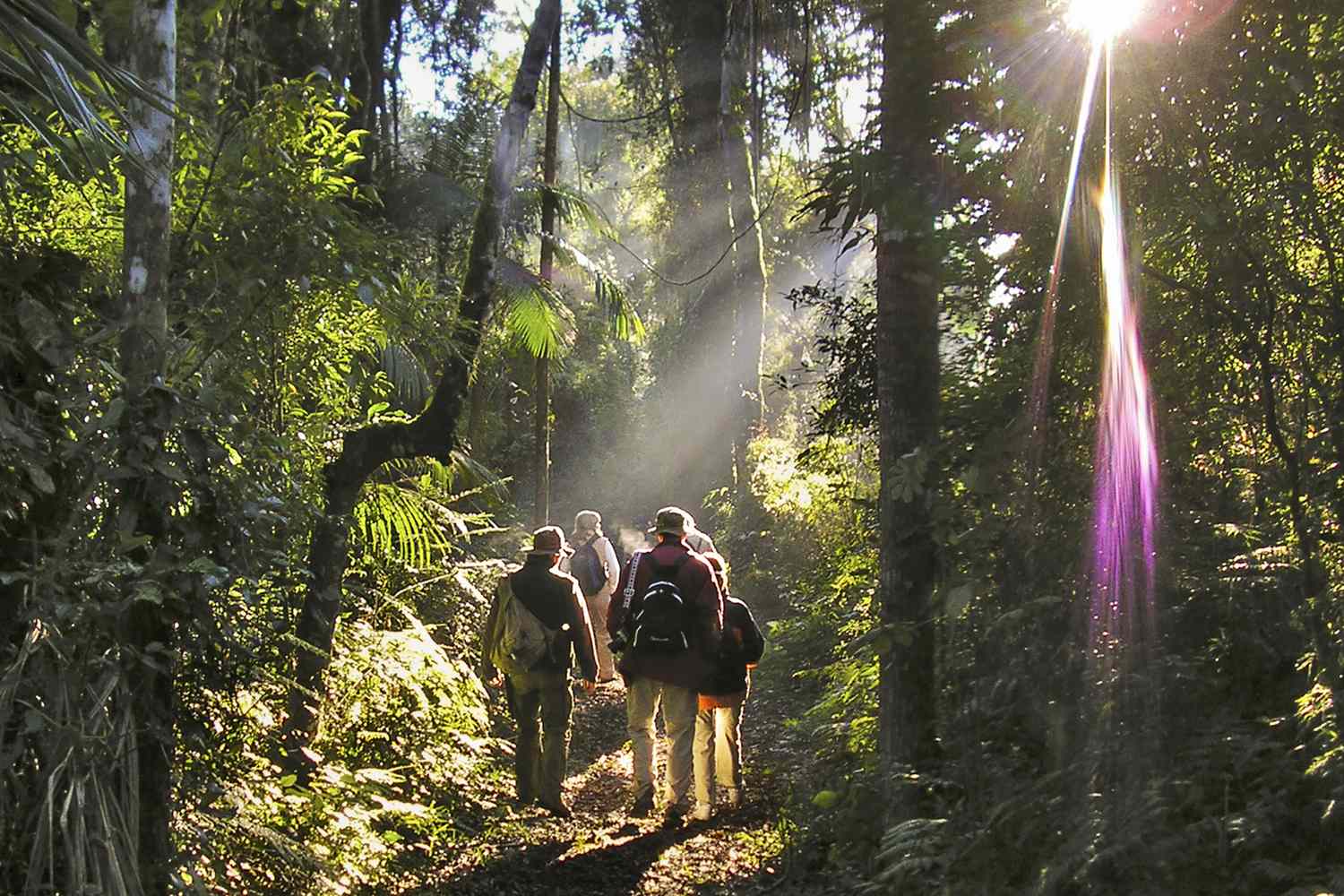
The morning sun revealed what the previous night had concealed: elephant-ear leaves, rosewood trunks dappled with white orchids, fallen timbo trees, and towering açaí palms tangled with liana vines. After a breakfast of lemon cake and papaya, my group set out to explore the forest’s biodiversity, hiking through dense jungle until we reached the Río San Francisco. We climbed into orange kayaks and paddled down the muddy river. An hour later, we reached the Iguazú River and the current picked up speed.
Diego Frangi/Yacutinga Lodge
The birdlife was rich and varied. A plush-crested jay flitted ahead, as if showing us the way. A pair of yellow-headed caracara falcons sat atop a huge jatoba tree, scanning the forest below for prey. Black vultures circled overhead. About a quarter-mile down the Iguazú, we spotted Diego Pelinski, a worker from the lodge, in a clearing. He loaded the kayaks onto a truck, and we embarked on the hour-long hike back. Along the way, I stepped on fresh dung from a South American tapir—the closest I would come to spotting that endangered mammal, which resembles a pig with a long snout.
We got back to the lodge in time for lunch, leaving plenty of time to sit by the kidney-shaped pool and watch capuchin monkeys playing in the palms overhead, sending coquito nuts clattering onto corrugated metal roofs.
Our final day was devoted to yerba mate and the role it plays in Guaraní culture. We began at the cooperative yerbatera Andresito, a modern processing plant about 20 minutes away from the lodge. We visited a warehouse that held 20 million pounds of mate in huge white sacks, and watched as different machines dried, ground, and packaged the greenish-brown leaves.
Back at Yacutinga, we met with Rafael Osmualdo, a Guaraní medicine man, who would take us to the source. He is a member of the Kagui Pora Indigenous community, who have lived in the Atlantic Forest for centuries and regard the jungle as nature’s pharmacy. We followed Osmualdo down a path as he pointed out various medicinal plants and their uses. He walked up to a canafistula tree and explained how its bark is boiled to make a tea that is used to soothe a sore throat and to promote wound healing. A few paces later, he pointed to a yellow orchid known as a miltonia that, when smashed and boiled, is said to aid heart arrhythmia and improve circulation.
From left: Kali Photography; Julia Lopez Radits/Yacutinga Lodge
The path opened to a grove of yerba mate trees, about eight feet tall with dense, leathery leaves that smelled like grass. Osmualdo told us about the plant’s health benefits—it curbs the appetite, is good for the skin and digestion, and is rich in antioxidants—then snapped off a leafy branch to bring back to the lodge.
Later that night, as we sipped our freshly crushed mate cocido by the fire, eight children from Osmualdo’s village arrived in T-shirts and jeans. They sang in the Guaraní language and kept time by pounding hefty sticks against the earth. As my hands cupped the mate, their song captivated me and its rhythms carried me deeper into the forest.
Four-day Yacutinga Origins experience at Yacutinga Lodge from $625.
A version of this story first appeared in the December 2025 issue of Travel + Leisure under the headline “It’s a Jungle Out There.”
Read the full article here