


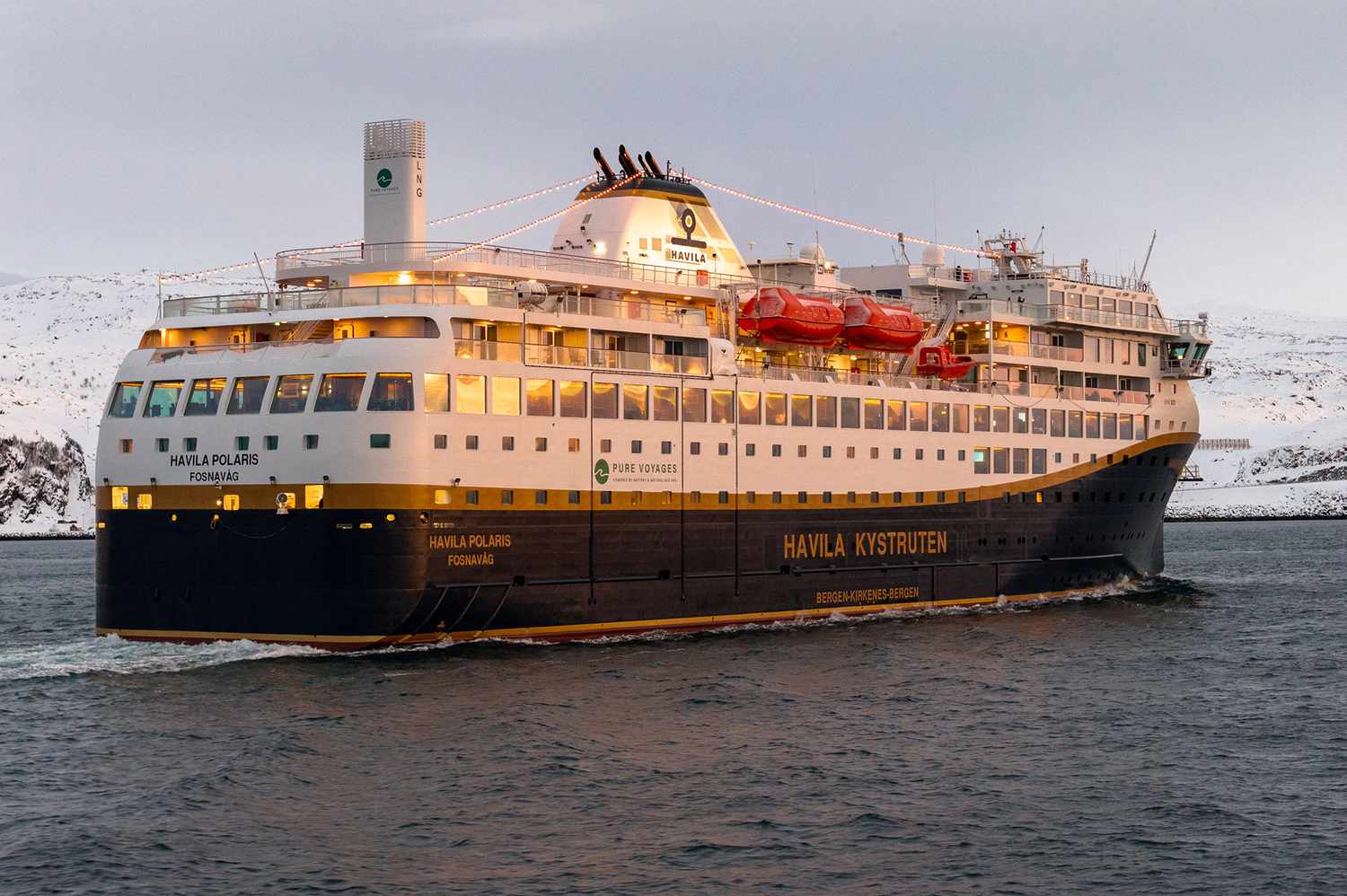
Sailing the Norwegian fjords aboard Havila Polaris ship in November, I gathered with fellow passengers in the Havblikk Bar to watch the vessel bunker. It’s typically a mundane process—effectively, a stop to refuel—but for this voyage, it was the reason I was on board. A truck at the terminal pumped about 300 cubic meters of liquefied biogas (LBG), not fossil fuel, made from processed municipal waste (so, garbage) into the ship. Fish guts, food scraps, and agricultural waste from Norway’s coastal communities would power this first-of-its-kind journey.
The next morning on the bridge, I asked the captain, Kurt Harald Nærbø, if there was any difference running on biogas versus liquefied natural gas (LNG) or other fossil fuels.
“No, it’s the same,” Nærbø said. “If you go from energy to biogas, you don’t feel a difference.”
That operational invisibility is the point. Norway built the world’s largest sovereign wealth fund by selling oil; Norway’s Government Pension Fund Global, a $2 trillion nest egg, was built almost entirely on North Sea oil and gas revenues. Now it’s spending that money to prove you don’t need oil at all. As of Jan. 1, 2026, Norwegian regulations require zero emissions for passenger ships under 10,000 gross tons operating in the country’s five UNESCO World Heritage fjords, with larger vessels facing the same mandate in 2032.
Martin Giskegjerde/Oclin/Havila Voayges
“The fossil fuel age will come to an end,” said Vegard Sævik, Havila Holding’s chairman, during a press briefing aboard the ship. “In that transition, we should do the operations as clean as possible. It’s not going to be a revolution; it’s going to be evolution.”
Four decks below the Havblikk Bar, in a machinery space most passengers never see, the operational reality of Havila’s biogas experiment becomes clear. The ship runs on Rolls-Royce, dual-fuel capable engines, meaning they can easily switch between LNG and LBG.
Power consumption varies by weather—12 tons of fuel on calm days, 15 tons during winter storms with headwinds. The ship can also run entirely on battery power in protected fjords, drawing from temperature-regulated battery rooms kept at 20°C year-round, cooled by seawater in winter and air conditioning in summer. Safety regulations require some natural gas to remain in the tanks at all times, but the amount of biogas bunkered at the port of Bergen—those 300 cubic meters—equals the fuel requirement for the entire 11-day round trip to Kirkenes, along the Russian border, and back to Bergen.
For passengers, nothing changes. The ship performs identically. But the infrastructure that enables it is radically different. A normal LNG-powered round trip on this route produces about 650 metric tons of CO2 equivalent. This biogas voyage produces 50 to 55 metric tons. That’s a 91.7% reduction.
Havila can claim “climate neutral” rather than just “lower emissions” because the organic waste powering the ship—fish guts, food scraps, agricultural dross—would decompose and release methane anyway. Methane is roughly 28 times more potent than CO2 as a greenhouse gas. By capturing that waste, processing it into biogas, and burning it in ship engines, Havila is intercepting emissions that would have occurred regardless.
“You capture what’s worse than CO2, and then you can actually burn it with good conscience,” explained Gunnar Malm Gamlem, a researcher from SINTEF Ocean, Norway’s maritime research institute.
Norway produces this useful waste at enormous scale—enough to power significantly more than four coastal cruise ships. The bottleneck isn’t supply, it’s infrastructure and political will. Gunnar Helmen, the director of Molgas, a European renewable energy company, described the central challenge during the press briefing: “It’s risky to be a producer if they don’t know that there are ships that want [LBG]. The really tough thing is actually to fit the parts together at the same time.”
Biogas producers won’t build facilities without guaranteed customers. Shipping companies won’t commit to biogas without a guaranteed supply. Government procurement is supposed to break that stalemate by creating predictable demand, but the funding hasn’t kept pace with the mandates.
The economic model only works where three conditions align: Concentrated organic waste streams, government willing to subsidize the transition, and existing gas infrastructure to repurpose. That makes Norway’s coastal routes an ideal testbed, but not an easily replicable one. Caribbean cruise ships, for instance, can’t rely on locally sourced fish waste when they’re operating thousands of miles from any aquaculture industry. What works in the fjords doesn’t necessarily scale to the open ocean.
Back on the bridge, captain Nærbø steers the Polaris through the same fjords Norwegian ships have navigated for generations. His job hasn’t changed. The ship’s performance is identical. Passengers in the lounges barely register a difference.
But below deck, in machinery spaces and fuel tanks, Norway is quietly engineering its post-oil future. The same infrastructure that made the country wealthy—LNG terminals, dual-fuel engines, a maritime industry built on fossil fuel expertise—now enables the transition away from it. LBG may seem experimental for the moment, but it’s likely to become the Norwegian standard, simply because a government that profited from oil decided to change tack.
Read the full article here