


Purple Haze. Violet levitation. Drifts of sky. Standing in my first bluebell wood, I struggled to find words for what I was seeing. On its own, the English bluebell is a fetching little flower, a periwinkle-colored petticoat nodding from a stem a few inches high. But by the hundreds, the thousands, the bluebells were creating what felt like an optical illusion, a carpet of color that hovered above the forest floor. Others, I learned later, had found words better than mine. A.E. Housman wrote:
Like a skylit water stood
The bluebells in the azured wood
“Falls of sky-colour,” Gerard Manley Hopkins called them. “Smoke-blue as an autumn bonfire” was Vita Sackville-West’s apt description.
In English woodlands, bluebells flower early in spring, as light seeps through newly leafing trees. I’d come to the country’s southeast in April and was lucky enough to see them; within a few weeks they would be gone. The bluebell woods created a kind of trail for me to follow, whether in gardens I visited or as surprises along roadsides. Their beauty and delicate scent stopped my breath each time.
And yet the tradeoff for getting to see the bluebells was being too early for the roses, peonies, foxgloves, and summer wildflowers. A garden is never the same from morning to night, let alone from one season to the next, which means you are always missing something. My trip was only half done when I vowed to return in early June to see them in their full effulgence, or in fall when they’re blowsy and sun-drunk.
I can’t say exactly when my love for gardens began: all I know is that suddenly I was digging up my tiny yard in Brooklyn and putting money I might once have spent on clothes toward plants. My fascination extended to gardeners, who voluntarily labored to create something with no hope of permanence. I read their writings and visited local botanical gardens when I could, but many of the places I drooled over were in England. This made sense: the aristocracy there had large estates, as well as large fortunes to spend on landscaping, and creating and visiting gardens became a beloved leisure activity for the broader population, too. Whether in grand proportions or on the tiny scale of a cottage plot, it was the English style I loved: the looseness, the unexpected mix of plants, the poetry.
Wanting to see some in person, I contacted Rachel Shoemaker, a Pennsylvania-based travel advisor who adores English gardens. She advised me to focus on the southeast of the country, specifically the counties of Sussex and Kent, the latter of which is known as the Garden of England. She provided a list of close to 20 locations—more than I could see in one trip. Amazingly, all of them were concentrated in an area not much bigger than Delaware, and within easy reach of London. I planned a weeklong tour, with my husband joining me for the second half.
Before farms and estates claimed the land, this area was covered by forest, or weald in Old English. Because the south of England saw minimal industrialization, parts of it can feel outside the flow of time. Embedded in an undulating landscape of stone walls and fields (many covered, when I was there, with electric-yellow rapeseed) are medieval cities and picturesque villages. Driving along winding country roads—two lanes, sometimes even one—I felt slightly lost and pleasantly off-balance, even when my directions were clear.
I began to see the links among gardens, and the lineage of the gardeners who had shaped them—and one another. I traced threads of influence that reached even to my own amateur cultivation. And I pondered the questions gardens raise: What is a garden, and what makes a good one? Where does the border between art and nature lie? How do we think about the often-hidden histories embedded in them? And what should happen to a garden once its creator is gone?
Emli Bendixen/Travel + Leisure
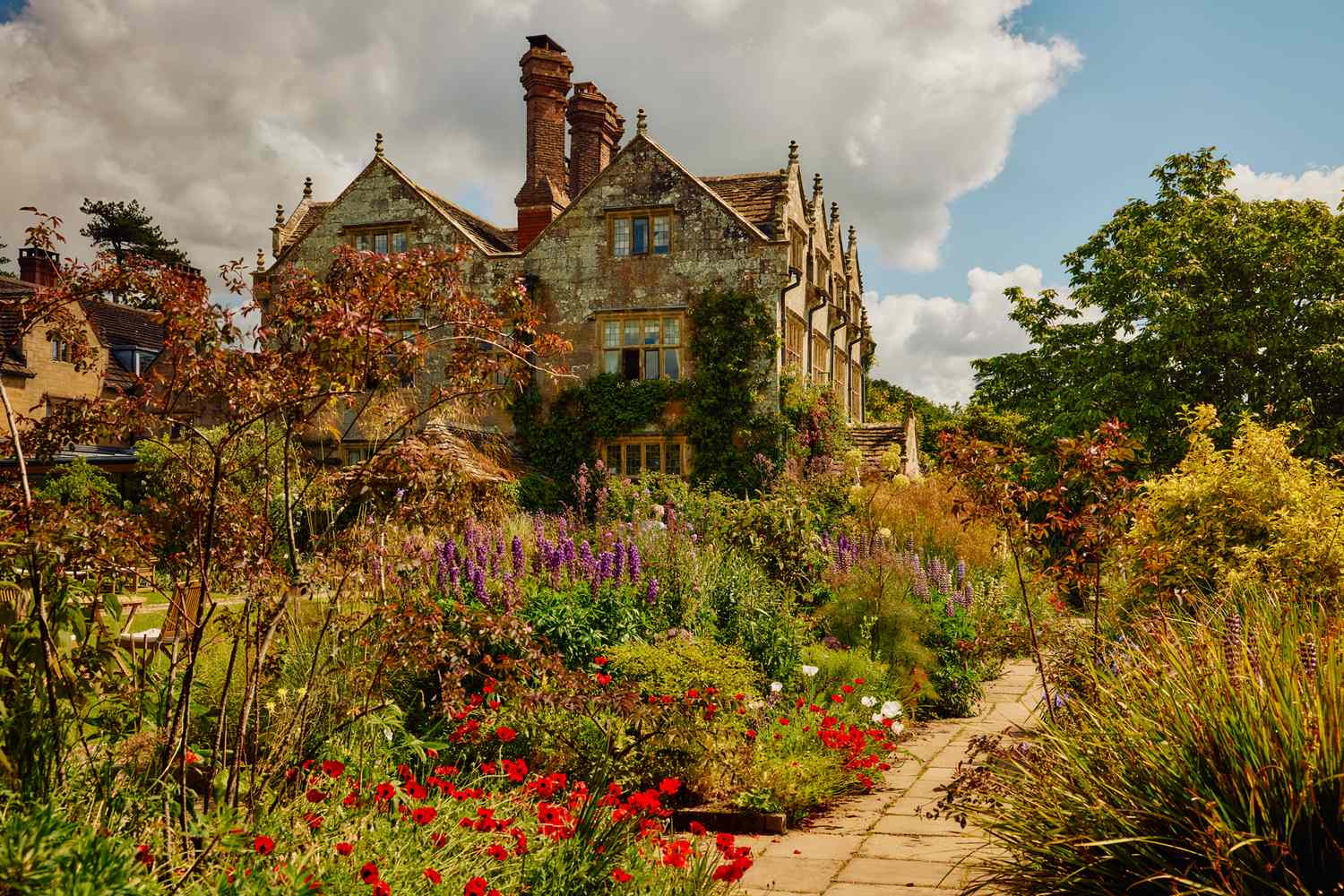
I began my trip at Gravetye Manor, in West Sussex, about an hour’s drive from Heathrow Airport. It seemed a fitting place to start, being both an elegant country-house hotel and an important piece of gardening history. For 50 years, until 1935, Gravetye was the home of William Robinson, one of England’s most influential garden writers. Built in 1598, Gravetye, with its thick stone walls and gabled roofs, was where Robinson, who also bought the surrounding 1,000 acres, put his ideas into practice. The area around it also contains a constellation of visit-worthy gardens, many created by wealthy Victorians.
I’d never heard of Robinson before this trip, but by week’s end I saw his influence everywhere. His genius was to reject the formal beds of subtropical flowers that Victorians favored for what he called the “wild garden.” He encouraged the naturalizing of plants—which means they propagate themselves, without human effort, to become part of the landscape—and the extension of the garden to woodlands, roadsides, and hedgerows. His notion of “wildness” still informs how we think of the English garden. Into his nineties, Robinson was scattering bulbs from his wheelchair.
Gravetye’s grounds, which include terraces, meadows, woods, and a pond, are gorgeous, as are its interiors. The floral theme plays out in covetable textiles and wallpapers, and in the ornate flowers Robinson carved on the ceilings of what are now the bar and sitting rooms. The window of my room looked out on a hillside thickly planted with heather, tulips, oxeye daisies, spurge, and rhododendron. In the dining room, a wall of windows also gave onto the gardens. I sipped a glass of Bacchus from Kingscote Vineyard down the road and watched brooding grays and pinks mottle the sky. Only the exquisite food—all of it inspired by produce from the ellipse-shaped kitchen garden Robinson designed—distracted me from the view.
The window of my room looked out on a hillside thickly planted with heather, tulips, oxeye daisies, spurge, and rhododendron.
Luckily I could walk off my meals on garden paths. A 20-minute drive brought me to both Nymans, a National Trust property, and, around the corner, High Beeches, which Tom Coward, the head gardener at Gravetye, called “a perfect plantsman’s paradise.” Ponds, streams, small ravines, and valleys provide drama throughout its 27 acres. About 20 minutes farther west, I turned in at Knepp, a 3,500-acre property where, as part of a rewilding experiment, native Exmoor ponies and even beavers have been reintroduced to what had been unprofitable agricultural land. I’d come to see the estate’s walled garden, which was created in 2021 on a former croquet lawn. Some 1,000 species have been planted on its 1.3 acres, all designed to support pollinators and other wildlife. Its substrate is mostly crushed building debris, with plants chosen for their ability to survive in harsh conditions with minimal water. It’s a reminder that the gardens of the future don’t need to look like the past; indeed, given the changing climate, they may not be able to.
Emli Bendixen/Travel + Leisure
If Knepp represented one kind of botanical laboratory, I found another at Wakehurst, a country estate that the Royal Botanic Gardens, Kew (the famous plant collection just west of London) has leased for the past 60 years. Its Millennium Seed Bank stores the seeds of more than 40,000 wild plant species. Wakehurst’s hilly topography also made for a wonderful walk, on which I passed from birches in bluebells to giant sequoias to a dell massed with irises.
The next day I drove east into Kent, stopping along the way at Riverhill Himalayan Gardens, which has been owned by the Rogers family since 1840. A 2010 episode of Country House Rescue (could there be a more British show?) found the family struggling to keep the place up. They have since fully opened the gardens to the public, and today Riverhill is thriving. Its attractions include a mossy, cool grotto of ferns as well as vast views of Ashdown Forest and distant towns. Its awe-inspiring array of rhododendrons and their close relatives, azaleas, were collected in the Himalayas by Victorian plant hunters. The gargantuan Loderi King George rhododendron stood four or five times my height, shaggy with giant effusive blooms of the palest pink. I struggled to connect its magnetic unruliness and divine scent to its tame cousins in America.
These plants are a living reminder that England’s garden history is inextricable from its history as an empire. This doesn’t just apply to the colonial plant hunters. As Olivia Laing writes in The Garden Against Time: In Search of a Common Paradise, her memoir of making and thinking about gardens: “Slavery also provided the capital for a concerted beautification of the landscape, as the grotesque profits from sugar plantations were used to fund lavish houses and gardens back in England.” I wondered if this imperial legacy had prevented the gardens from being seen as a common heritage. England—London especially—is vibrantly multicultural, but I didn’t encounter much of that diversity on the garden paths.
Emli Bendixen/Travel + Leisure
I made my way to the Pig–at Bridge Place, an outpost of the English hotel brand that has brought a youthful energy to historic properties. This Pig, which is in the countryside just outside Canterbury, inhabits the remaining wing of a 17th-century country manor, the bulk of which was torn down in 1704. Surrounded by a green expanse, the building’s long history includes a stint as a rock-and-roll club where Led Zeppelin and the Kinks played. My night was more sedate: I fell into a dreamless sleep in a room with double-height ceilings, a rolltop bathtub by the windows, and portraits of someone’s ancestors on the walls.
The next morning I joined a tour of the hotel’s impressive kitchen garden and farm, which includes everything from a mushroom house to hops to, yes, pigs. I then drove about 15 minutes to Goodnestone Park. Jane Austen became a frequent visitor to the estate when her brother married into the FitzWalter family, the owners since the early 1700s. She may have been inspired to write Pride and Prejudice after a dance at Goodnestone, and the tower of the 12th-century church where she worshiped rises over three connected walled gardens. Pollinator-friendly plants, which reflect an effort to make the garden ecologically sound as well as pleasing, have been integrated with the traditional roses and wisteria. I felt like I was looking at the past and future at the same time.
Emli Bendixen/Travel + Leisure
In the afternoon I collected my husband at a train station in Canterbury (too late in the day to visit the 1,400-year-old cathedral, alas). We drove north for dinner at the Sportsman, a Michelin-starred restaurant set on the Thames Estuary, and feasted on poached oysters. The next morning we set out for Sissinghurst Castle Garden. (It’s not actually a castle: the name is ironic, bestowed when it housed French prisoners of war.) It’s among England’s most famous gardens, due to both the originality of its design and the larger-than-life personalities (and unconventional marriage) of its creators.
Harold Nicolson, a diplomat and author, and his wife, the writer Vita Sackville-West, bought the property in 1930. It was mostly a ruin, with a circa-1570 tower at its center where Sackville-West wrote (her study is still intact). You can—and if able, should—climb the 78 steps to the top for an outstanding view of the fields, the “weald,” and the garden, whose structure can best be appreciated from above. Its architecture, in which yew hedges and pleasantly aged pink-brick walls define rooms and axial walkways, was primarily Nicolson’s work. He called it a “succession of privacies… a series of escapes from the world.” He also laid out the Lime Walk, a formal allée of trees with intricate carpets of bulbs at their bases.
Sackville-West was more of the plantswoman. She introduced close to 200 cultivars of roses, as varied in scent as in appearance. In a gardening column for the Observer, she described perhaps her most famous innovation, the White Garden. Drawing on a palette of gray, green, white, and silver, it aimed for a “cool, almost glaucous, effect” in a space enclosed by walls and contrasting dark hedges. White climbing roses, delphiniums, peonies, silvery thistle, and a canopy of Rosa mulliganii bloom in succession through the months. I’d seen countless photos of this garden, but none could match the enchantment of it in person.
Nicolson once wrote that his wife, who became more reclusive as the years went on, wished that her staff could be thrown into a trance, with “she and her dog and the little robin by the dining-room to be left as the only three moving things at Sissinghurst.” Remarkably, it’s possible to have something akin to that experience today (sans dog, and without entrancement) by booking a stay in the Priest’s House, a three-bedroom cottage within the garden grounds.
Once an Elizabethan banqueting hall, the house served as kitchen and dining room for the Nicolsons, then as sleeping quarters for their boys. Now administered by the National Trust, the house is self-catering, as the British say, meaning you must bring everything (including shampoo and firewood). Your reward is being able to wander the garden before and after visiting hours. Alone, I watched the morning sun spill over the spurge and red poppies in the spare, rock-lined Delos Garden, a 2021 addition inspired by the Nicolsons’ time in Greece. At night we sat under a pergola in the White Garden, its lilacs, tulips, and meadow rue luminous in the moonlight.
With only a daytime café open at Sissinghurst, we ventured one night to Tillingham, a vineyard and farm hidden down a back road. Another night, we walked the hilly streets of Rye, where remnants of the ancient town walls sit alongside art galleries and boutiques. Returning to Sissinghurst, we heard nightingales—rare in England today—singing from the fields as the silhouetted tower pointed up toward a meadow of stars.
A garden like Sissinghurst can feel so effortless, so “natural,” that it is easy to forget the labor required to maintain it as a work of art. Creating the “timeless illusion of flowers spilling out of walls,” as the Nicolsons’ grandson Adam puts it, requires inserting flowers in compost plugs into the walls each year. As at all National Trust gardens, this is done in the name of preserving, as much as possible, the garden that Sackville-West and Nicolson made (or, as in the Delos Garden, dreamed of). Yet a garden, ideally, is a living embodiment of creativity. I wondered, while at Sissinghurst, if there was an irresolvable tension between conservation and innovation.
Emli Bendixen/Travel + Leisure
“Living” is exactly how I would describe Great Dixter House & Gardens, even though its creator is gone. About a 30-minute drive from Sissinghurst, the garden was originally laid out by Sir Edwin Lutyens, who also designed the imperial capital in New Delhi, but it was the life’s work of Christopher Lloyd, who was, like William Robinson, an important garden writer. Lloyd died in 2006, but Fergus Garrett, who Lloyd hired as head gardener and who is now also chief executive, has continued Lloyd’s sense of experimentation, in which the natural and the cultivated are in constant conversation.
Bamboo shoulders up next to roses, Anatolian tulips next to woodland forget-me-nots. A fig tree is intricately espaliered on a wall in the mesmerizing Barn Garden, around whose small pond I walked again and again, trying to take everything in. Meadows with high grasses and spotted orchids yield to an exuberant, 200-foot-long border. Packed with dozens of species, ranging from alliums and brassicas to Jerusalem sage, it is, as studies have shown, one of the most biodiverse places in the country. But there’s thought (and instinct) behind every plant placement: the green gold of hare’s-ear to provide early color, for example, or silvery foliage to set off a hot-orange tulip.
Creating a memorable garden, I realized, requires not just an understanding of plants, not just an eye for color, texture, shape, and structure, but also a sense of play, of surprise. A great garden works not just on your eyes (and nose), but also on your feelings.
“The gardens I love most belong to people who’ve done their own thing,” Garrett told me. At his suggestion, I visited Balmoral Cottage, where I found another strong personality at work. Just 10 minutes from Sissinghurst, the property sits down a lane in the quintessentially English village of Benenden. (Like many private gardens, it opens several times a year through the National Garden Scheme, which uses the admission fees to raise money for charities.) For 42 years, Charlotte Molesworth, an artist, and her husband, Donald, have been creating a garden of almost dreamlike eclecticism. The lawn has been mowed to create concentric ridged circles; Charlotte’s dazzling yew topiaries, shaped to resemble waves, peacocks, and more, provide structure. I felt like I’d found the Lewis Carroll of gardeners.
Another idiosyncratic spirit was behind Prospect Cottage, one of the last gardens my husband and I visited, and the southernmost. (We paired it with a glorious late-afternoon walk along the White Cliffs of Dover, which are about 45 minutes away). The black-tarred former fishing shack is set in Dungeness, a headland that is sometimes called—inaccurately but not entirely facetiously—“England’s only desert.” The terrain feels disdainful of human enterprise, with broken-down boats reflecting its history as a fishing village and a sea of flint pebbles, known as shingles, covering the beach.
A well-done garden is like a puzzle: the details and bones, the work and choices of the gardener, emerge with time.
The queer filmmaker and writer Derek Jarman bought Prospect Cottage in 1987. “The shingles preclude a garden,” he wrote in his first year on the property, but by the next year he was making one anyway. He had discovered how many plants, such as sea kale and dog rose, grow naturally here, and how many more could be coaxed to, sometimes by embedding soil and manure beneath the shingle. From the gray ground emerge pops of color: scarlet and orange poppies, indigo irises, pink foxgloves, red wallflowers, blue echiums.
Jarman died of AIDS in 1994. Today the cottage is preserved as an artists’ residency. It is neither marked nor walled—“my garden’s boundaries are the horizon,” Jarman wrote. It seems to almost melt into the surrounding landscape, and in doing so, “deliberately obliterate the border between cultivated and wild,” as Laing observed in The Garden Against Time.
It takes extraordinary patience to make a garden, but my trip taught me that it takes patience to appreciate a garden, too. A well-done one is like a puzzle: the details and bones, the work and choices of the gardener, emerge with time. The more I looked at Jarman’s, the more I noticed, from the bright-yellow lichen that matched the trim on the house and the circle of rusty chains next to a circular plant bed to the wit in the way the driftwood columns framed two now-defunct nuclear reactors visible in the distance.
Laing, who was involved in the effort to preserve Jarman’s house, concluded, after a 2019 visit, “A garden dies with its owner.” This may well be, yet Prospect Cottage remains a pilgrimage site, not least for art students, many of whom were eating down the road at the Dungeness Snack Shack, an outdoor fresh seafood spot.
Prospect Cottage still feels like a place of great freedom, one that made me want to go home and experiment in my own garden, even by making a sculpture from a branch. Like the new garden at Knepp, Jarman’s teaches how to cultivate under constraint.
The actor Tilda Swinton, who was Jarman’s friend and frequent collaborator, has written that she and Jarman found Prospect Cottage when they were searching for a bluebell wood she remembered from her childhood in Kent. The wood had been paved over, she reports. And yet, wandering around the cottage, I spotted bluebells, in a forbidding thicket of elderberry growing beneath a utility pole that warned danger of death. Not the vast carpets I’d seen in the woods, but thick handfuls nonetheless. They were like a blue thread stitching Prospect Cottage to all of its more conventional brethren—a reminder that this, too, was an English garden.
A version of this story first appeared in the April 2026 issue of Travel + Leisure under the headline “Earthly Paradise.”
Read the full article here