


I was walking along the black volcanic sands of El Zonte, a laid-back town on El Salvador’s Pacific coast, when I snapped a photo of a modern, wavelike pavilion made of glass and pine. Within moments, I was accosted by a security guard who mistook me for a paparazzo; a famous Spanish actor was staying at Al Suave House, a five-bedroom villa that looked as if it had been plucked from a glossy design magazine.
The celebrity clientele says a lot about how far this once-sleepy village has come. El Zonte first attracted local and international surfers in the 1990s, drawn to the consistent waves and tight knit community. (The town was largely spared from lingering violence of a civil war between the military and left-leaning guerrillas that ended in 1992.)
And despite El Salvador’s struggling economy—the country, which is about the size of New Jersey, has one of the highest poverty rates in Latin America—El Zonte has, in recent years, become an unlikely innovation hub. An anonymous cryptocurrency donation in 2019 prompted the surf town to begin accepting Bitcoin for everything, from street-cart snow cones to hotel rooms. Soon, crypto traders and other digital nomads flooded El Zonte, lending it the nickname Bitcoin Beach.
Palo Verde
When I visited in August, I spotted big-wave riders from Uruguay and Australia, young families from Chile and Mexico splashing in infinity pools, and solo female travelers like me seeking to level up their surf game. El Zonte is pretty small; it takes about 20 minutes to walk from one end of the beach to the other. Wander inland and you’ll find yourself in a warren of unnamed streets lined with $40-a-night hostels, ramshackle board shops, and hole-in-the-wall restaurants with chalkboard menus and thatched roofs.
The town’s top accommodations are strung like beads along the rocky crescent shore. The newest is Wave House, a retro-modern hotel that opened in 2024, consisting of 19 wood-and-rattan apartments with terraces.
Nearby is Palo Verde, a 12-room, family-run hotel that prides itself on being community-minded and earth-friendly. It tries to hire women, encourages its staff to attend university, and seeks to reduce its footprint with solar panels and rainwater. Owner Camilo Menéndez told me he grew up surfing in El Zonte. He also snapped up plots when foreigners were afraid to invest. “That gave Salvadorans the chance to buy land before anyone else,” he said. “We built businesses that keep the local vibe alive.”
From left: Wave House; Joaquín Aguilar Fernández/Roka
I stayed in Palo Verde’s second-floor loft, which felt like an urban apartment with its subway-tiled kitchen, sleeping alcove, and breezy balconies. On my first morning, I woke to the sound of roaring waves before claiming a bar seat at Nan Tal, the hotel’s zero-waste organic restaurant. I ordered a Salvadoran breakfast of eggs scrambled with loroco (a native flower), refried beans, sweet plantains, and farmer cheese served with a tomatillo sauce. As I sipped a fresh coconut, I watched about 20 surfers take turns peeling across six-foot waves.
After stretching in Al Suave House’s public yoga pavilion, it was time to hit the surf myself. I met up with Kevin Cortez, a young instructor from Puro Surf Hotel & Academy, a well-known school in town. Our group of beginners piled into a van and headed for San Blas Beach, about nine miles away, where the conditions are gentler. After handing me a blue-and-white longboard, Cortez taught the class the most basic of surf moves: the pop-up, in which riders go from lying on the board to standing up in one smooth motion. We practiced on the sand before heading out into chest-high water.
Lying prone on the board, I waited for a breaking wave to form before I started paddling to try to match its speed. “Stand up!” Cortez cheered as he pushed my board forward. I rose to my feet, but quickly lost my balance and fell. It took me a half-dozen tries to stick my first pop-up. Before long, I found myself riding wave after wave. It was my first real taste of surfing, and I was hooked.
The hour-long lesson was exhilarating. And exhausting. As soon as we got back to El Zonte, I headed to Canegüe Café, a tree-house shack near my hotel run by Olivier Champagne, a French-Canadian chef who changes the brunch menu weekly. I ordered a dish of roasted tomatoes, sautéed broccoli, fried egg, and crispy bacon over a bed of guacamole. I tried using Bitcoin to pay, but my digital wallet wasn’t set up correctly. Luckily, cash and credit cards are still accepted.
From left: istockphoto/Getty Images; Al Suave House
Because El Salvador is so compact, it’s easy to tack on day trips, whether it’s volcano trekking in Cerro Verde National Park or exploring the Ruta de las Flores, a cultural trail in the country’s southwest that links colonial towns. The next morning, I drove 30 minutes to the town of Tamanique and met up with a guide, who led me down a path with giant guanacaste trees and electric-blue morpho butterflies before reaching the first of four big waterfalls. At the last one, we had to wade through a rocky river and thigh-deep water. The 160-foot-high tower of water crashed down with such force that the spray felt like hail.
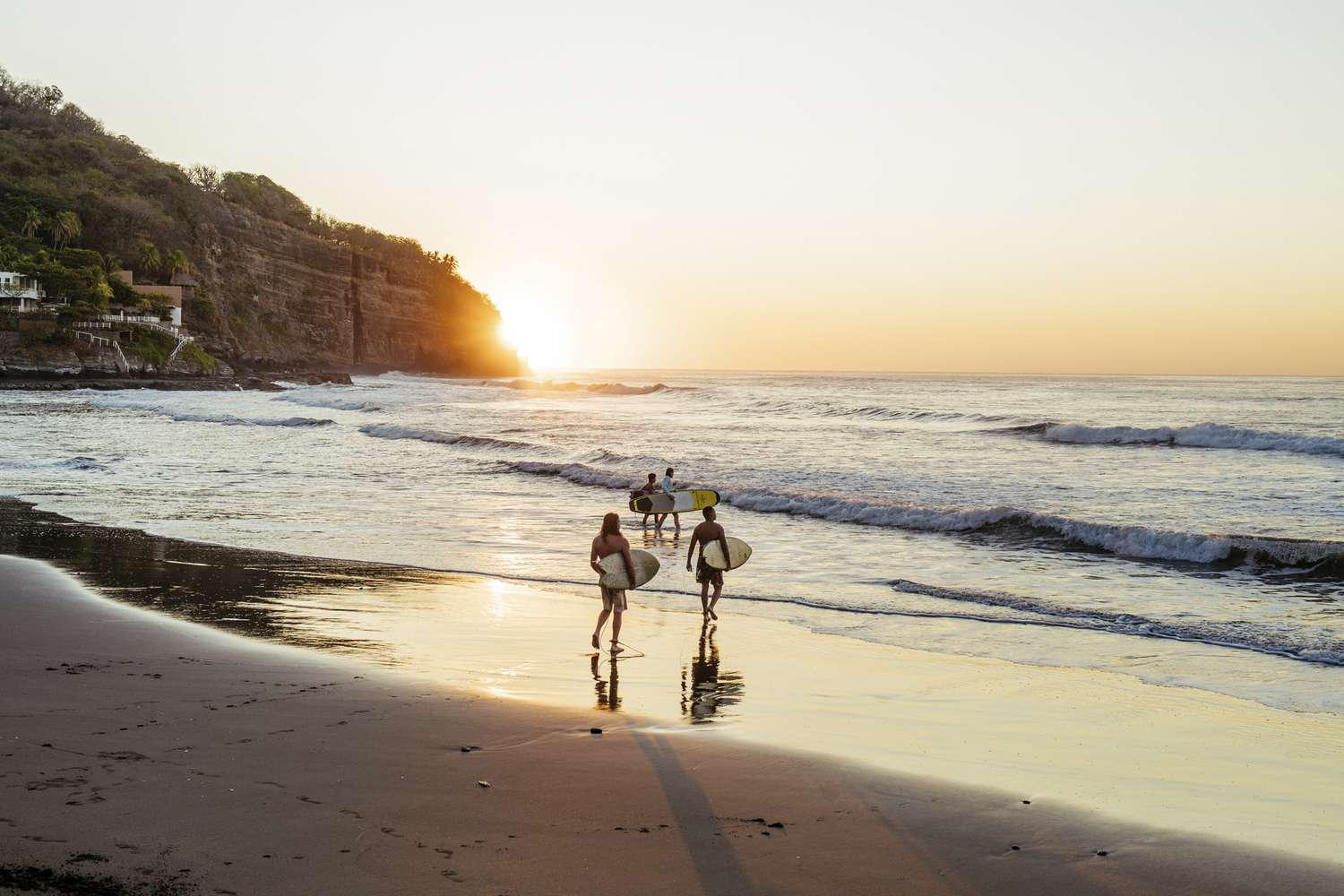
By twilight, I was back in El Zonte, walking barefoot across the black sand as the tide receded. I crossed the El Zonte River bed, which bisects the town, to a wider beach that filled up with weekenders escaping the heat of San Salvador, the country’s capital. Young couples walked their dogs. Teenagers played soccer. I ventured into the warm water as the sky turned neon pink.
Joaquín Aguilar Fernández/Roka
That evening, I had dinner at Roka, a fusion restaurant with a ceiling sculpted from reeds. I ordered a Mangonada cocktail, made with chaparro (a corn-based liquor), juice from mangos and arrayán (a native fruit), and ground pumpkin seeds. It tasted like a Salvadoran riff on a margarita. That was followed by a red-snapper ceviche, roasted cauliflower over a red-bean hummus, and prawns glazed in peppers and sweet cherries.
For a nightcap, I crossed the street to Low Tide Eatery, a shack where I had become a regular during my weeklong stay. Every time I sat at the bar, I met someone new. That night, it was a thirtysomething couple from Nashville. While friends had headed to Europe, they wanted something different. “No one we know has been to El Salvador,” the wife told me. I thought to myself: If more celebrities visit, that might not hold true for long.
A version of this story first appeared in the Feb 2026 issue of Travel + Leisure under the headline “Ride the Wave.”
Read the full article here