


Top 5 Can’t Miss
- Indiana Dunes National Park is one of the most biodiverse national parks in the U.S., with over 2,000 species and 350 types of birds.
- The park encompasses five different ecosystems, including dune, wetland, and forest habitats.
- One of the best ways to experience Indiana Dunes is by embarking on the 3.4-mile-long Paul H. Douglas Trail, which winds through several environments.
- You can have a chic, historic stay here by booking a night at the Cypress Log Cabin, which was originally built for the 1933 Chicago World’s Fair.
- Spring is an especially beautiful time to visit, with wildflowers and plenty of migratory birds.
- After a long day at the park, fill up on Italian classics and housemade pasta at Lucrezia’s, a local favorite.
Just an hour from Chicago, Indiana Dunes National Park stretches along Lake Michigan’s southern shore—its 15,000 acres of beach, forest, and wetland feel far removed from the city. And even though it’s one of the lesser-known national parks, it’s one of the most biodiverse landscapes in the country.
“First-time visitors are often surprised to learn what the Indiana Dunes National Park offers beyond the beach,” says Michelle Senderhauf, digital marketing director at Indiana Dunes Tourism. “The park stretches far beyond the shoreline, encompassing forests, wetlands, prairies, and rivers teeming with life.”
Nearly 2,000 recorded species live here, including more than 350 types of birds—it’s considered to be the fourth most biodiverse national park in the U.S. After decades of advocacy from conservationists such as Dorothy Buell and the Save the Dunes Council, Congress granted the park national status in 2019, making it the 61st national park in the U.S. and one of the newest in recent history.
Here’s what you need to know before visiting Indiana Dunes National Park.
Know Before You Go
Bonita/Adobe Stock
Indiana Dunes National Park is open year-round. Entry costs $25 per vehicle for a seven-day pass or $15 for walk-ins and cyclists. Annual passes cost $45 and are available online at recreation.gov or at park entry points.
The park stretches 15 miles along Lake Michigan’s southern shore, and there’s no single entrance. Trailheads, beaches, and facilities are scattered across the coastline. Popular areas such as West Beach fill early on summer weekends.
“During the summer, it is best to visit during the week in order to avoid the weekend crowds,” Senderhauf says.
Start at the Indiana Dunes Visitor Center (1215 IN-49, Porter). Rangers and destination concierges can help tailor your visit. The center is open daily from 8 a.m. to 6 p.m. in summer and 8:30 a.m. to 4:30 p.m. the rest of the year. The Paul H. Douglas Center offers exhibits and ranger programs near Miller Woods, although it is closed during the government funding lapse.
If you’re going in for a dip, it’s good to know that Lake Michigan behaves more like an inland sea than a lake. Rip currents can form quickly, and not all beaches have lifeguards. Check the swim conditions at the park’s website or by calling the visitor center before heading into the water.
Best Time to Visit
Nicola/Adobe Stock
In spring, wildflowers cover the forest floor, and thousands of migratory birds funnel into the park. “Because of the shape of Lake Michigan, birds following both of its coasts funnel into the dunes each May,” Senderhauf says. “Birders from around the world visit the Indiana Dunes Birding Festival to spot warblers, owls, woodpeckers, and falcons.” The festival generally takes place the third weekend in May.
Summer is peak season, with crowds flocking to West Beach and the park’s 15 miles of shoreline. Arrive early as the 642-space West Beach lot fills quickly, but lifeguards, bathhouses, and snack bars make it a comfortable visit.
“By fall, the summer crowds fade and the cooler air and colorful leaves make hiking through the dunes and forests unforgettable,” Senderhauf says. And in the winter, she continues that “Lake Michigan begins to freeze along the shore, forming otherworldly shelf ice. We always remind visitors never to climb on it because beneath the frozen surface are hidden air pockets and open water.”
How to Get There
Nicholas/Adobe Stock
From Chicago, it’s about an hour’s drive east on I-94. Indianapolis is about 2.5 hours away. Within the park, U.S. Highway 12 connects major trailheads and beaches.
Car-free travelers can take the South Shore Line commuter rail, which runs between Chicago and South Bend. The Miller stop is about a 20-minute walk to the Paul H. Douglas Center, while the Dune Park station connects to Indiana Dunes State Park.
Best Things to Do
Daniel/Adobe Stock
Walk the Indigenous Cultural Trail.
The Indigenous Cultural Trail at the visitor center explores more than 10,000 years of human history. “Long before the area became known for its conservation movement, it was home to the Potawatomi, Miami, and other Indigenous peoples who lived in balance with the landscape,” Senderhauf says. Limestone turtles etched with lunar calendars and multilingual tree markers honor these communities.
Join a Ranger-led Tour of Pinhook Bog.
Access to Pinhook Bog is limited to ranger-guided hikes—a rare opportunity to see one of the park’s most unique ecosystems. “Pinhook has carnivorous plants like sundew, pitcher plants, and orchids,” Senderhauf says. Tours run on summer weekends, and spots fill quickly. You can reserve a pot through the visitor center or on the park’s website.
See the 1933 World’s Fair homes.
Five modernist houses from Chicago’s 1933 World’s Fair now line Lake Front Drive in Beverly Shores. They were relocated by barge across Lake Michigan after the fair. While you can see the exteriors year-round, interior tours only take place during the last weekend of September through Indiana Landmarks and typically sell out fast.
Experience five ecosystems in one day.
Indiana Dunes National Park’s mix of dune, wetland, and forest habitats all mingle together to create one of the most diverse ecological areas in the Midwest.
“In the morning, visitors can hike along West Beach’s sandy trails in search of prickly pear cacti and wild lupine,” Senderhauf says. “A short drive away at Cowles Bog, they’ll find carnivorous plants and lush ferns, and by evening, watch the sun dip over prairies bursting with wildflowers.”
Watch for returning wildlife.
River otters, once absent from the region, are back. “They’re still rare to spot, but visitors have captured unforgettable moments, including one otter sliding down a snow-covered dune like it was on a sled,” Senderhauf says. Sandhill cranes and bald eagles are now regular sightings as well.
Best Hikes
EJRodriquez/Adobe Stock
Paul H. Douglas Trail through Miller Woods
This 3.4-mile-long trail showcases the park’s ecological range, winding through oak savanna, wetlands, and dunes before opening onto the beach. The first mile is easy, but sand hiking slows the pace. Pack water and layers—temperatures vary sharply between the forest and the shore. On clear days, you can see Chicago’s skyline.
West Beach Trail
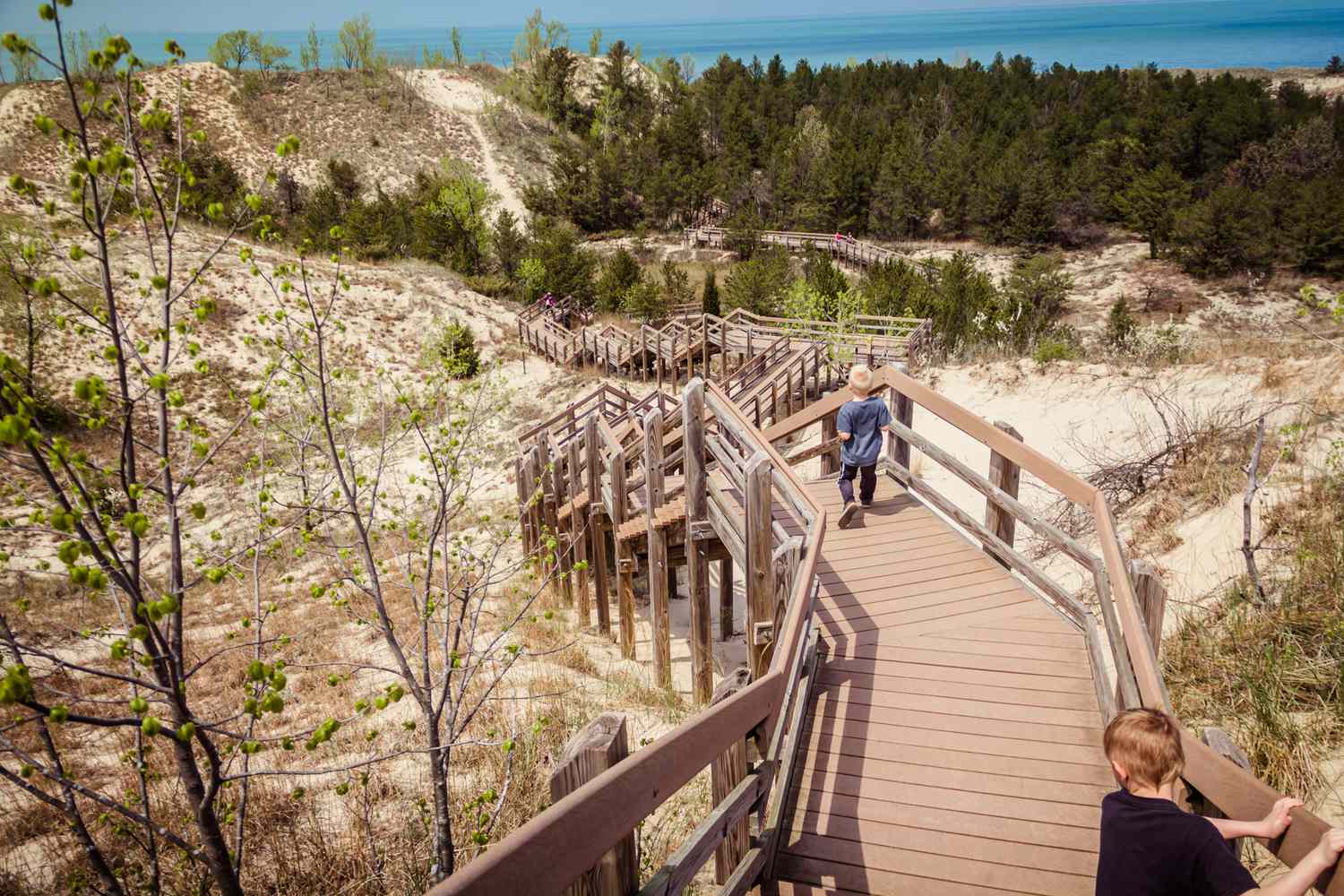
Also known as the Diana Dunes Dare, this short but steep climb includes 250 stairs and sweeping lake views from the top. The trail illustrates four stages of dune development. Afterward, West Beach has bathhouses, picnic shelters, and seasonal food service.
Cowles Bog Trail
This 4.7-mile-long loop was named after Dr. Henry Chandler Cowles, whose early 1900s research here helped establish ecology as a scientific field. The path passes wetlands and savannas before reaching the lake. The final sandy section is strenuous, but the shoreline is worth the effort.
Best Places to Stay
Inn at the Dunes
Cypress Log Cabin
Built for the 1933 Chicago World’s Fair, this historic cabin was built with the intent to prove that cypress wood could endure Midwest winters. It’s now a private rental within park boundaries—a rare chance to stay inside a national park in style.
Dunewood Campground
The park’s primary campground has 66 sites across two loops, each with restrooms and hot showers. Sites cost $25 per night; passes like the Senior Annual or Access Pass can get a 50 percent discount.
Hilton Garden Inn, Chesterton
“For an overnight stay, the Hilton Garden Inn in Chesterton is a top choice, and it’s only about 20 minutes from West Beach,” says Mike Augustine, a Travel + Leisure A-List advisor. Expect modern rooms and convenient proximity to the park.
At Home in the Woods
This five-acre bed-and-breakfast is a quiet, wooded retreat with an outdoor pool, hot tub, and homemade breakfast. Hosts Victoria and Scott Philips create a nature-focused stay that extends the park experience beyond its borders.
Places to Eat
Jeffrey Greenberg/Universal Images Group via Getty Images
Dining inside the park is minimal, so plan ahead. “I also recommend packing all of your own food, drinks, etc.,” Augustine says. Snack bars operate seasonally at West Beach and Portage Lakefront, and picnic shelters are scattered throughout the park. For provisions, Chesterton has grocery stores including Jewel-Osco, Aldi, and Nature’s Cupboard.
Lucrezia’s
Regularly voted the region’s top Italian restaurant, Lucrezia’s serves housemade pasta, classic Italian appetizers, and braised lamb shanks and short ribs in a garden setting.
George’s Gyros
A long-standing Chesterton favorite serving gyros, hot dogs, Polish dogs, and burgers made to order since 1998. The drive-thru is ideal for quick park-day meals.
The Port Drive-In
A Chesterton institution since the 1950s, The Port serves chili dogs, hand-cut fries, and home-brewed root beer in iced mugs. You can eat at a picnic table or have the car hops deliver food straight to your window. They’re open seasonally.
Tao Chen’s
This family-owned Chinese restaurant has been a local standby since the early 1980s, known for fresh, customizable dishes and friendly service.
Read the full article here