


Top 5 Can’t Miss
- Take in some of England’s most legendary views on the water by kayak or paddleboard.
- Walk the same paths that Romantic poets once did and see the 65-foot-tall Aira Force waterfall.
- Cumbria arguably has one of the best dining scenes in the U.K.—taste it for yourself at the three Michelin-starred farm-to-table restaurant L’Enclume.
- Explore the area’s storied history by visiting its mysterious stone circles or its handsome historic homes.
- Rest after a long day out and about at the Gilpin Hotel & Lake House, which earned two Michelin Keys in 2025.
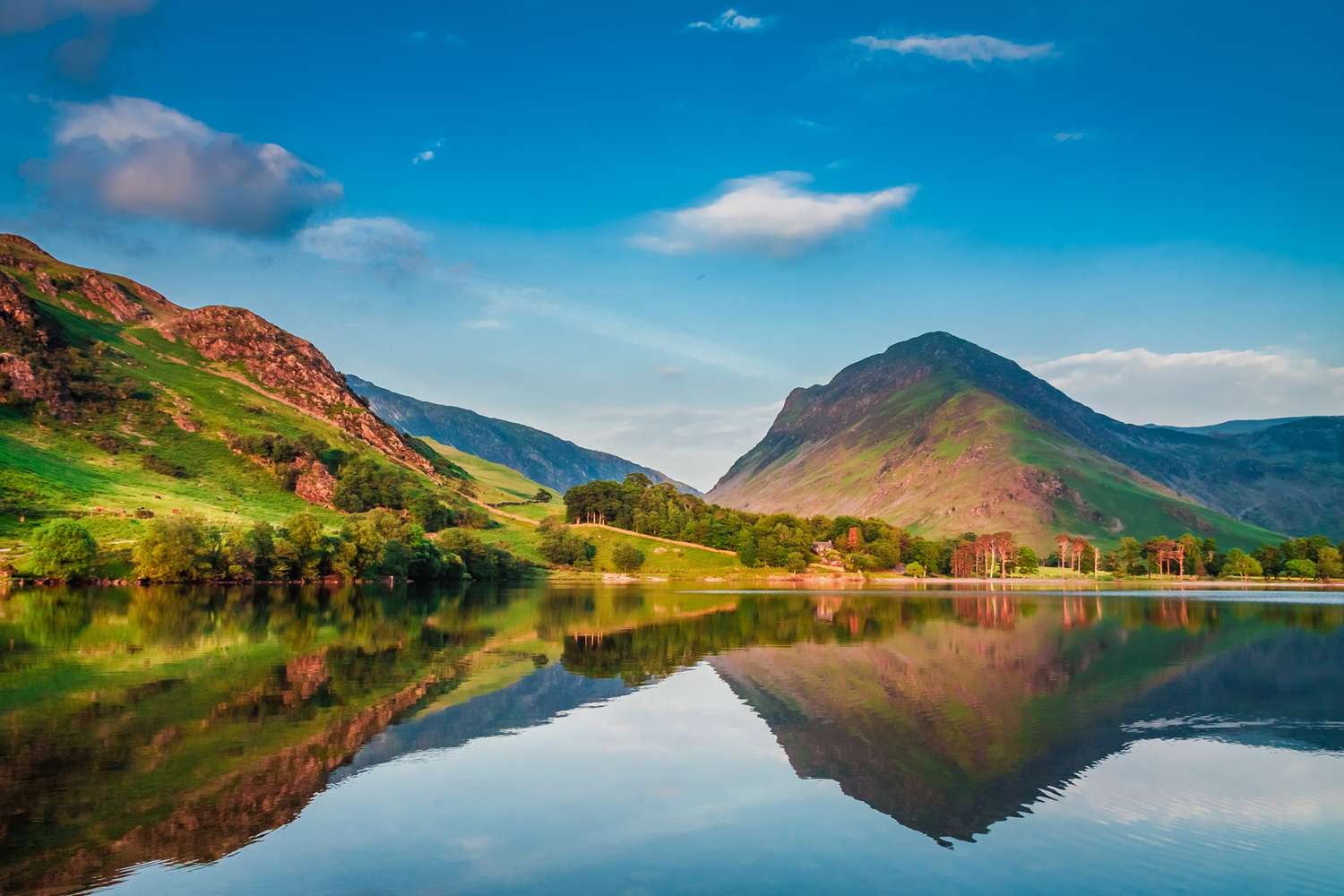
Romanticists and British poets have long praised the beauty of the Lake District of England—but that actually wasn’t always the case.
In the mid-18th century, “Robinson Crusoe” author Daniel Defoe called it the “most barren and frightful of any [place] that I have passed over in England,” echoing a common sentiment at the time. However, local creatives such as William Wordsworth and Samuel Taylor Coleridge later began to pen lofty odes to its glacial lakes, wide meadows, and jutting hills. Thanks to their nature-focused poems, a love for the U.K.’s natural landscapes was sparked, and visitors soon followed. Many years later, in 1951, the area became a national park.
“There’s something almost like a storybook about it,” says Rachael Gavan, head of travel for tour operator Wilderness England. “Rolling fells that rise gently into rugged peaks, mirror-still lakes that shift with the light, and valleys that feel as though you’ve stepped straight into a novel or a film. It’s no wonder generations of artists, poets, and writers have found their muse here.”
The Lake District is England’s largest national park and is home to its highest mountain, Scafell Pike, as well as its deepest lake, Wast Water. The park also has quaint villages such as Grasmere and Keswick, and you can also find evidence of the land’s ancient history—things like prehistoric and medieval artifacts such as field systems, stone circles, Roman roads, and castles—peppered across the landscape. While here, visitors may also see a native breed of Herdwick sheep that has survived due to efforts once led by conservationist and children’s storybook author Beatrix Potter of Peter Rabbit fame.
“Each town and village has its own personality,” Gavan says. “Wander a little, and you’ll find communities that feel deeply rooted in place, where traditions haven’t been polished away for visitors but simply continue as they always have. Truly, it’s the people who make the Lakes special … There’s an authenticity and warmth that you feel everywhere you go.”
Here’s what you need to know before planning a trip to Lake District National Park in England.
Know Before You Go
SolStock/Getty Images
Open 24 hours, year-round, with no gates, barriers, or entry fees, this is England’s most popular park. Five visitor centers can be found throughout, with bathrooms, free Wi-Fi, knowledgeable staff, and maps available for purchase. Some have cafes and bikes for rent, but hours vary depending on the season. Gavan recommends strategically planning when you travel.
“The Lake District is relatively small, but many of the towns and villages were built long before cars were a consideration,” she explains. “The roads are narrow, winding, and often shared with everything from walkers and cyclists to wandering sheep, so getting around takes longer than you’d expect. Because it’s such a popular destination, the well-known spots can get busy, especially in peak seasons. But that doesn’t mean you can’t find peace and quiet.”
Fires and barbecues are not allowed in the park, and neither is wild camping unless you have a landowner’s consent. Leave No Trace principles apply everywhere.
Best Time to Visit
Shaiith/Getty Images
Each season in Lake District National Park holds its own kind of magic.
“Spring is always a joy,” Gavan says. “When the daffodils appear, you get that instant connection to Wordsworth, and seeing lambs skipping about on the fells feels as classically English as it gets.”
While summer is the busiest season, Gavan recommends it for those interested in water-based activities and dining. “The days are long, and there’s a whole world of ways to get out on the water, from swimming and paddleboarding to boat trips and kayaking. The local produce is at its best, so even mealtimes feel vibrant and seasonal,” she says.
The fall is a particularly beautiful time to visit, thanks to the changing color of leaves—and winter is not to be written off either.
“Autumn brings those rich colors: golds, russets, and deep greens,” she says. “There’s something magical about mist rising off perfectly still, glass-like lakes first thing in the morning. [Winter] is when the traditional pubs and inns really shine. There’s nothing better than a cold and crispy walk or a day of pottering through villages and independent shops, then settling in front of a crackling fire with a proper English roast dinner. It feels cozy, nostalgic, and wonderfully atmospheric.”
Regardless of the season, the weather can change drastically by the hour, especially in the colder months. Being prepared, dressing appropriately, and packing all the necessities are crucial. Make sure to check the weather report before you head out, and you can get an idea of on-the-ground conditions through the park’s live webcams.
How to Get There
john finney photography/Getty Images
Lake District National Park is located just south of the Scottish border, in England’s northwest county of Cumbria. It’s about a 4.5 hour drive from London, and all its airports such as Heathrow Airport (LHR) and London Gatwick Airport (LGW). The closest major international airport to the park is Manchester Airport (MAN), which is a little over an hour away.
Since Lake District National Park is England’s largest at 583,747 acres, it has multiple entry points—each gives you access to different experiences and landscapes. For those coming from London, the natural first stop is Windermere with its iconic Lake District views—but there is much more to see.
“If you’re traveling from the north or east, your most natural entry points are Penrith or Keswick,” Gavan says. “Penrith brings you straight to beautiful Ullswater, perfect if you want that slightly quieter, more serene introduction with big scenery and lovely lakeside villages. Keswick, on the other hand, sits right at the heart of some of the park’s most dramatic landscapes. It’s brilliant for walkers, nature lovers, and anyone who wants to jump straight into the mountains.”
When you’re there, it’s very easy to get around the area by simply walking, cycling, boating, or taking public transit. Electric cars are also available to rent at the region’s railway stations and villages, and charging points can be found throughout.
Best Things to Do
kmiragaya/Adobe Stock
Explore ancient sites.
From ancient forts and settlements to Roman roads, some of England’s most impressive Neolithic monuments can be found here. One of the most intriguing historic points of interest in the Lake District is arguably its stone circles, mysterious sites composed of giant, carved rocks that were believed to have been used for ritualistic purposes. Stonehenge, for example, is the U.K.’s most famous—but there are actually 1,300 such sites scattered throughout the British Isles, and there are a few well-known ones in the Lake District.
One of Britain’s oldest, Castlerigg Stone Circle, features 38 massive stones, some towering 10 feet high, and is located east of Keswick. Above the glacial lake Ullswater, prehistoric cairns and burial mounds dot the high moorland, including the Cockpit Stone Circle, which spans 90 feet. Several farmsteads dating back to the Roman era can also be found at the village of Aughertree, and the well-preserved Hardknott Roman Fort (which dates back to the second century) are all free to explore.
Tour historic homes.
One of the most interesting ways to experience the area’s unique culture is by visiting the historic homes of the creatives who once lived here and were inspired by the Lake District. In Bowness-on-Windermere, you’ll find an architectural masterpiece, the Blackwell Arts & Crafts House. Designed in 1901 by famed British architect Mackay Hugh Baillie Scott, the home’s original wood carvings, plasterwork, textiles, and furnishings are still intact.
Literature lovers will want to step inside Dove Cottage, where William Wordsworth lived with his sister Dorothy, his wife, and their three children, while writing some of his most notable poems. Similarly, beloved children’s book author and illustrator Beatrix Potter lived at Hill Top and Hawkshead, a farmhouse near the village of Sawrey, which she bought with earnings from her most famous work, “The Tale of Peter Rabbit.” Here, you can see the wild gardens that inspired much of her later work, and her presence there is still palpable. “It feels as though she has just stepped out for a moment,” Gavan says.
Take to the waters.
No trip to the Lake District would be complete without experiencing one of its many bodies of water. With more than 16 large lakes and even more tarns (aka mountain pools), it’s no surprise that wild swimming, kayaking and canoeing, paddleboarding, windsurfing, and scenic cruises on traditional steam-powered boats are all popular things to do here. Many people like to fish in the area, too, but certain locations require permits that are issued by local angling associations. Determine which area you would like to fish in and look up what fees may be involved before casting a line.
Best Hikes
Long before the area was designated a national park, the Lake District’s lakeside strolls and hillside treks were already legendary, and inspired paintings and poems. Dorothy Wordsworth’s (sister of William Wordsworth) “Grasmere Journals” detail the long walks she’d take with her more famous sibling through the area’s iconic scenery. Now, nearly 2,000 miles of well-marked and signposted trails, including at least 50 accessible routes, make these celebrated landscapes available to everyone.
Tarn Hows
At two miles long, this gentle, mostly flat loop is part of the park’s Miles Without Stiles accessible routing program, which makes it perfect for beginners, those with mobility issues, or anyone looking for an easy amble with lovely views. The land it runs through was once owned by Potter, and it has views of a series of low, forested hills (the Hows), which surround a man-made lake or “tarn,” which gives the path its name. The five-peaked Langdale Pikes and the Coniston Hills are visible in the distance. “It’s a great introduction to the landscape,” Gavan says. “Its peaceful setting has inspired many artists over the years.”
Aira Force
Multiple trails of varying intensity wind their way through picturesque woodlands to take in Aira Force, a spectacular 65-foot waterfall, which served as the setting for William Wordsworth’s 1835 poem “The Somnambulist.” Depending on the challenge you’re after, you can scale to the summit of Gowbarrow Fell for wide views over Ullswater or opt for a short out-and-back walk that still delivers on epic vistas.
“This is a classic Lakeland walk with a huge dash of romance, literally,” Gavan says. “The falls were a favorite of the Wordsworth family, and the surrounding woodland feels straight out of a storybook. The trails range from easy to slightly more challenging loops, making it a flexible choice for families or mixed-ability groups.”
Cat Bells
“If you want that ‘I’ve climbed a Lake District fell’ feeling without committing to a full day, Cat Bells is a perfect choice. It’s a firm favorite with locals and visitors alike,” Gavan says.
Overlooking the town of Keswick, this is one of the Lake District’s most frequented hills, popular for its moderate climb and unforgettable views of Derwentwater, Skiddaw Mountain, and Newlands Valley. In about three hours, you can scale to the top and back (it’s about five miles round-trip) with photo stops and rests along the way.
Grasmere to Rydal Water via the Coffin Route
William Wordsworth notably described Grasmere, the vale he called home, as “the loveliest spot that man hath ever found.” When you wander along the former coffin road—a walking route once used to transport bodies to the consecrated burial ground at St. Oswald’s church, where Wordsworth himself is buried—you’ll probably agree. Now a popular circular trail connecting two of the area’s most scenic lakes, this two-hour walk starts in Grasmere village, offering a chance to stop at Dove Cottage. Gavan describes this as “an ideal walk for literary lovers” that’s moderately challenging and “rich in history and atmosphere.”
Helvellyn via Striding Edge
This eight-mile, round-trip climb to the top of England’s third-highest mountain, Helvellyn, by way of the renowned Striding Edge ridge, is not for the faint of heart and should only be undertaken by experienced hikers. Crossing a narrow, exposed spine with tough scrambles along the way, Gavan describes this route as “dramatic and exhilarating, with sweeping views that stay with you long after the walk is finished.”
Best Places to Stay
Relais & Chateaux
Gilpin Hotel & Lake House
Set on 21 idyllic Lake District acres, each room at the Gilpin Hotel & Lake House has a lovely view, and more than half have private hot tubs. An on-site spa, two award-winning restaurants, and a pack of resident llamas and alpacas make this an all-around unique stay. “It’s known for its warm hospitality, beautiful rooms, and incredible dining,” Gavan says. “It’s perfect for a relaxing escape after a day outdoors.”
The Drunken Duck Inn & Restaurant
Set just outside of Ambleside, with mountain views, this countryside inn is adored for its cozy, eclectic rooms as much as it is for its restaurant’s creative menu of striking, plant-heavy plates. Locals love the pub here, too, and the surrounding area offers stunning walks to the top of Black Crag and around Lake Windermere.
The Quiet Site
This family-run campground has sites for both tents and caravans, plus pods and cabins with hotel-grade showers, fast and free Wi-Fi, a zero-waste shop, and a popular pub set in a 16th-century building. Surrounded by glorious views of the fells and Ullswater, sustainability is one of the property’s high priorities, and it has got the awards and accolades to prove it.
Places to Eat
Peter Shaw/Getty Images
Cumbria has more Michelin-starred restaurants than any other county in the U.K. outside of London. “Food lovers will be in heaven here,” says Gavan. “You can spend a whole day sampling local produce, from cheeses and cured meats … Add in a brewery or distillery visit, a wander through a farmers’ market, and perhaps a piece of Kendal Mint Cake, and you’ve got a perfect taste of the Lakes.”
L’Enclume
This three Michelin-starred farm-to-table restaurant in Cartmel is renowned for its seasonal produce harvested daily from the restaurant’s nearby 12-acre farm. Inventive dishes combine unexpected pairings like salted mackerel with gooseberry tart or sheep’s milk cheese with birch sap. “[It’s] one of the best dining experiences in the country,” Gavan says. “It’s a real treat and worth planning ahead for.”
Fellpack
In Keswick, this locally beloved gem describes its menu as “short, seasonal, and eclectic.” Here, diners will find Scottish classics listed among Japanese dishes, as well as a variety of vegan and vegetarian options. “[It’s] the kind of place where everything just tastes fresh and comforting,” Gavan says. “It’s great after a day of exploring.”
Homeground Coffee + Kitchen
Located in Windermere, the menu at Homeground Coffee + Kitchen leans American with plates like fried chicken and waffles, avocado toast, and hash browns. You’ll find loads of other options too, though, including Turkish eggs and huevos rancheros, cereals, pastries, and great coffee.
Local Shops
If you’re headed out for a long hike or just want to spend as much time exploring the landscapes as possible, local farm shops, delis, and bakeries can be found throughout the park. Gavan recommends Booths supermarkets, “especially in Keswick, Windermere, or Penrith” for regionally grown produce and other picnic foods. It’s a convenient place to stock up on local cheeses, meats, breads, and pastries.
Read the full article here