


The shower was red marble, moodily lit. How long I spent there, scrubbing away airplane grime and jet lag with a bar of Guerlain soap, I have no idea. By the time I’d arrived in Rome and checked in to my suite at the Orient Express La Minerva, the magnificent flagship of the brand’s new hotel portfolio, time had melted like a Dalí clock.
It usually takes about nine hours to fly from Washington, D.C., to Rome. On this trip last spring, it had taken me 32, thanks to a perfect storm of maintenance problems, crew time-outs, and actual storms. Around two in the morning, a sympathetic pilot (our second of the evening) had finally leveled with us over the loudspeaker: “I don’t know what they’re going to tell you at the gate, but there is no way this plane is going to Rome tonight.”
When everything goes according to schedule, flying is bearable, even pleasant—if you’re in the right seat. But the past year has underscored what a short road it is from bearable, even pleasant, to complete nightmare. Is it at all surprising that dignified, low-stress train travel is having such a revival?
Federico Ciamei/Travel + Leisure
I’d come to Italy to experience La Dolce Vita Orient Express, the first of three trains under the fabled and recently revived Orient Express brand. By 2027, its luxury carriages will crisscross Europe, but Italy was chosen as the location for its relaunch. La Dolce Vita and the Minerva, which occupies the erstwhile palazzo of 17th-century aristocrats, debuted last April.
My shower was halfway resurrecting. A frothy cappuccino on the sun-warmed terrace of La Minerva’s rooftop restaurant, Gigi Rigolatto, did the rest. Seven stories above the city, it smelled like citrus and jasmine, the fragrance carried on a breeze that raced over the terra-cotta roofs and rustled the tassels on the sun umbrellas. I ordered another coffee. I ordered spaghetti alle vongole. The fury of getting to Rome faded into the glory of being in Rome.
I wished I had more time, but my journey on La Dolce Vita was departing that night: a loop from the Eternal City to Puglia and then Abruzzo, the region from which my paternal grandfather’s parents emigrated in the early 1900s. Getting between these locations normally takes about 12 hours; La Dolce Vita stretches the trip into two days and two overnights of tuxedoed singers, Campari cocktails, breakfasts in bed, and stunning landscapes rolling by your cabin window. The new platinum era of train travel is slow, but unlike air travel, it’s that way on purpose.
Federico Ciamei/Travel + Leisure
Stop One: Rome
Ostiense Station announces itself with a massive bas-relief of Pegasus and his handler, the Greek demigod Bellerophon. The all-black Mercedes from La Minerva moved as swiftly as the winged horse, delivering me to the far end of the late-1930s landmark. Where once there was a supermarket there is now La Dolce Vita’s swanky departure lounge, guarded by potted birds-of-paradise and staffers in navy suits with tangerine lapels.
Campari cocktails, breakfasts in bed, and stunning landscapes rolling by your cabin window.
Within minutes, the staff had me checked in and mingling with my 39 fellow passengers. Moving throughout the suited and sequined group was Paolo Barletta, the charismatic 39-year-old founder and CEO of the Arsenale Group, the Italian luxury firm behind La Dolce Vita. “Over the next 50 years, this will be the third leg of tourism,” he said after finding me on a sofa, where I was chasing olives with an Americano cocktail. “You have hotels, you have cruises, and now you have train cruises.”
Barletta calls La Dolce Vita and its future siblings “train cruises” because they stop “in port,” just as a cruise ship would. Passengers go out for the day and return in time for pre-dinner drinks. Under Barletta’s direction, Arsenale started developing the concept five years ago, custom-manufacturing the carriages for La Dolce Vita with the Milanese design firm Dimorestudio. To help manage the project, he selected Accor, which owns the Orient Express brand. “They had this incredible asset that deserved to be reborn,” he said.
Federico Ciamei/Travel + Leisure
Indeed, Orient Express is perhaps the most mythic name in the travel world. From 1883 to 1977, opulent trains operated under this banner throughout Europe, the Middle East, and Asia, inspiring Agatha Christie’s titular 1934 mystery, along with legions of bucket-list-keepers for whom the trains represent the ne plus ultra of glamorous, old-school travel. Accor acquired the brand in 2022 and partnered with LVMH, which runs its own luxury trains through Belmond, including the Venice Simplon-Orient-Express. That the two companies use the Orient Express name is a source of confusion Barletta has aimed to untangle through his train cruising model. (Aboard the VSOE, which I traveled on in 2023, passengers typically remain on the train for the entire trip.) I’ll admit, I was still a little fuzzy on the concept. “You’ll see tomorrow in Matera,” Barletta smiled, his blue eyes crinkling at the corners, before dashing off.
After an hour in the lounge, the staff began escorting us to the train. A cabin steward led me along the wood-grain-detailed, sapphire-painted carriages and into my suite. Before I knew it, La Dolce Vita had left the station, and I had to get to dinner. The dining car was all white cloths and branded china and Gio Ponti–inspired salt-and-pepper shakers that have a habit, I was informed, of mysteriously going missing. (Better than murder, I suppose.) ’Nduja-crusted lobster followed scorpion-fish spaghetti, with the flickers of spice reflecting the cuisine of the Mezzogiorno, the southern half of Italy to which the train was heading.
Somewhere near the Gulf of Gaeta, my fellow passengers and I adjourned to the lounge car, which the talented Coky Ricciolino filled with athletic renditions of songs like “Mambo Italiano” and “Tu Vuò Fà L’Americano.” “Fly me to the moon,” he crooned, “Let me play among the stars.” All dressed up and a little wobbly from the wine and the locomotion, it felt like I was already there.
Federico Ciamei/Travel + Leisure
Stop Two: Matera
Puglia, the heel of Italy’s boot, kicked me awake.
I was wrapped like a caterpillar in white sheets by Rivolta Carmignani, the same brand used on the original Orient Express lines. My 118-square-foot suite, one of 30 en suite accommodations aboard, came slowly into focus. The VSOE owns the Art Deco look. LDV, wisely, went another way. Opposite the double bed was a love seat and two barrel chairs tucked under a dining table set with fresh flowers. Sunlight seeped in from the edges of the two big windows, revealing details in apricot suede, camel leather, and vermilion lacquer. In my suite and throughout the carriages, reflective surfaces and frisky curves channeled the midcentury aesthetic of the train’s namesake, Federico Fellini’s 1960 film La Dolce Vita.
A knock at the door. I threw on a robe to find my cabin steward bearing the breakfast I’d ordered the night before: soft cheeses, blush-pink folds of prosciutto cotto, fresh-squeezed orange juice, finely cut fruit, pastries, a perfect cappuccino with a barista-drawn heart, and a second cappuccino because one wasn’t going to be nearly enough. She arranged them on the dining table, and I pushed open the curtains. The Adriatic Sea flashed between vineyards.
Federico Ciamei/Travel + Leisure
The 40,000-foot views from an airplane never fail to inspire, but what you see from a train is so much more intimate. I ate breakfast and watched the scenery change. Fresh mower lines on a soccer field. Cactus paddles beaded with young prickly pears. Tablecloths draped over the balconies of mid-rise apartments with sun-bleached peach and coral exteriors.
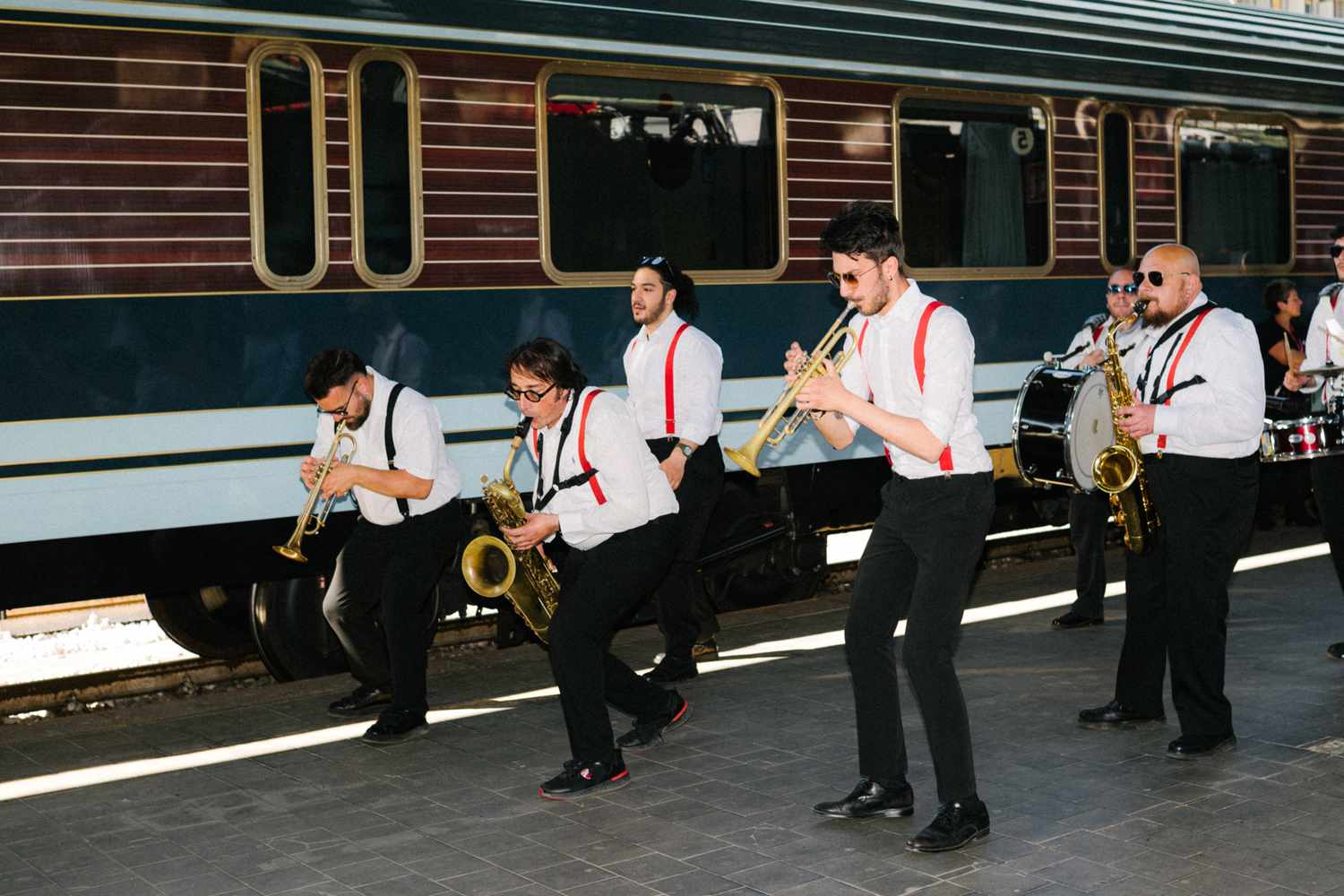
The train coasted into Bari, the capital of Puglia, to the exuberant horns and drums of a welcome band. The commuters at the station looked both confused and delighted, filming on their phones as we disembarked and the local guides wrangled their groups for the day’s experiences. My small group hopped in a black SUV and headed out of the city. It had rained all the previous week, leaving the countryside neon green. As we crossed the border into Basilicata, we stopped at Casal Dragone, a family-owned winery and agriturismo now in the hands of a third generation, to visit what Angela Dragone calls “the Sistine Chapel of southern Italy.”
We made our way a mile from Dragone’s farmhouse, along a dusty road above the Gravina River, which cuts a deep ravine through fields of wheat and lavender. We then followed a staircase carved into the limestone to a cavelike opening. Inside, early-medieval frescoes covered the walls. Royal blue, oxblood, and gold paint illuminated the creation of Adam and the temptation of Eve—the couple who give the place its name, the Crypt of the Original Sin—along with various apostles and archangels. Mary, in queenlike robes, gathered baby Jesus in her arms. The chapel, a voice-over recording explained, was likely founded by monks in the early ninth century before the Arab conquest in 859 AD, and was used by shepherds to shelter their flocks until it was rediscovered in 1963. The artist is unknown but has been colloquially named the Flower Painter of Matera for the red poppy-like blooms threaded through the frescoes.
Federico Ciamei/Travel + Leisure
The same flowers rouged the edges of the road, where the resident Labrador mixes, Lulu and Mocio, led us back to the agriturismo’s bodega. There, Dragone uncorked a bottle of the estate’s refreshing Malvasia Greco di Basilicata and filled my glass. She teared up while talking about her father, who donated the crypt to a nonprofit foundation so others could share its treasures. “This is very emotional for me,” she said, then, in typical Italian-mom style, smothered the table with meats and cheeses.
From Dragone we drove 15 minutes into Matera for a guided walk through the city’s jumble of limestone sassi, the rudimentary cave dwellings my guide said were considered “the embarrassment of Italy” when the government evicted all the residents in the 1950s. Now this stone honeycomb is hot real estate. While some sassi have been preserved as museums, others are now inhabited by gelaterias, pottery shops, boutique hotels, and restaurants like Vitantonio Lombardo, where the Orient Express passengers convened for a long lunch. The oven-crisped zitoni pasta stuffed with braised-forever ragù felt like a long-lost relative of my grandmother’s Sunday gravy.
We didn’t get back on the train until an hour or so before dinner—just in time for a flute of Franciacorta in the lounge. The wine fizzed over the rim; I fizzed over the art and hospitality at Casal Dragone. There, in the cool, stone-walled tasting room, La Dolce Vita had curated a genuine moment of discovery and connection, something that, in the Italy of The White Lotus and billionaire Venetian weddings, is harder and harder to do.
Federico Ciamei/Travel + Leisure
Stop Three: Abruzzo
Despite being only 110 miles east of Rome, the high plateaus, forests, and mountains of Abruzzo give the region a wild, remote flavor. Not a place you want to be abandoned in a blizzard, and definitely not in 1987, as Marcello D’Amico was on his first day working on the Italian “little Trans-Siberian,” the Sulmona-Carpinone train route nicknamed by a journalist in 1980 for the isolated, at times snowy wilderness it traverses.
Federico Ciamei/Travel + Leisure
“It was Christmas Eve,” he recounted, pausing for dramatic effect, “and the snow came out of nowhere.” He’d hunkered down in a trackside shack near the Campo di Giove station with a cot, a camping stove, and no way to get in touch with his family. Nobody came to get him until December 26.
In its heyday, the Sulmona-Carpinone was an engineering marvel providing vital connections between far-flung mountain villages, passing through Abruzzo’s 180,000-acre Maiella National Park. But buses had made it obsolete by 2011, when the line shut down. D’Amico and his coterie of historic-train enthusiasts revived it as a tourist attraction in 2014, with D’Amico returning as conductor. The antique cars of polished woodwork and burgundy velvet now carry about 30,000 people annually, including all the passengers on my trip. Unlike in Bari, where guests had excursion choices, everybody got off in Sulmona, our second stop, and boarded the “Trans-Siberian.” Our destination for the day trip was Pescocostanzo, a member of Italy’s borghi più belli association of small towns and villages with distinct historic, cultural, and artistic heritage.
Federico Ciamei/Travel + Leisure
My ears popped as we climbed 35 feet per mile, scooting through narrow tunnels and around villages nestled in the valleys of the Maiella mountains. The slopes shed their bright emerald foliage as we ascended the switchbacks, revealing bald limestone creases and peaks with snow dripping down the sides, like icing on a Bundt cake. At 4,160 feet above sea level, the train came to a stop at Rivisondoli-Pescocostanzo station, the highest on the Italian standard-gauge network after the Brenner Pass linking Italy and Austria.
Federico Ciamei/Travel + Leisure
During the Renaissance, a reputation for fine craftsmanship enriched Pescocostanzo, and walking its streets in a small group, I could see it still had a bit of Florentine swagger. There’s a hardy, mountain humility to the architecture, but the noble families, wealthy merchants, and artists who rebuilt the village after a 1456 earthquake took a flaunt-it-if-you-got-it approach to the details, like pairing a Cartier watch with Carhartt overalls. Carved-wood dragons watch from palazzo eaves, and an ornate wrought-iron cage encases double bells atop the city hall’s clock tower. A two-tone cobblestoned street connects Pescocostanzo’s civic hub to its spiritual center, the hilltop Basilica of Santa Maria del Colle, where a circular window peers down at the city hall like a cyclops. Inside the church, gold-dipped ceiling coffers, chiseled marble, and metal angels and demons create a Baroque fever dream. I could have spent the whole afternoon there, but a parishioner shooed us out for an incoming funeral procession. An aging population and declining birth rate are existential issues in Italy, but emigration further stretches the ratio in rural areas like this. Fortunately, D’Amico and his countrymen are delightfully obstinate in maintaining their traditions.
I met Alba Di Geronimo at the Bobbin Lace School & Museum, aged 88 and still working the prized Pescocostanzo handicraft of merletto a tombolo lace. “It’s a way of remaining young,” she said while juggling 10 wooden bobbins wound with thread. Her hands were smooth and sturdy, her fingernails like garden spades. She created an intricate lace border on an angled tombolo pillow with the effortless dexterity of a spider.
“The new generation doesn’t always want to learn the traditions,” 58-year-old Carmela Sette, Di Geronimo’s weaving partner, chimed in. “But in Pescocostanzo, they do.” Classes given by the museum’s school ensure the craft’s preservation.
Federico Ciamei/Travel + Leisure
There was one more traditional Abruzzese craft to experience. After a lunch of tender gnocchi in pea purée at La Corniola, a ristorante with rustic terra-cotta floors and wooden sideboards filled with delicate glassware, we traveled back to Sulmona on the “Trans-Siberian.” (D’Amico chatted the whole ride, showing me photos of deer and wolves along last winter’s snow-packed tracks and telling me about the time he traveled to Rome with a white goat, a gift for the late Pope Francis.) Back on La Dolce Vita, I found a square gift box in my cabin. Inside were candied almonds and hazelnuts in coatings the colors of raspberries and coffee, basil and lemons. Confetti di Sulmona. These small, multicolored confections, crafted by Abruzzese candymakers since the 14th century, are where we get the English meaning of confetti. Instead of throwing them in the air, I threw them into my mouth.
Stop Four: Back to Rome
On a luxury train like La Dolce Vita, the other passengers begin as characters: Ambassador Tweed, Madame Enormous Diamond. Some identities get revealed over cocktails and chitchat, others through Instagram snooping, which was how I learned a former secretary of state of Australia (she of the enormous diamond) was on board, along with the founder of luxury train competitor Golden Eagle, which, several months after my trip, Arsenale announced it had bought. Other guests remain cloaked in mystery, which suited the experience fine.
Federico Ciamei/Travel + Leisure
Over drinks in the bar car, representatives of the train mentioned Sarah Hebblethwaite. Would I mind if she joined my table for dinner? She’s traveling alone.
Interesting. Which character, I wondered, had I pegged her as? She was a retired English teacher, I would later learn, which probably explained why she arrived at the table first. Sensible silver haircut. Periwinkle cardigan. I hadn’t seen her in Matera or Abruzzo. I hadn’t seen her on board. In a mystery, she’d have made an excellent spy.
The staff served saffron risotto and Abruzzese wine as Hebblethwaite, a trilingual diplomat’s daughter, served her backstory. British by birth and Parisian by residence, she would turn 81 the following week and had loved trains for nearly as many years. Growing up, her family would travel from London to their second home in Italy, disembarking in Dover and boarding the ferry for the Channel crossing. “The Orient Express carriages would already be on the boat,” she remembered. “The idea of actually being on that train… it was a childhood dream.”
Federico Ciamei/Travel + Leisure
Her husband should have been there. A few weeks before the trip and their 60th anniversary, he died unexpectedly. But his passing did not determine whether Hebblethwaite, a woman who had waited seven decades to punch an Orient Express ticket, would cancel or travel. Her chemo schedule did. “I have a scan on Monday morning, so you know, back to reality.” Her tone was wry, but her voice hung there just for a moment before finding its footing. “It’s been lovely, being able to use my three languages, meeting people, and seeing a bit of Italy that I’d never seen.”
And that’s the X factor of La Dolce Vita. It’s about the train, the back-of-your-neck tingle that anything—a murder, an affair, a jewel (or at least salt-and-pepper-shaker) heist—could transpire in this liminal space where we might become more exciting versions of ourselves. But it’s equally about Italy.
“You’ll see in Matera,” Barletta had told me. And now I did. Hebblethwaite did, too. We finished dessert and said goodbye as we approached Rome. We were travelers of different generations, from different continents, who’d come for a train ride but would disembark with memories of a more meaningful adventure through Italy. It was a plot twist befitting a Victorian whodunit, one neither of us saw coming.
Two-night “Eternal Stones of Matera” itinerary on La Dolce Vita Orient Express from $4,850. Doubles at Orient Express La Minerva Rome from $1,400.
A version of this story first appeared in the March 2026 issue of Travel + Leisure under the headline “Wheels of Fortune.”
Read the full article here