


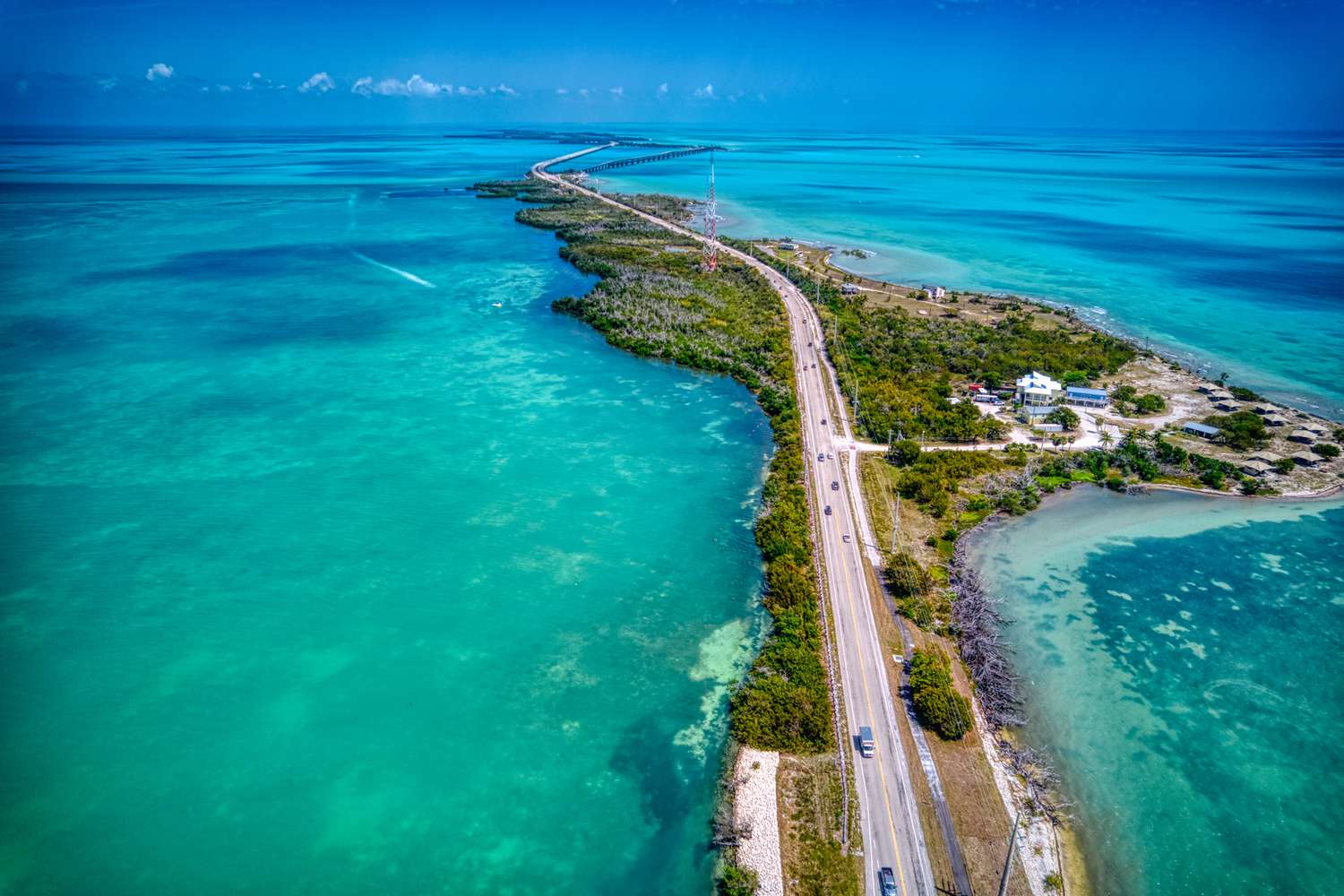
I point the car south from Miami just after sunrise, tossing my scuba gear into the back before pulling onto U.S. 1, Florida’s Overseas Highway. The city fades quickly in the rearview mirror. By the time I reach Key Largo, the air feels heavier with salt, softened by humidity, and the light sparkles on the water. As the mile markers count down, Old Florida sharpens into focus. Strip malls and snorkel shops thin out, turquoise water flashes brighter, and soon the highway becomes a series of bridges, skimming low over flats so shallow I can see stingrays ghosting beneath the surface.
You could make the 113-mile drive in a few hours. But that would miss the point. With 42 bridges stitching together a coral kingdom of islands, the Overseas Highway rewards slowing down, pulling over, and following curiosity wherever the water looks bluest.
I’ve driven these islands many times, usually chasing the sea. This summer, I set out again with fins, a mask, and a regulator riding shotgun, letting the Keys’ wild places—reefs, mangroves, beaches—set the pace, and filling in the gaps with places that feel rooted rather than flashy. I roll the windows down, cue up Jimmy Buffett, and let the Keys work their spell.
Key Largo
lucky-photo/Adobe Stock
I pull into the Bungalows Key Largo. A former trailer park reborn as a lush adults-only retreat, it’s a place of private verandas, plunge tubs, outdoor showers, and just enough Hemingway-era romance. With six bars and restaurants and a fleet of catamarans at the ready, it’s dangerously easy to never leave, but my eyes pull offshore, where John Pennekamp Coral Reef State Park protects the first undersea park in the United States. Beneath the surface, coral heads bloom like cities. Gear dropped, I head for the state park and my boat escort. The visibility, 80 feet, maybe more, highlights the schools of blue tang and parrotfish grazing on the reef as I fin past, making my way to the Christ of the Abyss, arms raised in quiet benediction. It’s one of the few places in Florida where the reef still feels alive and resilient, and surfacing here always leaves me both exhilarated and humbled. Above water, mangrove trails and tropical hammocks frame the park’s conservation legacy, dating to the 1950s. Glass-bottom boats gliding along the surface reveal sea turtles, Goliath grouper, and elkhorn coral to travelers who don’t want to get wet.
Back on shore, I linger over the cracked conch Benedict and massive Cuban coffee at the Key Largo Conch House, before checking out the REEF Ocean Exploration Center, which opened in 2025. Inside, a floor-to-ceiling reef sculpture showcases dozens of native fish species I recognize from my dives. Volunteers talk about fish surveys and citizen science, how everyday snorkelers help protect the ecosystems they love. Every Thursday at John Pennekamp, REEF hosts free fish ID talks—45 minutes that will change how you snorkel forever. And the best part? Everything they do, including the center, is free to the public. I close out the evening with a Florida spiny lobster roll at Key Largo Fisheries, looking out over the water, before making my final stop, a cocktail at The Armory Speakeasy at the VFW Post 1021, where a rotating password gets me in for one of their legendary key lime pie martinis.
Islamorada
THEPALMER/Getty Images
As I drive south into Islamorada, the road presses closer to the water. At the History of Diving Museum, I trace 4,000 years of underwater exploration through antique helmets and early scuba gear. It’s impossible not to feel grateful for modern regulators as I step back into the heat. A few miles away, at Robbie’s of Islamorada, massive tarpon erupt from the water in a spectacle that blurs the line between nature and performance, their silver bodies flashing as pelicans hover overhead.
Each evening, Morada Way Arts & Cultural District comes alive. Galleries, wine bars, and live music have transformed a once-sleepy stretch into the Keys’ closest thing to a main street outside of Key West. I grab a taco at Jalisco Taco Truck and a pint of Spiny Hopster, a juicy IPA, from Florida Keys Brewing Company to enjoy while listening to live music playing in the palapa. For the night, I check into Pines & Palms Resort, a cluster of 1930s oceanfront cottages refreshed by HGTV’s Bryan and Sarah Baeumler. With breezy porches, a tiki bar, and complimentary bikes, it feels like Old Florida—with better sheets.
Marathon & Big Pine Key
xbrchx/Getty Images
The drive into Marathon always leads to Fish Tales Market & Eatery, where I never miss the Johnny’s Rambler (catch of the day on grilled swirled rye) sandwich and homemade limeade. I can’t resist taking a container of conch chowder and key lime pie to fuel my exploration. This is a working section of the Keys, defined by marinas, bait shops, and weathered docks. I spend an afternoon at the Turtle Hospital, watching rescued sea turtles glide through rehab pools, some missing flippers, others bearing scars from boat strikes. It’s the world’s first state-licensed veterinary hospital devoted solely to sea turtles, and the tours are moving, educational, and worth every minute. Before sunset hits, I roll into Keys Fisheries for the legendary lobster reuben, a dish so popular it has its own sign with a counter (my order was number 418,581 in June). With a little cooler of Key West pink shrimp and a slice of rum cake secured for dinner, I head to adults-only Little Palm Island Resort for a fantasy stay on North America’s only private island resort.
Back on the road south, Key deer step lightly through the brush, unfazed by cars or cameras as I pass through Big Pine Key. Life feels quieter here, shaped by tides and pine rockland forests. Not far away, Bahia Honda State Park delivers one of the most iconic scenes in the Keys. I stand beneath the rusting arches of the old Bahia Honda Bridge—once part of Henry Flagler’s Overseas Railroad—and look out over water so clear it hardly seems real. Snorkelers drift over seagrass beds, paddlers skim the shoreline, and three sugar-soft beaches make it easy to lose track of time.
I refuel at Good Food Conspiracy, a natural café beloved for smoothies and turmeric shots. Then comes the stretch of road I always anticipate most. The Seven Mile Bridge unspools ahead of me, a ribbon of asphalt suspended between sea and sky. To my left, the Old Seven Mile Bridge, listed on the National Register of Historic Places, runs parallel, weathered and historic, leading toward Pigeon Key. On other trips, I’ve taken the train out to learn about the construction of the “Eighth Wonder of the World,” the Florida East Coast Railway, and toured restored buildings that reveal the lives of the workers who built it. But this time, I slow to pay quiet homage to Fred the Tree, improbably growing straight out of concrete on the abandoned span, before moving on to Key West.
Key West
Taylor McIntyre/Travel + Leisure
Roosters crowing from front yards signal you’ve made it to Key West before a welcome sign comes into sight. Bikes outnumber cars, and history layers itself into every block. I beeline for 5 Brothers Grocery, an unassuming house-turned-deli serving the best bites in Key West, in my opinion, since 1978. The Cuban sandwich is perfect, but it’s the bollos—garlicky black-eyed pea fritters—that steal the show. Belly full, I check into La Concha Hotel, the pink grande dame where Hemingway once wrote. Dinner takes me to Stock Island’s Hogfish Bar & Grill, hidden behind a marina. Pink shrimp, Bahamian conch ceviche, fried hogfish, and piña colada bread pudding taste like the Keys in edible form.
Breakfast calls for Moondog Cafe & Bakery. It’s always a tough choice because everything here sings with flavor, but I settle on the shakshuka, knowing I will load up at the pastry case on the way out. Between meals, I wander through the Hemingway Home and Museum, where six-toed cats sprawl across shaded porches and the writer’s studio still hums with creative energy. Later, I slip away from the crowds to paddle the mangrove tunnels off Stock Island with Lazy Dog Adventures. The air is hushed, the water glassy. Upside-down jellyfish pulse beneath my kayak, and mangrove roots stitch land together, holding the island in place.
At dusk, the whole town gathers at Mallory Square. Street performers tune up, artists set out their work, and strangers lean shoulder to shoulder as the sun sinks into the Gulf for another Sunset Celebration. Applause erupts—not for anyone in particular, but for the simple fact of being here, together, at the edge of the country.
On my final day, I head back out onto the water one last time. Some visitors push farther still, boarding seaplanes to Dry Tortugas National Park, where Fort Jefferson rises from impossibly blue water like a mirage. Others dive the Vandenberg, a massive former military ship turned artificial reef now draped in coral and schooling fish, or swing by the Southernmost Point for a photo with the iconic buoy. I opt for a sunset sail with Danger Charters instead, the sky bleeding orange and pink as Key West recedes, the captain blowing the conch as we lift a rum punch to one final day in paradise, hoping for that legendary green flash. The Keys don’t feel like a place you finish, so much as one you carry with you—salt still on your skin, dive gear drying in the trunk, already planning your return.
Read the full article here