


The first signs of the river were the volcanoes, armored with ice. I saw them from the plane as I was flying down from Quito, Ecuador’s high-altitude capital, into Amazonia, that vast region of rainforest, spread across nine countries, that is drained by the Amazon River and its tributaries. The glaciers of Cayambe, Antisana, and Cotopaxi are the sources of one of those tributaries—the Río Napo. From the sky their Andean summits floated by at eye level above the cloud cover. Like us, they seemed detached from the earth below: ethereal, almost unreal.
Misha Vallejo Prut
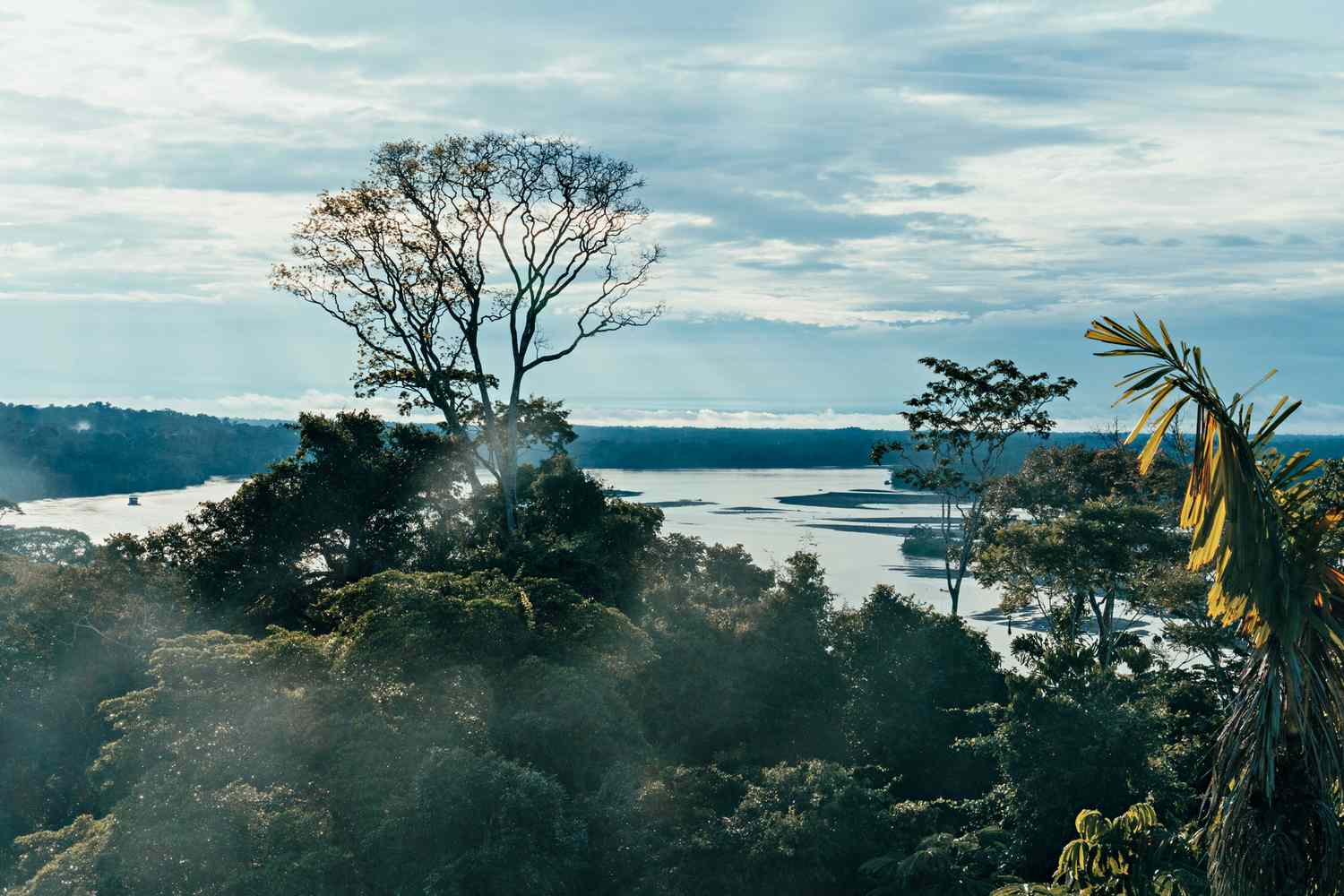
Forty minutes later, having descended a mile and a half in altitude from the Andes to the jungle, I stepped out at the airport in Coca, a city on the Río Napo, in northeastern Ecuador. The air was heavy and scented, as in a greenhouse. I was heading downriver for a week on the Anakonda, a luxurious riverboat that takes travelers to some of Ecuadoran Amazonia’s most remote stretches, along the border with Peru. On my first afternoon aboard, I found my favorite perch—the wheelhouse—where I would sit with the pilot, Angel Abarca, and watch the panorama of this wide, generous river unfold as it carried us deeper and deeper into the forest.
Misha Vallejo Prut
Just a few miles outside of Coca, we entered territory that lies beyond the reach of roads. There, everyone comes and goes on longboats that have awnings, a row of rudimentary seats, and a small outboard motor. Along the banks, the giants of Amazonia, the sentinel royal palms and the colossal domed kapoks, rose above a confusion of trunks, reeds, and trailing vines. The waterside trees leaned far out over the currents, almost toppling into the river, as if being pushed by the exuberant growth at their backs. There are 881 native tree species in the whole of the continental U.S.; in Amazonia, there are more than 16,000. There were times on this trip when all of them seemed to be crowding the banks at once.
Misha Vallejo Prut
At day’s end, Abarca pointed the bow toward the shore. The boat seemed to sigh as we nosed onto a mudbank. A crewman waded through the shallows with a rope over his shoulders, which he lashed around a tree trunk. Abarca cut the engines, and a chorus of nun birds rose from the forests. I stepped out onto the open deck. In the late afternoon light, the forest leaves were luminous. A little way down the bank, a hoatzin flapped awkwardly in dense foliage. This archaic-seeming, almost mythical species is thought to be a relic from the age of dinosaurs: its young are born with two claws on each wing that enable them to climb trees. Elsewhere, swallows flashed across the surface of the water. White egrets stood in the shallows, a woodpecker knocked somewhere nearby, and pairs of green parrots flew upstream, beating their wings in time.
Misha Vallejo Prut
Named for the world’s largest snake, the Anakonda has the air of a Mississippi riverboat, minus the paddle wheels and the linen-suited gamblers. Its story reminded me of Carlos Fitzcarrald, the rubber baron who had a boat hauled over a mountain, from one river to another, in the 1890s. Anakonda’s steel hull was built in Quito, then cut into 10 pieces and painstakingly transported some 220 miles by truck on difficult roads before being reassembled in Coca. In some of the tunnels that cut through the mountains, there were only a couple of inches to spare on either side of the loads.
Compared with the humble communities scattered along the banks of the Río Napo, life aboard the Anakonda was an embarrassment of riches, a floating oasis of air-conditioned comfort and chef-designed menus, pampering spa treatments and cocktails. The boat has 16 cabins, all with balconies. There is a roof deck with a hot tub, a bar for evening gatherings and nature presentations, and a hammock in the bow for those with a taste for traditional Amazonian travel.
Misha Vallejo Prut
I was traveling with Raúl García, owner of the Anakonda and its smaller sibling, the Manatee. Now in his sixties, García reminded me of Humphrey Bogart’s captain in The African Queen: a man without airs, self-deprecating, an old cap on his head. On the Napo, everyone knew him. An Ecuadoran, he had been on the river for more than 40 years and had come to love the place and its people. “I want to make a contribution to the lives here,” he said simply. “And to the conservation of these forests. If we can bring income to these communities, they can afford to preserve the forests.”
The Napo is home to small communities of Kichwa people, whose ancestors came down from the Andean highlands centuries ago. Their scattered houses peeked through leaves along the banks. Built of weathered planks and raised on stilts, they presented curious images of domesticity in this wild place—a line of laundry, a dog, children calling, a canoe drawn up on a mudbank.
Misha Vallejo Prut
Deeper into the forest, up narrow tributaries, live Indigenous people: the Huaorani, the Secoya, the Cofán, hunters and fishers with their blowpipes padding silently through Amazonia like ghosts, keeping to a traditional way of life. But for most of this trip, it was the emptiness of the forests that was compelling: mile after mile of tangled jungle with little evidence of habitation. In many places, the prints of jaguars were more common than those of people.
We climbed a freestanding canopy tower, some 120 feet up, to watch spider monkeys dancing through the treetops. They paused only to peer at us through the leaves as if they had never seen anything quite so strange.
Every morning, I would set off with my guide, Erik Camacho, who is a native of the Amazon, in a motorized canoe to explore a different part of the forest while the Anakonda chugged slowly downstream. Any hike in Amazonia becomes a series of narratives: every tree, every plant, every insect has a story. We followed trails to a clay lick where scarlet macaws gathered, a cascade of spectacular flapping plumage. They go there to soothe their upset stomachs; apparently the minerals in the clay counteract the alkaloids of many Amazonian fruits. We climbed a freestanding canopy tower, some 120 feet up, to watch spider monkeys dancing through the treetops. They paused only to peer at us through the leaves as if they had never seen anything quite so strange. We went on a night walk where insects and birds were theatrically spotlit in the beam of a flashlight—an enormous caterpillar covered in fur like a shag carpet; a mouse opossum, its bulging clown eyes transfixed by the light; tarantulas the size of my hand, including one species that ate birds and another that sported glamorous pink toes; an emerald-green monkey frog that slowly climbed the sleeve of Camacho’s jacket like a mountaineer.
Misha Vallejo Prut
We went in search of caimans in the shallows. Camacho gamely snatched one from the water, showing me its extraordinary teeth before releasing it again. We found a huge anaconda coiled on a mudbank, probably 16 feet long and as thick as a man’s thigh. British explorer Colonel Percy Fawcett, who wandered the Amazon for 22 years at the beginning of the 20th century before vanishing without a trace, wrote that the breath of the anaconda stupefied its prey. I imagine if you are close enough to smell the great snake’s breath, you are already stupefied with fear.
With the help of Camacho’s encyclopedic knowledge, I began to see the forests as an old-fashioned general store whose inhabitants could find everything they needed—reeds that are perfect for blowpipe arrows, leaves that are boiled for dye, the bark of the canalete tree that can treat malaria, the tall slender chambira palm whose fibers are worked for hammocks and rope. One afternoon Camacho paused on a trail and stripped the shoots of the duroia tree to reveal tiny ants living inside. These are an Amazonian snack, he said, and showed me how to lick the green shoot like a popsicle. The ants, tasting of lemon, were delicious.
Misha Vallejo Prut
One of the first outsiders to arrive in Amazonia was the conquistador Francisco de Orellana, who sailed to the New World from Spain in the 1520s and traveled from Quito to the Río Napo around 20 years later. He is still a famous figure on this river; the eastern province through which the Napo flows is named for him. He led an expedition of 200 Spaniards and 4,000 Indigenous attendants in search of La Canela, the mythical Land of Cinnamon. He was to be disappointed: there was no cinnamon in the Americas. In the end, he hoped only to get out of Amazonia alive.
By the time the expedition reached the mouth of the Río Aguarico, a tributary of the Napo near the present-day border with Peru, Orellana had lost two-thirds of his men to starvation, disease, and attacks from the Native population. His behavior became increasingly erratic; the remaining men realized that he was also losing his mind. Unable to turn back against the strong currents of the Napo, the party, now reduced to just 50, carried on downriver toward the Amazon. They eventually traveled 2,000 miles farther along the river’s entire length, crossing the whole continent of South America. When they arrived at the river’s mouth and the Atlantic Ocean more than a year later, they were depleted and exhausted. For Orellana and his men, it was the end of a nightmare. For the Indigenous peoples of Amazonia, it was the start of one.
Misha Vallejo Prut
The conquistadors were the first in a long line of outsiders lured by Amazonia’s natural riches. In the 16th century, the Spanish and Portuguese went looking for gold and silver. In the early 20th century, European rubber barons enslaved Indigenous people to harvest the valuable gum. By the end of that century, deforestation had become the Amazon’s critical issue. Of Amazonia’s 2.3 million square miles, it is estimated that roughly a quarter, nearly 350,000 square miles, was deforested between 1960 and 2023, chiefly to make way for mining and agriculture. In the 21st century, oil extraction has become a serious threat to Ecuadoran Amazonia, with large swaths of forest, often located in Indigenous territories, despoiled by the release of wastewater from the wells.
Forests are the lifeblood of Amazonian communities. Along the Río Napo, Kichwa villages have organized themselves into “eco-communities” committed to conservation and sustainable practices, with the aim of providing economic alternatives to oil and timber extraction. At the Sani Isla community, a women’s collective maintains craft traditions like pottery, jewelry, and weaving; produces coffee and artisan chocolate; and runs a conservation program for endangered charapa river turtles—all efforts to generate income without destroying the 50,000 acres of forest under its stewardship.
Misha Vallejo Prut
My visit to Sani Isla had a learning curve. Camacho exploded with excitement when we spotted a pygmy marmoset, the world’s smallest monkey, high in a tree. I learned that the live larvae of the chontacuro beetle are delicious, rather like gnocchi but more wriggly—provided you bite off their heads before chewing them, and wash them down with chicha, a sour, frothy beer made from the juice of the yuca plant. I discovered that I am hopeless with a blowpipe and that my ineptitude, as the Sani women politely informed me, meant I would never be able to find a wife in Kichwa society. I blamed the chicha.
On the fifth morning of my trip, García and I set off downriver with a guide and several of the Anakonda’s crew in a canoe with a small mountain of camping gear and supplies. We were making an excursion to the Río Aguarico, the intended destination of Orellana’s doomed expedition. García had arranged to meet a chief of the Cofán people, contacting him in advance on a mobile phone his grandchildren help him operate.
Misha Vallejo Prut
The Cofán’s fate is emblematic of that of many of the Amazon’s Indigenous peoples. Before the arrival of the Spanish, they were a considerable nation, rivals of the Inca. By the early 20th century, after several centuries of rape, disease, enslavement, and land confiscation by colonizers, rubber barons, and loggers, their numbers had been reduced to 300. (Today the size of the community is estimated at around 2,000.) In the 1930s, American oil companies arrived in Cofán territory. By the 1960s, gas flares and untreated waste spillage were destroying their forests. In a class-action suit, originally launched in 1993, the Cofán accused Texaco of dumping 18 billion gallons of oily wastewater across their ancestral lands between 1964 and 1990. In the 2000s, the case transferred to Ecuadoran courts, where it still rumbles on.
Misha Vallejo Prut
The day was overcast, the river slate gray, and the sky bruised-looking as García and I passed rafts of vegetation and islands thick with trees. The pendulous nests of weaverbirds, two feet long, hung like decorations from the trees along the banks. At the mouth of the Río Aguarico, we turned upstream. The Aguarico marks the national border: Ecuador on the left bank, Peru on the right. Both sides of the river were identical—banks of dense forest with no sign of habitation, let alone border control.
Misha Vallejo Prut
A few miles upriver, we came to an isolated ranger station. Three Cofán—an older man and his two young attendants—were waiting for us on the bank. In the first moment they seemed like apparitions, people from another time emerging from the trees in their feathers and necklaces of jaguar teeth. When we came ashore, they greeted us shyly, nodding and shaking our hands. They spoke Spanish haltingly. The older man, Chief Carlos Yiyoguaje, came forward and embraced García. They have known each other for 40 years.
Their presence had shifted something, some understanding for me. I realized these people were our hosts in this place. They are among the original inhabitants of Amazonia, there before the Spanish, before the Kichwa settlers from the highlands, before the loggers and the oilmen. Their lives, their beliefs, their worldview—everything about them was shaped entirely by these forests.
Misha Vallejo Prut
The Cofán were welcoming hosts. They asked about our trip, if we had encountered river dolphins or the strange hoatzin birds, if we had seen anacondas or caimans. They enjoyed our excitement, our observations, about their world. As we sat on the bank with them, a curious bond developed between us, a shared enthusiasm about the wonders of Amazonia.
Our Cofán friends were nothing if not dashing. They wore blue smocks, with long strings of beads crisscrossed like ammunition bands, knotted red kerchiefs, elaborate necklaces, and chest plates made of jaguar teeth. Yiyoguaje sported a spectacular headdress of layered feathers that cascaded down his back, blue and pink, green and yellow, topped by three long macaw feathers standing up like spears. The decoration and style of their dress came to them in dreams under the influence of ayahuasca, one of the younger men explained, because everything should have a meaning, a significance, beyond mere decoration.
Misha Vallejo Prut
For these men, we were rare outsiders. We had no designs on their lands. We were not looking for anything, beyond the joy of experiencing Amazonia. They discussed with García the idea of a lodge and the possibility of guests from the Anakonda. It would provide their tribe with a sustainable income without destroying their forests.
After a time they rose to leave. They had a long journey home: their territories lay four or five hours up a side tributary, the Río Cocaya. They offered salutations, then climbed down the bank to their canoe and started homeward, the boat swinging out into the current. They waved, the bright colors of their dress standing out against a wall of green. Then they disappeared around a bend, and were gone.
Misha Vallejo Prut
We camped overnight on the riverbank, each of us in a small tent equipped with a mattress, a duvet, and a reading lamp. Darkness came suddenly, as if it were a curtain drawn by the Orinoco geese that flew honking upstream at dusk. A table was laid for dinner—white linen and folded napkins, wineglasses and a lantern. All the pleasures of the Anakonda had come with us to this remote place. As the warm dishes were served, I thought fleetingly of Orellana, somewhere in these parts, starving, ill, worrying about the loyalty of his men.
It rained in the night, a gentle patter on the canvas. I lay awake for a while, listening to the chorus of cicadas and the growl of bullfrogs, and thinking what an honor it was to be there.
Misha Vallejo Prut
In the morning, tribes of howler monkeys were whooping, several miles off. As we sat at breakfast, pink dolphins rose in the Río Cocaya. Then we piled into the canoe and set off downriver, back to the Anakonda, and I had the delight—really my favorite part of this trip—of simply chugging up that wonderful river and drinking in the unfolding panorama of its forested banks.
Eight-day trips on the Anakonda with Steppes Travel from $6,320 per person.
A version of this story first appeared in the February 2026 issue of Travel + Leisure under the headline “A Passage to Amazonia.”
Read the full article here