


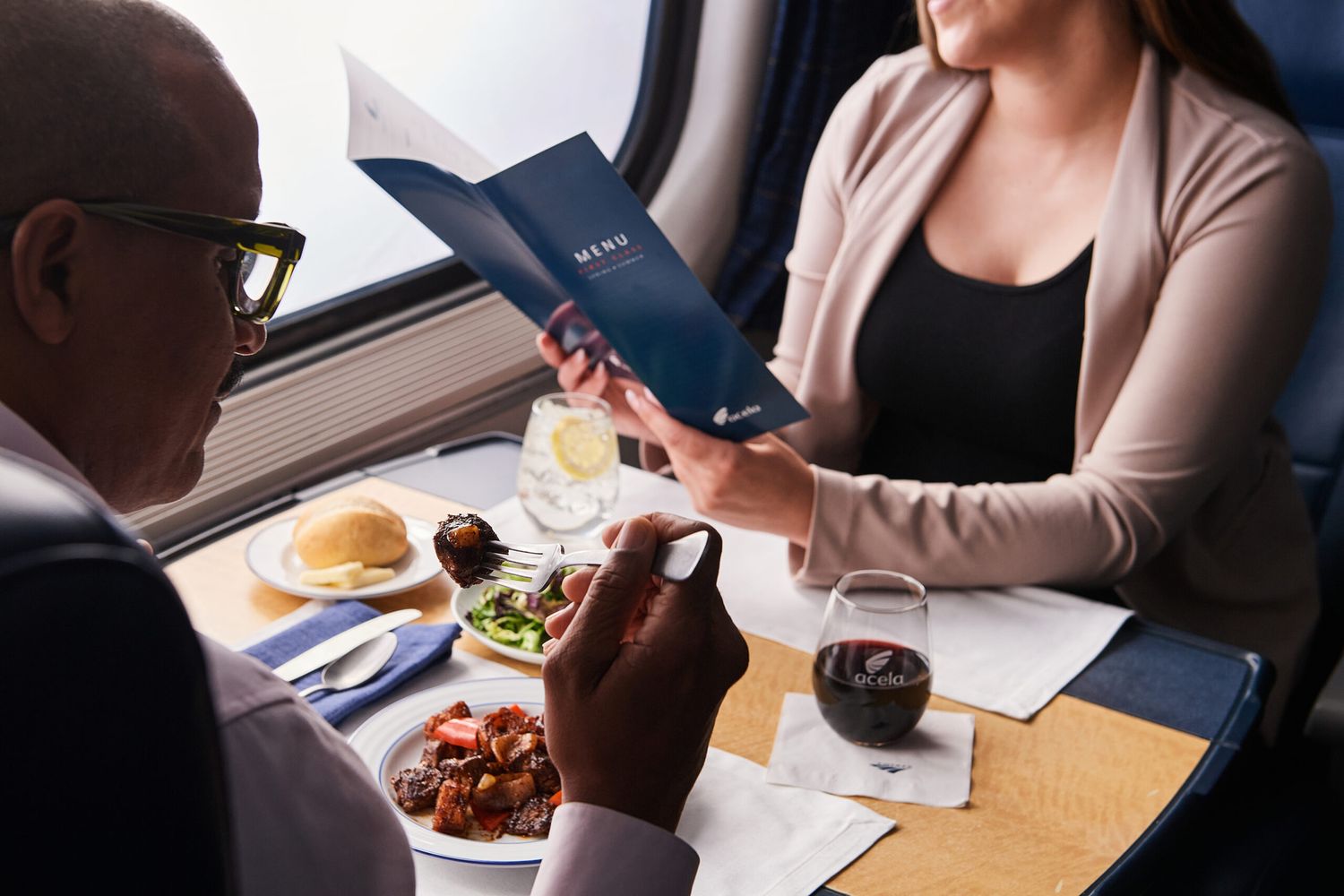
- Train kitchens face unique challenges like space constraints, vibration, and safety regulations, requiring specialized equipment and planning.
- Amtrak chefs cook meals onboard for long-distance routes, while other experiences, like Japan’s “52 Seats of Happiness” train, focus solely on dining in motion.
- Some rail operators, like Great Journeys New Zealand, use custom-built kitchens and airline-style trolleys to serve restaurant-quality meals on the move.
One of the reasons why train travel is so popular is that the journey to the destination is often just as memorable as reaching it. Views from the passenger car often linger in our memory, and more often than not, so does the food.
Many passengers assume that train food comes from prepackaged sources, but the meal arriving at your train seat or table could have been prepared hours earlier at a commissary or even cooked to order by a chef onboard. Train dining has significantly evolved from the era of vending machine snacks. Now, rail operators invest in specialized equipment, source from local suppliers, and develop menus months in advance.
Here’s how food is cooked on board trains.
Freshly cooked meals on Amtrak
Amtrak
There are a multitude of restrictions when it comes to what can and cannot be served on trains. Amtrak chefs are not allowed to boil water on the stove for safety reasons, and all food-preparation equipment has to be firmly secured in place. In fact, all of the kitchen equipment has to be certified for onboard use by the Federal Railroad Administration.
On Amtrak’s long-distance routes, food for First Class passengers is prepared on board by chefs in the galley. But First Class meals on the high-speed train Acela take a different approach. Meals are prepared off the train, then reheated on board before service, according to Amtrak. Not all meals are necessarily gourmet, though, and some regional café services rely largely on preprepared items, with a few hot items such as hot dogs or macaroni and cheese.
Japan’s open kitchen train cars
On Japan’s “52 Seats of Happiness” train, eating is the main highlight. On this traveling restaurant between Tokyo and Saitama, passengers can watch their meals being prepared in real time.
Nobuhiro Mori, Seibu Railway Company’s transportation department supervisor, says that staff precut ingredients before bringing them onto the train. “Onboard, our staff cook in the open kitchen in car No. 3, where final preparation and plating take place,” Mori says. “This allows us to serve hot dishes hot and cold dishes cold.”
The open kitchen is located between two dining cars and gives passengers a front-row view of the cooking experience, along with its challenges. “Because meals are prepared and served while the train is in motion, the environment presents unique challenges such as vibration and limited kitchen space,” Mori says. “Extra care is required when plating and finishing dishes, especially when handling hot food.”
New Zealand’s Custom-built Kitchen Cars
Toni Greaves/Getty Images for Lumix
Train operator Great Journeys New Zealand faces similar hurdles on its Scenic Plus service. “Serving restaurant-quality meals on a moving train comes with unique challenges, space constraints, timing, vibration, and constant motion, but that’s also what makes it so rewarding,” says Tracey Goodall, an executive at Great Journeys New Zealand.
To make things easier, there is a custom-built kitchen carriage with ovens, refrigeration, coffee machines, dishwashers, and stainless steel prep benches.
“Every element of the kitchen is designed for movement. Cupboards, fridges, and drawers are fitted with clasps and locks, so nothing shifts while the train is in motion,” Goodall says. The team then uses airline-style trolleys to transport meals safely across the train carriage.
When it comes to making the menu, Olly Edwards, food and beverage manager at Great Journeys New Zealand, says that some foods simply don’t work well in the train environment.
“Certain dishes can be polarizing for guests, and anything with a strong or lingering aroma simply doesn’t work well in a shared carriage,” Edwards says. “Cheese is great, over-ripe cheeses are another example, delicious in a restaurant, but not ideal on a train.”
Menu planning often starts months in advance.
Ladanifer/Adobe Stock
Amtrak starts mocking up First Class menu changes at least six months in advance for complex recipes, while café menus take a minimum of three months to implement, according to the company. When choosing products, it aims to find items that appeal to a wide audience. However, certain dishes have earned a fanbase despite the constraints. According to Amtrak, its signature steak on its Western long-distance services gets high praise, and the beef Hebrew National hot dog in café cars has developed a social media cult following of its own.
Read the full article here