


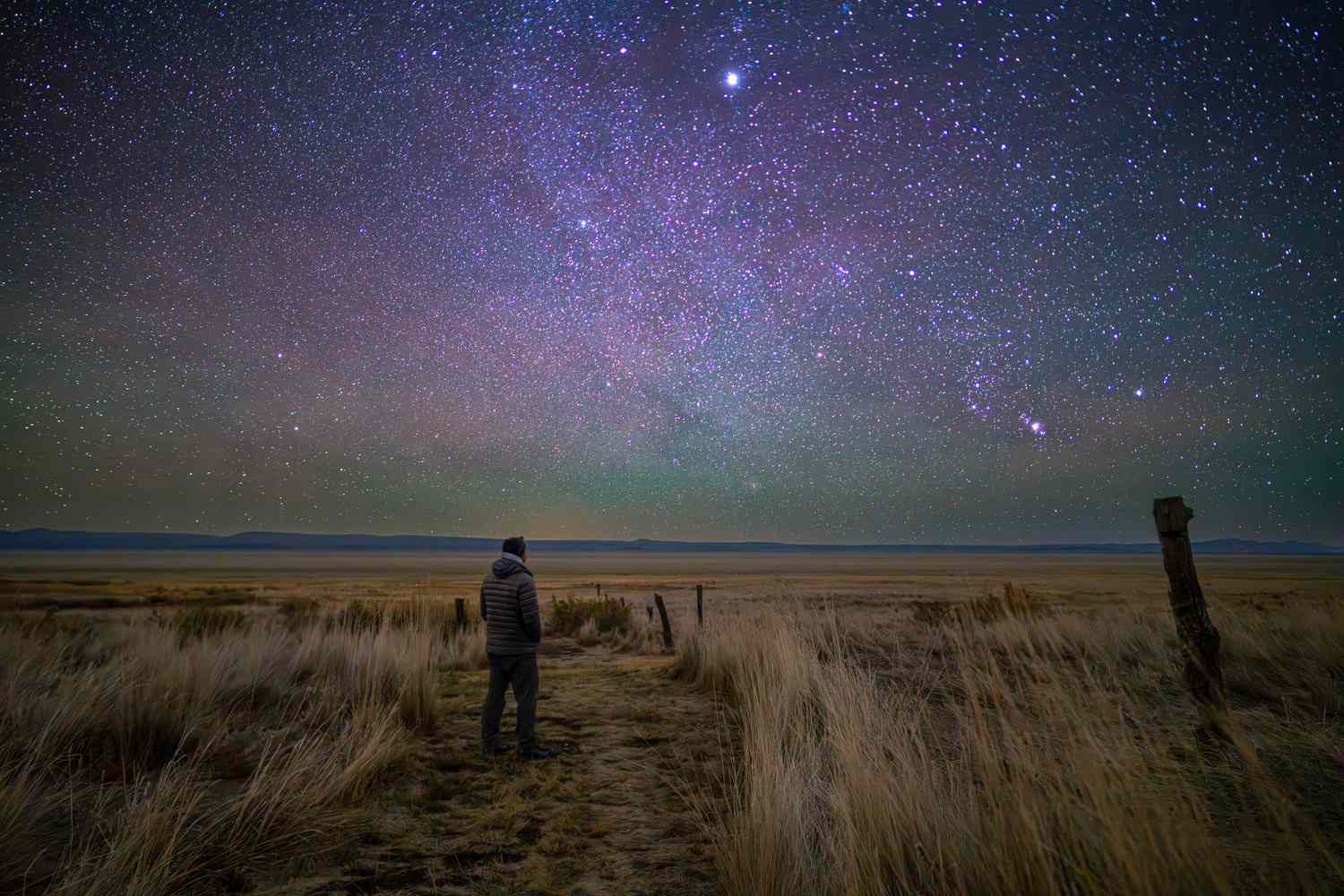
Think “Oregon,” and the state’s western woods and misty mountains likely come to mind; moss-shrouded, eternally drizzly, evocatively lush. But there is a different side of the state, literally, east of the Cascades, left parched by the rainfall-snagging high peaks. One place in particular feels like another world: the Oregon Outback.
Spanning the state’s southeastern corner, the Oregon Outback is a stretch of high desert punctuated by volcanic fissures, jagged rocks, and the odd town dating back to pioneer times. A former inland sea, today water mainly exists as seasonal wetlands, gurgling geysers, hot springs, and a hypersaline lake that’s saltier than the ocean. It’s rugged and remote, with few roads cutting across the expanse and herds of pronghorn antelope and bighorn sheep roaming freely. But as dramatic as the landscape is by day, it’s arguably even better at night.
That’s because the Oregon Outback is home to the world’s largest International Dark Sky Sanctuary, encompassing around 2.5 million acres of Lake County. Thanks to a lack of light pollution, low population, and limited rainfall and tree coverage, the region has the perfect recipe for clear, untouched dark skies ideal for stargazing.
“Few people are unchanged after seeing a dark sky like that,” says Jeannie D’Agostino, a naturalist guide for Bend, Oregon-based Wanderlust Tours, a company that offers stargazing tours at Fort Rock State Natural Area. “It’s a magical place.”
Since the designation was achieved in 2024, more and more people, from astrophotographers to outdoor enthusiasts, have found their way to this far-flung corner of Oregon, drawn not just by the dark sky but the opportunity for wild adventures in the backcountry and the feeling of being truly off-grid.
“You get all different kinds of people coming out here,” says Bob Hackett, the executive director of Travel Southern Oregon. “It’s a wonderful thing to share.”
And this is the start; the Oregon Outback International Dark Sky Sanctuary is still growing, hoping to reach more than 11.4 million acres. But no need to wait; it’s magical to visit as it is now.
Here’s what you need to know before planning a trip to the Oregon Outback.
Best Things to Do
Joey Hamilton
Naturally, stargazing and astronomy-focused outings are a must here—you can take a guided tour like those offered by Wanderlust Tours or go it alone. As for the best spots, pick anywhere; the sky is literally the limit. The Hart Mountain National Antelope Refuge and the Alvord Desert playa in neighboring Harney County are two nice spots, but any place away from lights and with clear views will do.
“You have lots of open land to choose from,” says D’Agostino, who reminds travelers to be respectful of private property and aware of their own light pollution by avoiding bringing white lights.
A few other logistics to consider: some places, like Fort Rock, require filling out a free stargazing permit application. Hackett reminds stargazers to check the moon cycle and recommends using a vehicle that can handle gravel roads to get around. All seasons offer good stargazing odds; winter has shorter (but colder) days for more after-dark hours, but Hackett adds the caveat that some areas may be inaccessible due to snow, even late into the spring.
Don’t stay up too late, though; there’s plenty to do by day as well. Drive along the 171-mile Oregon Outback Scenic Byway to points of interest like the petroglyphs at Picture Rock Pass and Old Perpetual, Oregon’s only continually erupting geyser (it shoots 200-degree Fahrenheit water 60 feet into the air every 90 seconds). At Fort Rock, you can hike through an ancient volcanic tuff or tour a cave where Indigenous artifacts were once discovered. The hypersaline Lake Abert is a birding haven, drawing tens of thousands of feathered friends with its brine shrimp and alkali flies.
For hikers, there’s no shortage of options; you can walk through a two-mile volcanic fissure at the Crack-in-the-Ground, trek to cirque-cradled lakes and oasis gorges in the Steens Mountain area, or try out tracts of the Oregon Desert Trail. Cyclists can have a field day on the 90-mile Scenic Bikeway, and the Christmas Valley Sand Dunes has ATV thrills. Depending on the season, you can even go hang gliding off the Abert Rim near Lakeview—dubbed the “Hang Gliding Capital of the West”—or skiing at Warner Canyon Ski Hill.
At day’s end, you can soak sore feet and tired muscles at any number of natural hot springs, like the Alvord Hot Springs Bath House & Campground, Crane Hot Springs, and Antelope Hot Springs.
Where to Eat and Drink
Jak Wonderly/Travel Southern Oregon
Most dining options are concentrated in small towns rimming the Dark Sky area, like Paisley, Lakeview, Christmas Valley, Burns, and Fields.
Housed at an old cattle drive stop, the Cowboy Dinner Tree offers a taste of the Old West with its hearty frontier fare like whole-roasted chickens and gigantic, juicy sirloin. It’s a cook-to-order joint, so advance reservations are required, and the restaurant only accepts cash. In Lakeview, grab burgers, fries, and hot dogs at the Burger Queen Drive-In and diner-style breakfasts at Tall Town Café & Bakery. Over in Fields, pop into the pink-hued Fields Station General Store, which has been around since 1881, for the famed milkshakes.
And don’t forget to pause in Paisley for drinks at the Pioneer Saloon, said to be the oldest continuously operating bar in Oregon. The Wild West-esque watering hole opened its doors in 1883 and has been slaking customers’ thirst ever since.
Where to Stay
As both Hackett and D’Agostino note, the Oregon Outback is really remote, so services can be far between, and tourism infrastructure is limited. Campers and RVers will be in their element here, with hook-up-equipped sites like the Oregon Outback RV Park and Campground, primitive campgrounds, and BLM dispersed camping all available. But there are a few options for the non-roughing-it crowd.
Most accommodations are pretty rustic and barebones, but they get the job done. Summer Lake Hot Springs is a stand-out, with its smattering of rustic but cozy casitas and a bathhouse for soaking in indoor and outdoor mineral hot springs. Neon Cowboy Roadhouse + Hot Springs near Lakeview is another option, with simple but stylish rooms and a hot spring pool just steps from the Old Perpetual geyser. Hackett also recommends looking into Airbnbs and vacation rentals like the Summer Lake Lookout, which comes with an outdoor Jacuzzi for stargazing while soaking.
How to Get There
Joey Hamilton
There are no major airports in Lake County, so your best bet is to fly into a nearby regional airport like the Crater Lake-Klamath Regional Airport (LMT) in Klamath Falls or Medford’s Rogue Valley International–Medford Airport (MFR) and make the rest of the journey by car; the drive is just shy of two hours from Klamath Falls and over three hours from Medford. From Bend Municipal Airport to Fort Rock at the northern end of the dark sky area is a shorter 1.5-hour drive, but you’ll need to drive an additional hour or so to reach gateway communities like Paisley or Lakeview.
Read the full article here