


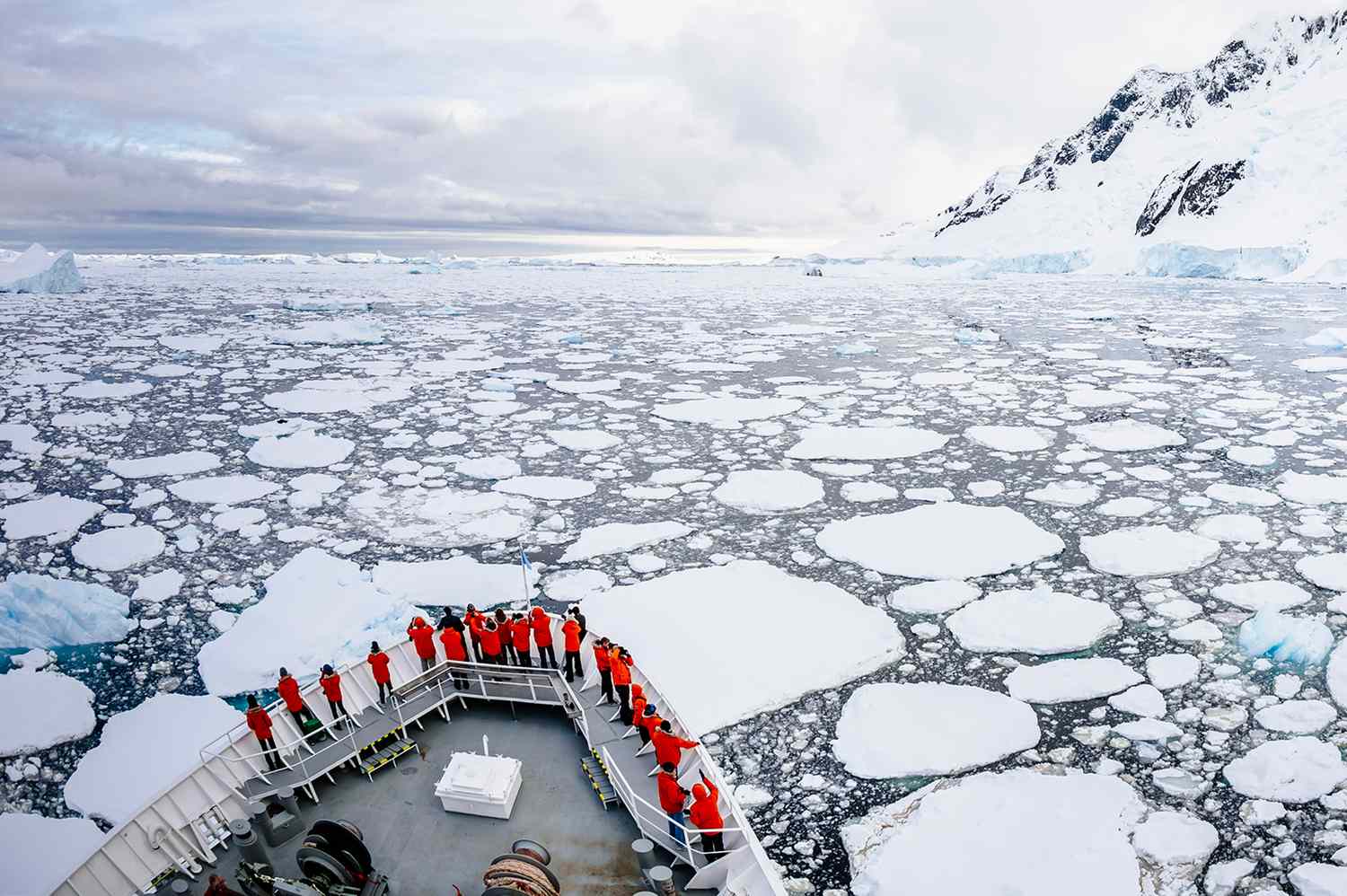
If you’re a cruise fan, it’s likely that you’ve seen the video circulating online of the United States Coast Guard (USCG) carving out an Antarctic escape route for Scenic Eclipse II, whose path was obstructed by shifting pack ice in the Ross Sea on January 17th, 2026. Guests onboard sipped champagne from the observation deck as the USCG Polar Star cleared the waters for their onward passage.
Scenic Eclipse II is a Polar Class 6 ship, a classification that indicates it’s capable of cruising during summer and autumn in medium first-year ice. In other words, through ice that’s not as thick as multi-year ice.
As you browse expedition cruise itineraries and websites, you’ll come across terms like Polar Class, often grouped under the umbrella term of Ice Class. But what does it all mean exactly?
“Ice Class is a maritime rating indicating that a ship is designed and reinforced to operate safely in icy waters, such as polar and high-latitude regions,” Claus Andersen, HX Expeditions’ Senior Vice President of Marine Operations, told Travel + Leisure.
The most important criteria for classification, Andersen continues, are hull strength and ice reinforcement, propulsion power and protection, maneuverability in ice, and the vessel’s ability to operate safely when encountering ice pressure and varying ice types.
“Importantly, the ship’s life-saving and fire-fighting equipment are also specially designed and certified for polar conditions, ensuring evacuation systems, lifeboats, survival gear, and critical safety systems function reliably in extreme cold and remote environments,” he said.
Perhaps the most common rating system you’ll see is the Polar Class (PC), the international hull strength classification regulated by the International Association of Classification Societies (IACS).
There are seven categories of polar class, ranging from PC7 to PC1, which represents the highest ice capability. The highest-rated cruise ship currently in the water is Ponant’s Le Commandant Charcot. With a PC2 rating, it can operate year-round in moderate, multi-year ice conditions. “It is capable of reaching much more remote destinations,” said Caroline Revnell, expedition cruising specialist at Audley Travel, all while offering “an incredible client experience with on-board menus designed by Michelin-starred chef Alain Ducasse.”
Lindblad Expeditions’ National Geographic Endurance was the first PC-5 polar class ship built for cruise expeditions. It can sail year-round in medium first-year ice. Sister ship National Geographic Resolution has a PC5 rating, too. Other ships to have the same classification are Swan Hellenic’s SH Minerva and SH Vega.
Most expedition cruise ships in Antarctic waters, like Scenic Eclipse II, have a PC 6 rating, including Viking Octantis and Viking Polaris, Silversea’s Silver Endeavour, Seabourn Venture, HX Expedition’s MS Roald Amundsen and MS Fridtjof Nansen, and Quark Expeditions’ Ultramarine.
Mainstream cruise lines that offer Antarctica itineraries, such as Holland America Line, Norwegian Cruise Line, and Princess Cruises, do so on ships that are not purpose-built, ice-class expedition ships.
So, why does the ice class even matter on your polar cruise? “Ice class of a ship doesn’t determine whether you can cruise to Antarctica. It determines how you experience Antarctica once you’re there,” Amy Kilbreath, founder of Port and Passport Travel, told T+L.
“Ships rated Polar Class allow captains to push into remote areas where wildlife is active, make more landing attempts, and more easily adjust to ice conditions as they change during the day,” she says.
When Antarctica’s ever-changing weather and ice flow call for a Plan B (or even Plan C) ships with stronger Polar Class ratings are often able to stay closer to the original plan when conditions change, she adds—although the experience of Scenic II demonstrates that even classified vessels can get stuck.
Meanwhile, non-ice-class ships, considered scenic, or “cruise-only” tourism by the International Association of Antarctica Tour Operators (IAATO), often have to stay on the sidelines. ‘They don’t have the same ability to push into the ice, to access more remote sites or make landings the way ice-rated expedition ships do,” Kilbreath continues.
Of course, there are trade-offs to expect on vessels with top-of-class ice classifications. Higher ice-class-rated ships are usually smaller, often with a capacity of a couple of 100 passengers only. They come with a higher price tag, less public space, or fewer amenities, such as restaurants, on board.
“One significant tradeoff is that the reinforcement of the hull for such vessels tends to create more noise and vibration compared to more conventional cruise ships,” Jason Margulies, maritime lawyer with Lipcon, Margulies & Winkleman, told T+L. “These ships go slower, too, though you’ll enjoy prolonged views of your surroundings.”
The ship you choose depends on how you want to experience these remote waters.
“Some travelers want luxury cruises to Antarctica with a side of expedition. Other travelers want a truly expedition-forward experience: camping overnight on the ice of Antarctica, kayaking in water that expedition leaders call ‘whale soup’ or standing among thousands of chirping penguins,” says Kilbreath. “It comes down to whether you want an expedition-forward luxury cruise or luxury-forward expedition cruise.”
Read the full article here