


As the helicopter dipped down around a mountain peak in the Andes, we started following the serpent-shaped clouds hovering over the Rio Palena, a river carving through its namesake valley. It was our second attempt in two days to reach Sasha’s Last Dance, a 6,000-foot-high glacier that’s about a 15-minute flight from Eleven Rio Palena Lodge in Los Lagos, Chile. A steady sprinkle of rain tapped lightly on the windshield of the single-engine AStar—the same model of helicopter that has landed on Mount Everest. It’s painted like the Magic School Bus with beetles on the door and a dragonfly along the tail.
Our pilot, Pablo, cruised closer to see if the charcoal-colored clouds were covering the mountain peak or scattered enough for us to land safely for a hike on the summit. “These valleys all have different behaviors,” said Pablo, adding that he’d give the clouds another minute. “We’ll go to those trees and see what happens.”
Lane Nieset/Travel + Leisure
Waterfalls flowed like veins through the mountains as we slowly approached, but the clouds were too low, too concentrated, appearing almost like smoke from a volcano, so we pulled back and returned to Rio Palena Lodge. When we got back, the drizzle was so faint, I took a walk along the banks of the river, which comes right up to the property. Apart from a sole fishing boat, I was entirely alone. A raft-like ferry connecting the two banks is the main access to this area of the Chilean Lake District, but I only saw it once during my five-day stay at the lodge.
While most people think of Greenland, the Galápagos, or Antarctica as getting off the grid, Patagonia, on South America’s southern tip, is so remote that the trip requires nearly 24 hours of travel. I took multiple planes, helicopters, and 4×4 rides to reach my destination. The Andes divide Patagonia into two pieces: Argentina, with its grasslands and deserts, and Chile, home to glacial fjords rivaling Norway’s and Selva Valdiviana, which is widely considered the world’s most beautiful rain forest.
The Colorado-based luxury adventure company Eleven purchased an old lodge near the Chilean town of Palena and, as the managing director Ian Wick put it, “took it down to the studs.” It was transformed into the seven-room Eleven Rio Palena Lodge, an upscale 45-acre hideaway with a wraparound terrace overlooking the Palena River, where double rooms are bookable from $4,092 per night, and private buyouts will cost you $29,730 per night, with a three or four-night stay minimum.
To reach the lodge, you fly to Chile’s capital, Santiago, connect to Puerto Montt, hop a charter to Chaitén, and, finally, drive another three hours off-roading on mostly unpaved paths.
Courtesy of Eleven Experience
Rio Palena serves as one of the only luxury bases in the area for expeditions to surrounding alpine lakes, treks on glaciers suspended below volcanoes, and white-water rafting on the Futaleufú River. The perfect base for adventuring in style, the secluded spot is attracting serious anglers with some of the world’s best fly-fishing. It also appeals to those who want to try their hand at more extreme sports like heli-skiing or hiking nearby glaciers on unnamed peaks they might be the first person to set foot on.
Around the lodge, the neighboring organic garden and greenhouse supply ingredients for private chef–prepared meals. You’ll also savor seafood from Chile’s 4,000-mile coastline and more modest fare like empanadas baked in traditional mud ovens. Nearby cattle ranches host asados, or barbecues, baking disk-shaped flatbread called tortilla de rescoldo—a staple for the Indigenous Mapuche people—under embers of an open fire to serve alongside skewered meat and vegetables a la parrilla.
Lane Nieset/Travel + Leisure
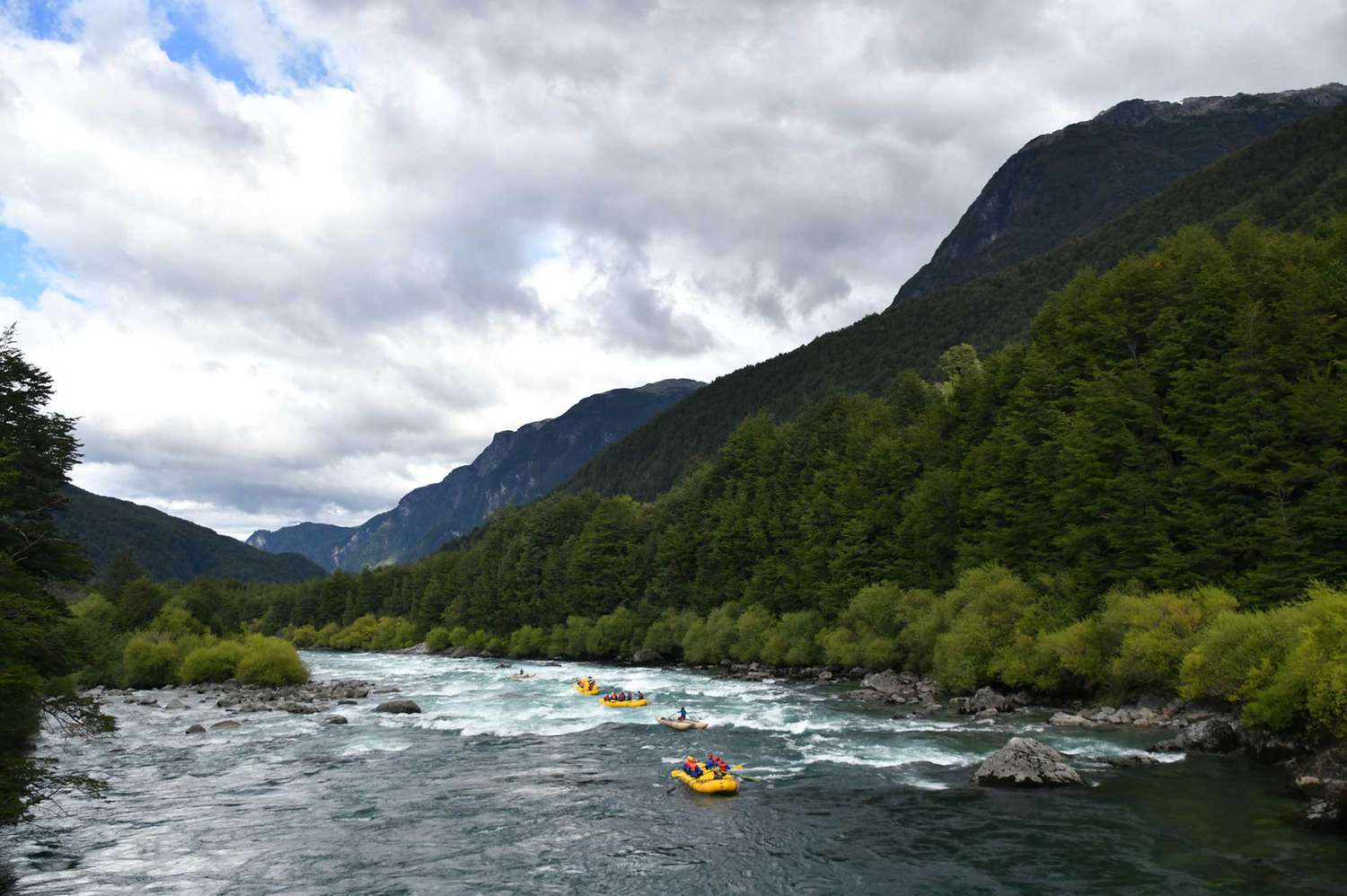
After feasting, our host, a gaucho nicknamed Nikito, spent 30 minutes toasting wheat berries over the same fire to grind and sprinkle in chicha, a fermented apple drink. We’d kayaked for three-and-a-half hours down the Rio Palena, but our guide, Andres, was just warming us up for the real deal: white-water rafting on Futaleufú. Futaleufú means “big water” in the Indigenous Mapuche language—a nod to the river’s Class IV and V rapids that hit in rapid-fire succession like a boxer’s punches.
The Futa, as locals call it, is what earned this part of Patagonia its reputation as an adventure capital. The main square of the expedition town of Futaleufú is lined with gear shops, hostels, and adventure travel companies like Patagonia Elements, Eleven’s outfitter for white-water rafting. After fueling for the morning with coffee and a homemade pastry at Café Tierra Azul, I’d visit the Futa to gear up in a dry suit for kayaking or rafting through rapids with names like Terminator and Infierno.
Given the vastness of the terrain, Eleven’s guides can lead lighter hikes through old-growth forests to nearby waterfalls or arrange ropes-assisted glacier mountaineering, if that’s more your speed. From late September through mid-November, ski guides are charting out new glacier runs and heli-skiing slopes on snowcapped summits. When you return to the lodge after a day of adventuring, two wood-fired hot tubs and a barrel-shaped sauna are warm and ready for the late afternoon ritual of après—a year-round activity here. Behind the horseshoe-shaped bar in the great room, Peru-born bartender Vicente preps pisco sours, which I sipped by the fireplace, watching as the sun set and the mountains framed a ceiling of stars.
Lane Nieset/Travel + Leisure
Each day’s expedition depends on the weather, which shifts in seconds in Patagonia. The wood-constructed Rio Palena Lodge features plush amenities like steam showers, an adjustable sound system running throughout all of the guest rooms, and complimentary, fully stocked in-room minibars, but it’s a fishing cabin at its core. Guests are geared up for activities in the basement muck room, where cubbies outfitted with wader boot dryers store rain jackets and dry suits.
“While Patagonia is a well-known destination for angling enthusiasts, the focus tends to be on Argentina,” Wick said. “Eleven’s team of local guides and expansive infrastructure allows us to provide unique access to this environment in a way that no other commercial operator has been able to achieve.”
Throughout the summer season, from early December through late March, anglers can fly-fish in alpine lakes accessible only by helicopter or on rivers where they won’t encounter another person except their guide. Itineraries can be tailored entirely around trout, with guests staying in a series of fishing lodges strategically placed near some of the best stretches of rivers and lakes, stocked with nearly every type of vessel from cataraft to jet boat.
There’s something meditative about fly-fishing. It’s similar to dating, I joked during the casting clinic on the lodge’s lawn; it’s a numbers game and requires patience. The fish bore easily, so once we progressed to the pond, we slowly sidestepped, casting in different directions and continuously switching out flies for something larger and flashier. I thought I’d bore quickly, too, but each time I tried casting, hoping to feel something tug on the fly, I was more hooked to the sport.
After a few hours in the misty rain, water gliding off my jacket and down my waders, I still hadn’t caught anything, but I didn’t feel defeated. I was ready to sit by the fireplace inside and trade in the pole for a warming glass of inky Carménère. We could try our luck again the next morning, cruising to a smaller river we’d have all to ourselves.
Read the full article here