


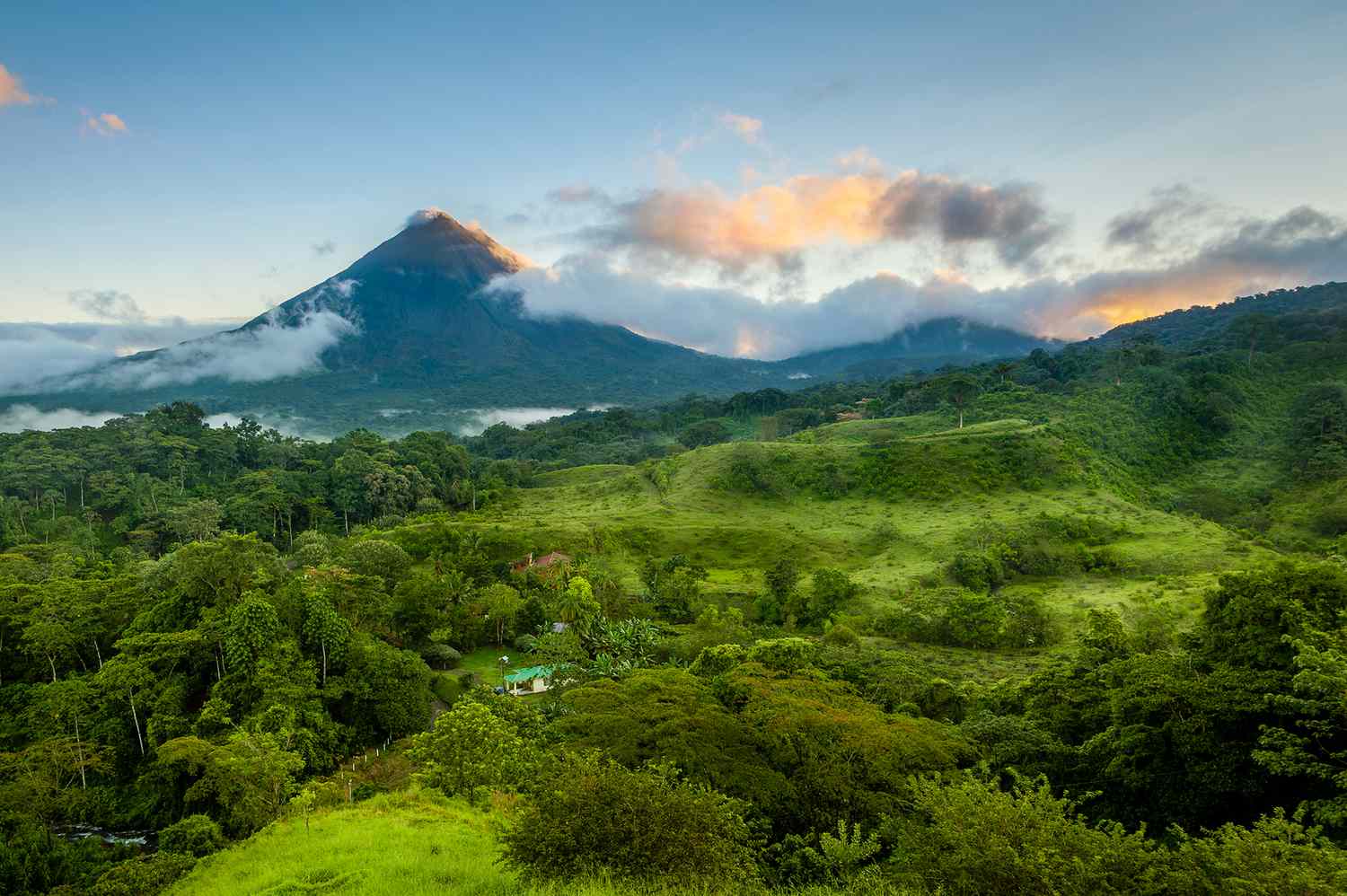
Rain forest. Hot springs. Jaguars. Active volcanoes. These different, yet related, sights are all found within the nearly 30,000-acre expanse of Arenal Volcano National Park in north-central Costa Rica. Like much of the nation, Arenal Volcano National Park is renowned for its geologic and biological complexity. It is a place where you can experience the changing landscape.
At the park’s heart is the 5,357-foot Arenal Volcano, Costa Rica’s most active volcano. During the day, smoke billows from the peak, while at night, you can see red lava pouring down the mountain’s sheer slopes. The park’s second volcano, the inactive Chato Volcano, collapsed thousands of years ago, creating a picturesque turquoise lagoon in its crater.
All that volcanic activity means natural hot springs are prevalent within and outside the park. Two favorites include Tabacón Hot Springs, which is bisected by a thermal river, and the terraced Titokú Hot Springs, surrounded by lush gardens.
But before you cocoon yourself in hot water from the planet’s core, you’ll want to stretch your legs on one of the many trails that cut across lava fields and through rain forests. Las Coladas Trail is a fan favorite, allowing hikers to walk across ancient lava flows on a beginner-friendly hike (roughly a mile round trip).
Hiking is also one of the best ways to spot the park’s wildlife, including howler monkeys, sloths, jaguarundis, parrots, and tapirs. Jaguars live in the park but are rarely seen.
Rafting is another popular way to explore Arenal. Three main rivers run through the area, each with its own float offerings. Rafting trips on the Peñas Blancas River tend to be slow and calm, providing plenty of time to spot monkeys, crocodiles, and sloths, while the Balsa River has calm stretches along with exposure to Class II and III rapids. The fastest-moving of the three rivers, the Toro River, has technical Class III and IV rapids. (Rapid classes range from Class I, with small waves, to Class VI, where paddlers are at risk.)
The wonders of Arenal can be enjoyed year-round, but the weather is significantly more pleasant in the dry season, which typically runs from December to April. The rainy season, which is also sometimes called the green season, usually lasts from May through November.
Brice-Ferre-Studio/Courtesy of Nayara Tented Camp
Hot spring lovers might want to consider staying at The Springs Resort & Spa, which has a series of hot spring-fed pools and lagoons that are only available to guests and often have volcano views. The luxe Nayara Tented Camp is another great option. The glamping property has 29 tented suites with private decks and thermal plunge pools and has been one of Travel + Leisure readers’ favorite resorts in Central America for several years running.
Read the full article here