


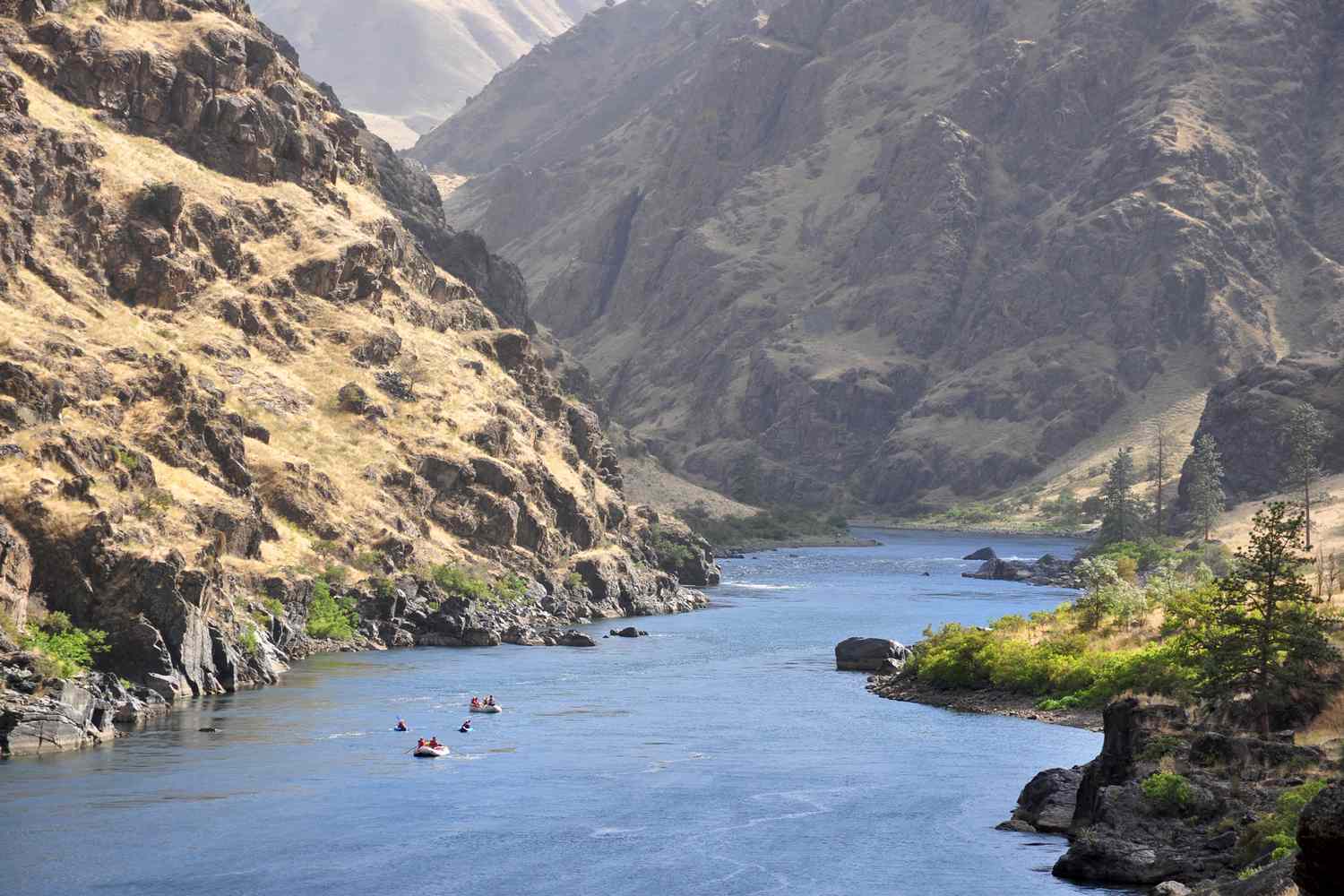
- Hells Canyon reaches around 8,000 feet at its deepest point, 2,000 feet deeper than the Grand Canyon.
- With fewer tourists, incredible wildlife viewing, and strong water flow for rafting, early summer is the best time to visit Hells Canyon.
- To make the most of your journey to Hells Canyon, book a tour with a local rafting outfitter or tour company.
To get a clear picture of the Hells Canyon National Recreation Area, we’ll need to look at it by the numbers. For starters, it straddles two states: Oregon and Idaho. The entire area covers 652,488 acres, and its eponymous gorge, Hells Canyon, is the deepest river gorge in North America. Carved by the Snake River, Hells Canyon measures around 8,000 feet in some places, making the comparison to the most iconic gorge in the U.S., the Grand Canyon, a natural one. Not only is Hells Canyon about 2,000 feet deeper than the Colorado River-sculpted Grand Canyon, but it’s also more remote and harder to access (though the journey is well worth it).
“The Grand Canyon gained fame over the decades, as it garnered more media attention long before people knew much about Hells Canyon,” says Peter Grubb, the founder and president of Row Adventures, an Idaho-based company that has been operating rafting and hiking trips through Hells Canyon since the ’80s. “Many fewer people raft Hells Canyon each year than the Grand Canyon—permits are tightly controlled by the U.S. Forest Service—[and] hiking infrastructure is generally less developed and less used than in the Grand Canyon.” He also adds that Hells Canyon is “less of a sheer-walled canyon,” which means you can see “more stars and get more of a sense of scale and depth than much of the Grand Canyon.”
Like the Grand Canyon, though, Hells Canyon has a deep connection to the Indigenous people who have long called this part of the country home. “The most spectacular thing about Saqánpa (Hells Canyon) is that it is located within the homelands of the Nimiipuu (Nez Perce), who continue to have a relationship to the land and water for over 16,500 years,” says Stacia Morfin (k’uusn’im qicxnew’eet or “Takes Care of Water”), CEO of Nez Perce Tourism. She adds that Hells Canyon is “a place of deep cultural, historical, and spiritual significance.”
Here’s what you need to know before planning a trip to Hells Canyon National Recreation Area.
What to Do
iStockphoto/Getty Images
There are three main ways to see Hells Canyon: rafting trips, jet boat tours, and hikes. “Rafting trips range from three to six days, and five is a perfect length to explore the many special places the canyon offers, including riverside hikes, the rock art of native peoples, pioneer homesteads, [and] natural wonders,” says Grubb.
While you can embark on a self-guided trip along the river, you’ll need expert whitewater skills—and a permit. “Permits for visiting the canyon are issued by the Hells Canyon National Recreation Area,” he explains. “People who sign up for a trip with an outfitter don’t need to worry, as the outfitter handles all permitting.”
Several companies provide jet boat tours through Hells Canyon. These typically day-long excursions, however, give “a cursory view of the canyon,” according to Grubb. However, if you are interested in a jet boat experience that gives you a more in-depth understanding of Hells Canyon, you can book the Saqánpa Hells Canyon Jet Boat Tour with Nez Perce Tourism.
“While visiting Saqánpa (Hells Canyon) with any company is insightful, only Nez Perce Tourism shares firsthand accounts of village sites of our family and legend stories told by Nimiipuu storytellers,” says Ciarra Greene (Sapóoq’is Wíit’as or “Thing That Causes Survival”), the company’s executive director. “Learning that Nimiipuu culture is embedded with ecological knowledge and advanced social structures, not only of the past, but continued today, is an experience not available anywhere else in the world.”
Hells Canyon Area is also rich in hiking trails, and Grubb notes that hikers should plan trips between May and early June, “before the summer heat arrives.” One of the most ancient and notable things to see in Hells Canyon is accessible by boat or on foot.
“Visiting 6,000-year-old petroglyphs at Buffalo Eddy is an experience we recommend not just once in a lifetime, but as a place to build a relationship with for reflection and visioning,” says Greene. “Many of our guests who we share this experience with are able to see themselves, feel connected to something beyond themselves, and leave with an appreciation of their life journey.”
You can reach the Buffalo Eddy petroglyphs via a short hike near the small city of Asotin, Washington (Hells Canyon is located primarily in Oregon and Idaho, but the surrounding national recreation area does include a small section in Washington). The petroglyphs on the Idaho side are only accessible by boat. But no matter what you’re doing, whether hiking, boating, or rafting, keep a lookout for local wildlife.
“Wildlife within Saqánpa (Hells Canyon) are relatives within the Nimiipuu way of life. Visitors may encounter bighorn sheep, elk, deer, black bear, eagles, hawks, and river species such as salmon, steelhead, bass, and sturgeon,” says Morfin. “During our time on the river, we’ve come to notice that mid-afternoon is when the bighorn sheep reveal themselves to us. We ask visitors to approach these moments with respect, observe from a distance, and understand that you are entering a living system where all beings have a role and responsibility.”
Before or after your Hells Canyon rafting, boating, or hiking adventure, be sure to spend a day in Lewiston, Idaho, the primary northern gateway to the recreational area. “One of the most important places to begin the journey into Saqánpa (Hells Canyon) is at simíinekem, the place where the waters come together, a place known today as Lewiston, Idaho,” says Morfin. “Simíinekem, where the Clearwater and Snake Rivers meet, is a natural gathering point for Nimiipuu. It has always been a place of movement and connection.”
Best Time to Visit
Zack Frank/Adobe Stock
Your exact experience in Hells Canyon will be weather and season-dependent, so plan accordingly. “May, June, and September are the best months for the combination of good flows, fewer people, and more wildlife,” says Grubb. “The fruit trees planted by homesteaders bear fruit, bringing black bears near the river to eat cherries, apricots, and plums, as well as berries. Because it’s not so hot, other animals are still near the river’s edge more so than later in the summer.”
As summer gets into full swing, Greene shares that the “warmer waters draw recreationists from around the world, seeking adventure, wildlife, fishing, and culture,” and peak season for jet boat tours and rafting trips kicks off. “Guiding guests into Saqánpa in the summer allows us to facilitate a story [that] the canyon walls and ripples in the water share on their own, the opportunity for true personal connection to our homeland,” she says.
Come September, expect chillier weather, but sunny days and fewer visitors. “As our tour season dwindles, the canyon colors of oranges and reds line the calm waters; a true sight to observe as the canyon begins to shift back to her resting phase,” Greene says.
How to Get There
Robert Appleby/Adobe Stock
Unlike major tourist destinations, Hells Canyon isn’t a place you can (or should) visit without proper planning. “Cambridge, Idaho, is the best place for entering the river from the south, while Lewiston, Idaho, is the best access point from the north,” says Grubb. If you go with the latter—one of the more popular options and a gateway town to many boat tours of the canyon—your best bet is to fly into Washington’s Spokane International Airport (GEG). From there, it’s about a two-hour drive to Lewiston, Idaho. Alternatively, you could fly into Lewiston-Nez Perce County Regional Airport (LWS), though you may be limited in flight options.
Read the full article here