


Several decades ago, I was living with my future wife in Santa Fe, working as an editor at a magazine about outdoor sports. I would find myself sitting at my desk, cutting words and moving sentences, and entertaining the same daydream about seven times a day. In my mind I would trace the route north from Santa Fe as Sara and I drove up through high-desert scrub and the towns of Pojoaque, Espanola, and Velarde. I’d follow its wriggling path through the gorge of the Rio Grande until we shot out onto the mesa, the distant Sangre de Cristo Mountains lit tangerine by the ever-burning Southwestern sun.
Jen Judge
Somewhere among those peaks was the place I dreamed of: Taos Ski Valley. The origin story has it that in 1953 Ernie Blake, a Swiss-German transplant, flew in a little four-seater over northern New Mexico, spied the epic possibility in a steep, north-facing slope, then set to work, clearing and constructing his idea of a perfect ski mountain. About 20 miles northeast of the town of Taos, pressed up against sacred Pueblo lands, it would combine an old-world European ski resort with the New Mexican melting pot.
Jen Judge
On weekends, my daydreams became reality. Our car loaded with skis, Sara and I would start driving before dawn. We were young and not exactly flush, spending what we had on gas and lift tickets ($38 in the mid 90s). She was the real skier; I could tumble down behind her. We loved the hippie spirit of Taos, the collection of characters in cowboy hats, jester hats, and hand-knit hats (these were the days before ski helmets were really a thing) lining up in an ecstatic parade as the lifts opened.
Jen Judge
Since Ernie Blake built the first run, Taos had always prided itself on being different—a little edgy, a little secret. The mountain’s best terrain could be found in the snow bowls beneath the 12,500-foot Kachina Peak, and accessing them required a 45-minute hike, paid off by the ensuing splashdown through airy powder. The crazy snow years of the mid 90s—the time when Sara and I came and went from Taos—coincided with the mountain’s visitor heyday, in which roughly 350,000 skiers took to the slopes annually. Yet by the time the 2000s rolled around, the facilities had aged and skier visits had plunged by nearly half. Even some of the old-schoolers—including the founding Blake family—felt change was necessary.
By then Sara and I had moved East and gotten married. We had children; time passed. We skied mostly on New England ice, holding on to the memory of those freer, sunnier days in Taos. Eventually, we heard the Blake family had sold to a billionaire, who was modernizing the mountain. We kept wondering: What about the old Taos? What about those perfect days and the daydreams that had sustained us? Would those be lost, too?
Jen Judge
So it was that the future met Sara and me at the front door of the Blake, in the form of a valet. That word seemed, well, strange for Taos. “Now that you’re here,” the valet said, “you have nothing to worry about.” Luggage was whisked away, skis were carried off to the gear room, check-in commenced. Wait—we didn’t need to do a Clydesdale clip-clop half a mile in ski boots from the parking lot, lugging our gear like old times?
The Blake is one of the first statements of the new Taos brought about by Louis Bacon, a billionaire hedge-fund manager and conservationist who bought the mountain for an undisclosed sum in 2014 and quickly started pouring in money. The smartly appointed, LEED-certified 80-room hotel, just steps from Lift #1, is an homage to Ernie and his wife, Rhoda. One look at the Blake’s spa, complete with an oxygen bar and steaming outdoor hot tubs, made it clear that the hotel represented a quantum leap forward in terms of ease and amenities. There were nods to the past, too: gabled roofs and raw wood hinted at that European Alpine ethos, while local art and fabrics adorned the rooms.
Jen Judge
We noticed other changes afoot, including a second hotel under construction and a new lift put in to provide easy access to Kachina Peak’s double-black-diamond runs, bypassing the need to hike for those glories. Taken together, the changes sent a signal. The new Taos would be a mix of adventure and accessibility that matched the new owner’s apparent vision: upgrade everything and make it environmentally sustainable, while changing nothing about the experience of actually skiing there.
On our first morning, Sara and I woke to one of the roughly 300 days of sun that Taos receives each year—gaudily beautiful weather for the end of February. The sky was a Delft blue; the green pines were frosted with white puffs of powder. Early skiers dotted the snowy avenues in neon flecks, and the schussing of skis harmonized with the creaking of trees in a light wind.
Jen Judge
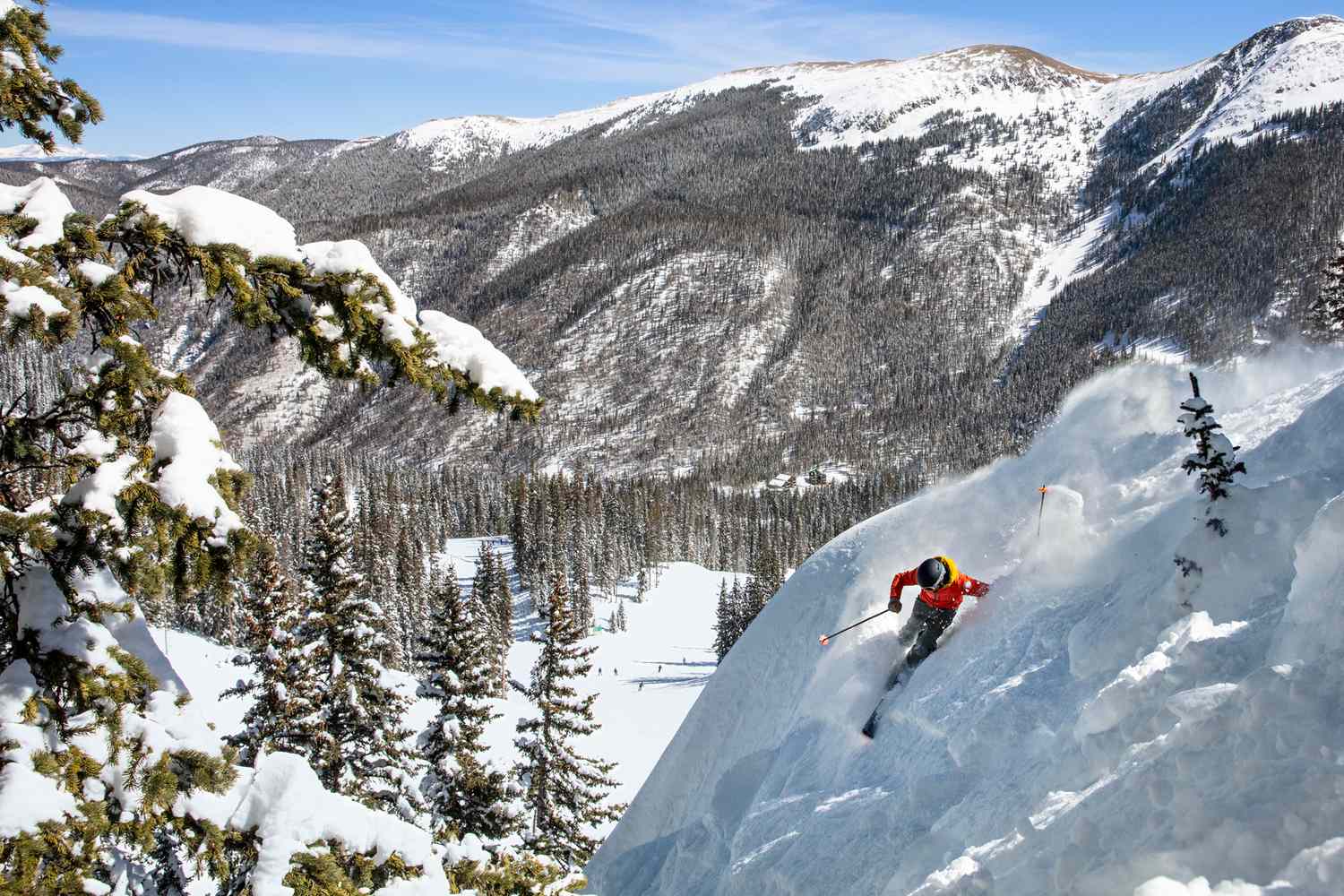
Riding Lift #1 was déjà vu, floating straight above the dizzying descent of Al’s Run, with its famous yellow sign: “Don’t panic! You’re looking at only 1/30 of Taos Ski Valley.” Taos is located in Carson National Forest, and covers 1,300 acres of wilderness. The mountain is 60 percent north-facing and averages 300 inches of snow a year. Half of its trails are classified as “expert.” The terrain pockets and protects its snow, which, because of the dryness of New Mexico, has a light, flyaway quality. (After big storms, powder hounds have been photographed skiing down Al’s wearing snorkels.)
Early skiers dotted the snowy avenues in neon flecks, and the schussing of skis harmonized with the creaking of trees in a light wind.
I’d forgotten about the adjustment necessary for breathing at altitude (the village itself is situated at about 9,300 feet). But once we were on the mountain, the trails were like old friends we knew by name: Blitz, Walkyries Glade, Hunziker Bowl. It wasn’t pretty, our skiing, or the huffing and puffing that accompanied it, or our shambolic 90s skiwear, but who cared?
Jen Judge
That afternoon the ski school, famous for mixing European and American styles of instruction, had arranged for us to ski with one of its longtime instructors, Tiger Stafford. He had arrived in Taos at age six in 1972; now he seemed to know every other person lounging in a deck chair at the base. He is one of those effortless, exemplary skiers you can’t help emulating. At our request, he had, within half a run, diagnosed our various weaknesses and idiosyncrasies (Sara’s bunny-hop turns, my form-defying unruliness), telling us to focus more on sliding over the top of the monster moguls—“schmear” was the word he used—before turning.
When I asked what had sustained him over five decades of skiing there, he said it was the mountain’s diversity. “You go up two chairs, take a hike, and there’s infinite possibility.” As someone who’d witnessed all the changes, he said he’d never felt anything but at home there. “It’s something about the mountain itself,” he said.
Jen Judge
One run was enough to remind us of Taos’s intoxicating power. After all, Taos started with Ernie Blake and a single T-bar lift. Eventually, he and his friends built out the front side of the mountain, where Stafford led us now: down Spencer’s to Rhoda’s to the top of Showdown, where we finished in Edelweiss Glade. All were black-diamond mogul runs. Weaving in and out of trees and bumps, over multiple varieties of snow, we found a little fluency, regained a rhythm as the snow flew in sparkles that felt like a renewal of our now-30-year-old Taos vows.
I do. Or: I will. Or just a spontaneous: Yee-haw!
Afterward, we took a short walk through the village, past shops and an outdoor ice rink, over a mountain stream to the Brownell Chalet, a four-room guesthouse with a cozy restaurant, Der Garten Bistro. Run by Christof Brownell and his partner, Asia Golden, the chalet was Brownell’s childhood home, one he’d shared with his family, which ran another legendary oldie, the Thunderbird Lodge, from 1970 until its sale in 2005. Brownell’s parents were Taos royalty, and people from Jimmy Carter to John F. Kennedy Jr. stayed at the Thunderbird—or the “T-bird,” as it was known by locals.
Jen Judge
When we arrived, the après-ski crowd was warming itself by the fire in what had once been the living room, a space filled with vintage photos, old paintings, and artifacts. It was like a memory palace, old Taos alive and well, but with a selection of international beers and organic food, including sandwiches with names like Stoffy (turkey, Gruyère, and peppers) and Figalicious (chile-fig spread with triple-cream Brie).
Soon we were joined by Brownell, who easily slid into stories about the past. It’s not that he has never supported change, he said. Snowboarders were barred from Taos until 2008; back then, he would take stealth rides after-hours or in the off-season. Joining other boarders in protest, he’d scrambled up a hill opposite the mountain on a full moon and with a snow shovel dug out the words free taos, photographs of which ran in various ski magazines. He’d just finished his term as mayor of the tiny municipality of Taos Ski Valley, having won by a single vote, 41-40. What worried him was that the new owner was changing the nature of the place he loved: fewer families in the valley, fewer independent businesses. But even he had to acknowledge that there was one element that never seemed to change: the bonds of community.
Jen Judge
He had a story to prove it. Five years earlier, there had been an avalanche off the ridge near Kachina Peak in which two lives were lost. In a flash 300 people—ski patrol, maintenance, townsfolk—were there to help probe and search through the slide. On the wall of the chalet, near where we sat, was a memorial: a snowboard on which Brownell had scrawled a tribute to the two victims and those who had rushed to help. “The community rallied together in shock, hope, and spirit, knowing it could have been any one of us,” he had written.
THE NEXT MORNING I was up before dawn to meet Tommy Murray, director of mountain maintenance, and his wife, Angelisa. In the darkness, the mountain loomed purple and otherworldly. As we climbed uphill in the snowcat, the three of us packed inside the heated cab as the pale headlights pooled on the trail before us, he described the Sisyphean effort of grooming a mountain like this. “All day long the skiers and boarders are pushing snow downhill and all night long we’re grabbing that snow and bringing it back up,” he said. Though he now had his hands full managing a number of departments, he couldn’t seem to give up grooming the mountain, a job he’d done for 11 years. It was “meditative,” he said, to move snow under a full moon in a glacial valley full of 1,200-year-old trees.
Jen Judge
He recalled the time when the mountain traded hands more than a decade ago. “During that moment of change there was fear,” he said. “As new management came in, people started realizing that this isn’t so bad, this is a pretty good thing: new lifts, new hotels, new equipment. It provided jobs for everyone from town, so a lot of people embraced it.”
Murray took pride in what had been accomplished on the mountain so far. The emphasis on sustainability—one of Louis Bacon’s priorities—had led to a new fleet of electric snowcats, an on-site composter, a ban on plastic bottles in the village, solar energy to run the lifts, energy-efficient snowmaking guns, and a carbon-neutral rating. We stopped at the top of Lift #2 to watch the sun rise. It was like watching a curtain go up: the peaks caught fire and slowly everything was ablaze again. Showtime.
Jen Judge
I said goodbye to the Murrays and met Sara at the lift. We skied like we did in the old days, connecting our favorite dots across the mountain, chasing our younger selves. If it was the case that our bodies were less willing to hike the ridge, we were grateful for the lift that took us to Kachina Peak. Up there, we took off our skis and scrambled 50 yards to the very top of the peak, where a set of prayer flags flapped in the wind. A sign nearby read, “Outside the Carson National Forest lies Taos Pueblo. The peaks and wilderness that surround you are their ancestral lands. These high places safeguard their traditional way of life.”
From there we could look west, too, down toward the town of Taos, founded by the Spanish in 1615. The high plain ran to the rift valley and the Rio Grande, which flows all the way to Mexico. The panorama of all that history was, as it had always been, breathtaking.
Jen Judge
Skiing the bowl, navigating the hazards and high angles (some exceeding 40 degrees) is a feather in any skier’s cap, Stafford, our ski instructor, had told us. If harder terrain existed on the mountain—and it did—this was enough for us. We schussed and schmeared, edged and hooted, calling in the ski gods. We flew as we went, inadvertently racing time, or trying to hold on to it. We took in giddy gulps of air, catching a little transcendence with every one.
We could have squinted our eyes and imagined we were back in the 1970s, when Dennis Hopper and his pals, Bob Dylan and Leonard Cohen, would come strolling in.
On our way out we stopped in town, as we used to in the old days, planting ourselves at the historic Taos Inn. Founded in 1936, the place still has a photogenic neon sign, a popular bar called the Adobe that serves mouth-puckering margaritas, and an overall sense of well-worn charm. We could have squinted our eyes and imagined we were back in the 1970s, when Dennis Hopper and his pals, Bob Dylan and Leonard Cohen, would come strolling in.
Jen Judge
Just across the street we found the Rolling Still, a distillery and cocktail lounge started by two couples seven years ago. This was the new Taos: young, artisanal, with a dash of glam. The women, Nicole Barady and Liza Barrett, owned and ran the business; their husbands, Scott and Dan, were in charge of distilling the homemade blends (whiskey and vodka made with mountain water, some infused with green or red chiles, lavender, or pecan). The wives joined us, and together we drank delicious drinks, ate charcuterie, and talked about the realities of running a business in a place like Taos.
Like the ski valley, the town of Taos is caught in its own moment of flux. The pandemic brought more outsiders in, adding more stress to the population of about 6,500. It’s a place where the Taos Pueblo people and the Latin community have always maintained an uneasy alliance with artist-arrivistes, from Georgia O’Keeffe and D. H. Lawrence to today’s coastal transplants. When a developer tried to build a Starbucks drive-thru last year, it was burned to the ground, twice. (“Starbucks to Charbucks,” read a Reuters headline. “Taos Chafes at Coffee Chain.”)
Jen Judge
But sometime during dinner that night at the Love Apple—the best of the Taos restaurants, housed in a former chapel and described by one reviewer as a “haute hippie hideaway”—I stopped asking myself if this place or that place belonged or didn’t belong in Taos. People have been settling in Taos for centuries, eons, inspired to create a life there, in some cases with their own ideas about protecting, enhancing, and animating the landscape. Did new things signal the end of the world, or an expansion of it? There would be more hiccups, more rearrangements. The issues of ethnicity, class, violence, and exclusion were real. As nice as it would have been to go through a wormhole back to the past, the message was clear: the way-it-was was over.
Before leaving the next day, we had a predawn date to take one last look at the volcanic plateau and mountains of this alien landscape. On ranchland to the west of the river, Sol Lothe, the proprietor of Rio Grande Balloons, fired up his hot-air balloon with propane. We clambered into the wicker basket, 10 of us in all, and were off. Lothe sported a mustache waxed at the tips and seemed like someone completely out of time. He measured the speed and direction of the wind at various altitudes, and used it to maneuver the balloon along the rift canyon. Then, heart-stoppingly, he dipped us down into the gorge, where we saw bighorn sheep and came so close to the rushing Rio Grande that it felt as if we could reach out and dip in our fingers.
Jen Judge
Rising one last time, up and out of that fissured earth, then above it, we found it hard to distinguish much of anything man-made. The adobe homes melted out of view, the town itself seemed camouflaged, and in the distance the peaks of the Sangre de Cristos, including Kachina, caught fire like candles. Ancient orange rock, 1,200-year-old trees.
We could have convinced ourselves that it had all gone back to the land again. We felt it in our bones at that moment. The magic in Taos had nothing to do with us—we were just lucky to be there at all.
A version of this story first appeared in the December 2025 / January 2026 issue of Travel + Leisure under the headline “A Mountain in New Mexico.”
Read the full article here