


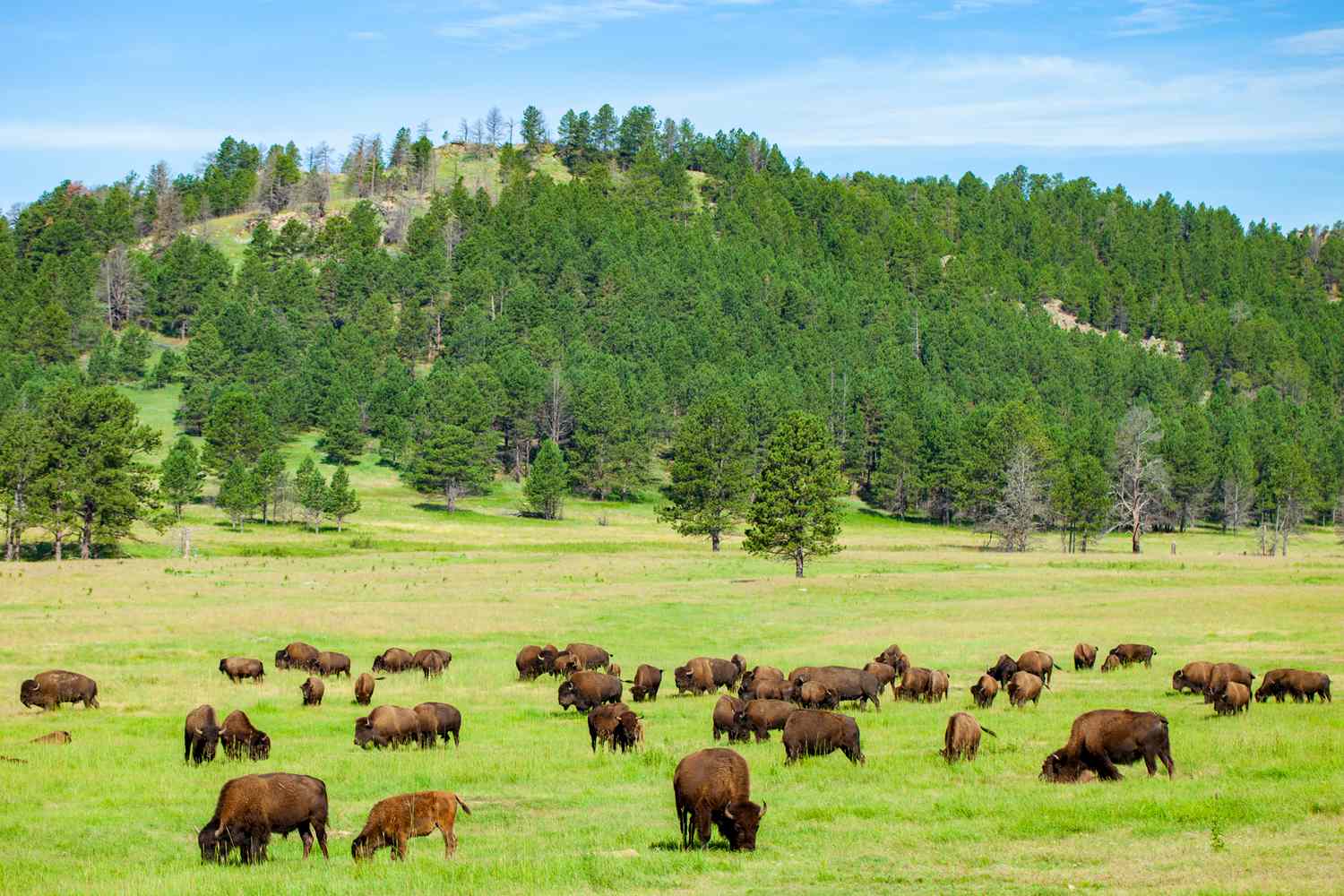
The southwest corner of South Dakota is home to several of the state’s biggest hits, making for the ultimate road trip adventure. In just a few days, you can check off Mount Rushmore, explore Badlands National Park, discover Custer State Park’s bison herd, and see the progress being made at Crazy Horse Memorial. Wind Cave National Park is another worthy addition to your itinerary; it’s also frequently billed as “two parks in one.”
Above ground, you have wildlife sightings and hiking trails. Below ground, you have one of the longest, most extensive cave systems in known existence. “It is also a geological wonder,” says Carrie Gerlach, owner of Black Hills Adventure Tours. “There are formations in the cave that are specific to Wind Cave and cannot be found anywhere else in the world.” More than 150 miles have been documented, but experts believe that’s only a percentage of the cave’s full scope. According to the National Park Service, the cave system is “still being explored with no end in sight.”
While Wind Cave became a national park in 1903, the area’s story goes back much further. “Wind Cave has a significant history, as it is considered the creation spot for the Lakota,” says Gerlach, referencing the “Emergence Story” that has been passed down through generations. “There are several interpretive signs that walk you through the story about the Native American creation story and history in the Black Hills and, specifically, Wind Cave,” she adds.
Cultural heritage, interesting facts, and boxwork—an incredibly rare mineral formation—await visitors at Wind Cave National Park. Here’s how to plan a trip.
How to Get There
Rapid City Regional Airport (RAP) is the closest commercial airport to Wind Cave National Park. Served by Delta, United, American, and Allegiant, the airport is a little over an hour’s drive from the park’s visitor center. You’ll need to rent a car—or arrange for another form of private transportation—to make the journey. The NPS recommends using the visitor center’s GPS coordinates (N43 33′ 22″ W103 28′ 38″) to navigate to the park; otherwise, there’s a chance you’ll end up in the wrong place.
Know Before You Go
Cavan Images/iStockphoto/Getty Images
At over 33,000 acres, Wind Cave is one of the smaller national parks in the U.S—and most visitors come with one goal: to see the famous cave. To make that happen, you’ll have to book a tour (visitors are not permitted in the cave without a guide). Although you won’t pay an entrance fee to enter the park, you will need to reserve a tour ticket, which starts at $15 for one standard adult, online. “If you are not able to get a reservation, they do hold back a few tickets for people who walk up,” says Gerlach. If you decide to risk a day-of spot, she recommends arriving in the morning: “I suggest going early to try to get on the first tour of the day. If you are not able to get on that tour, you can wait for the next. If you wait until the afternoon to get there, there is a chance that you will not get on a tour that day.” And, as she tells Travel + Leisure, the highlight of the national park is the cave. “You do not want to miss the tour,” she says.
The cave is also about 500 feet beneath the ground, so you’ll need to dress accordingly. Wear sturdy shoes, preferably with non-slip soles, and bring a light jacket. Wind Cave is a brisk 54 degrees Fahrenheit throughout the year.
Visitors who opt for one of the shorter cave tours—like the Garden of Eden or the Natural Entrance tour (more on both below)—will wrap up the experience in about an hour to an hour and a half, leaving plenty of time to see other South Dakota points of interest. “A visit to Wind Cave National Park can definitely be combined with other attractions or parks in the area,” says Gerlach. “Wind Cave is a little bit farther south than most of the other attractions, so it is a bit more of a challenge to get there and plan the day. However, you could easily do Crazy Horse, the Custer State Park Wildlife Loop, and Wind Cave in one day. With that agenda, you would spend at least three to four hours in the park.”
No matter how you lay out your journey to Wind Cave, be sure to plan ahead—make the proper reservations and pack a lunch. “This is very important. There is food service in Hot Springs and Custer, but it is limited and seasonal,” Gerlach warns. The towns are about 16 and 25 minutes from the visitor center, respectively.
Best Time to Visit
zrfphoto/Getty Images
The visitor center at Wind Cave National Park, where tours begin, is open all year round, with the exception of three days: Thanksgiving, Christmas, and New Year’s Day. You could technically join a cave tour in any season, but there are a few benefits of coming in spring or fall, Gerlach’s two favorite seasons in the Black Hills.
“The fall colors in this area are a mixture of gold and yellow, and they are absolutely beautiful,” she says, noting that you’ll see wild sunflowers as well as the aspen and birch trees changing colors. Following the snowy winter—park roads can temporarily close depending on the weather—spring emerges with a refreshing vibrancy. “I love the spring because it is a time when new babies are being born. Oftentimes, you’ll be able to see baby buffalo that have been born within minutes and are up and running around,” she says. “The spring is very green and lush and gorgeous.” Spring is also when you’ll see the blooming purple pasque, South Dakota’s state flower.
Best Things to Do
NPS Photo
Join a guided cave tour.
Of course, the top item on your Wind Cave National Park agenda should be seeing the cave itself, and there are a couple of different tours you can join. The one-hour Garden of Eden tour is the least strenuous option; covering about a quarter of a mile, the journey includes close-up looks at the cave’s famous boxwork, flowstone, and cave popcorn formations. On the Natural Entrance tour, you’ll visit the largest opening to the cave. At the entrance, which is about 10 inches wide, you might be able to feel the eponymous wind. This is a “breathing” cave, which means air moves in and out based on air pressure. Wind Cave National Park also offers Candlelight and Wild Cave tours seasonally.
Go for a hike.
You might come to the national park for its underground sights, but don’t overlook the beauty above ground—best enjoyed on a hike. “Lookout Point Trail is a great moderate hike. It is less than five miles. I suggest doing it clockwise,” says Gerlach. “There is a small climb in the middle. You may run into bison. You will hike through a prairie dog town where you could see coyote, badgers, or the burrowing owl.” She also recommends the Wind Cave Canyon Trail and the Sanctuary Trail. “They are easy and would be considered more of a prairie hike. You’ll also have the opportunity to see bison, pronghorn, and prairie dogs on both of these trails,” she says.
See local wildlife.
If you’ve seen the aforementioned species, there’s one more to check off your Wind Cave list: elk. “Wind Cave does have a herd of elk as well,” says Gerlach. “The best time to see elk is at sunrise or sunset. There is nothing like sitting out in the wilderness listening to a herd of elk bugle.” A portion of the herd is typically found on the eastern side of the park, near Boland Ridge, and the bugling can be heard during the elk rut in September and October.
Where to Stay
Brian Caissie/fStop/Getty Images
Elk Mountain Campground
The park’s Elk Mountain Campground has 64 campsites that can be reserved online. It’s open year-round, but the flush toilets and drinking water are only available from late May through September. Backcountry camping is also allowed in the northwestern section of the park with a free permit.
Rapid City
“I always suggest staying in Rapid City. It is a nice central location with plenty of food and entertainment options,” says Gerlach, who recommends the historic Hotel Alex Johnson and The Rushmore Hotel & Suites.
Custer
“Depending on the time of year, Custer is also a great option. There are some very nice privately owned campgrounds and boutique hotels,” she says. Travelers who prefer glamping-style accommodations may like the cabins at Fort Welikit Family Campground or Buffalo Ridge Camp Resort’s treehouses, teepees, and glamping tents. She also recommends the Bavarian Inn and EO Bungalows, describing them as “fantastic little boutique lodging options.”
Where to Eat
Ultima_Gaina/Getty Images
Custer
Food services are limited at the park’s visitor center, so most travelers will fill up in either Custer or Hot Springs—and options are limited in the off-season. In Custer, grab breakfast at the Feel Good Cafe, lunch at Black Hills Burger & Pizza Co., and dinner at Skogen Kitchen.
Hot Springs
If your South Dakota road trip brings you through Hot Springs—home to the largest concentration of Columbian mammoth bones in the world—swing by Wandering Bison Coffee for breakfast sandwiches and pastries for breakfast or chili, salads, and wraps for lunch.
Read the full article here