


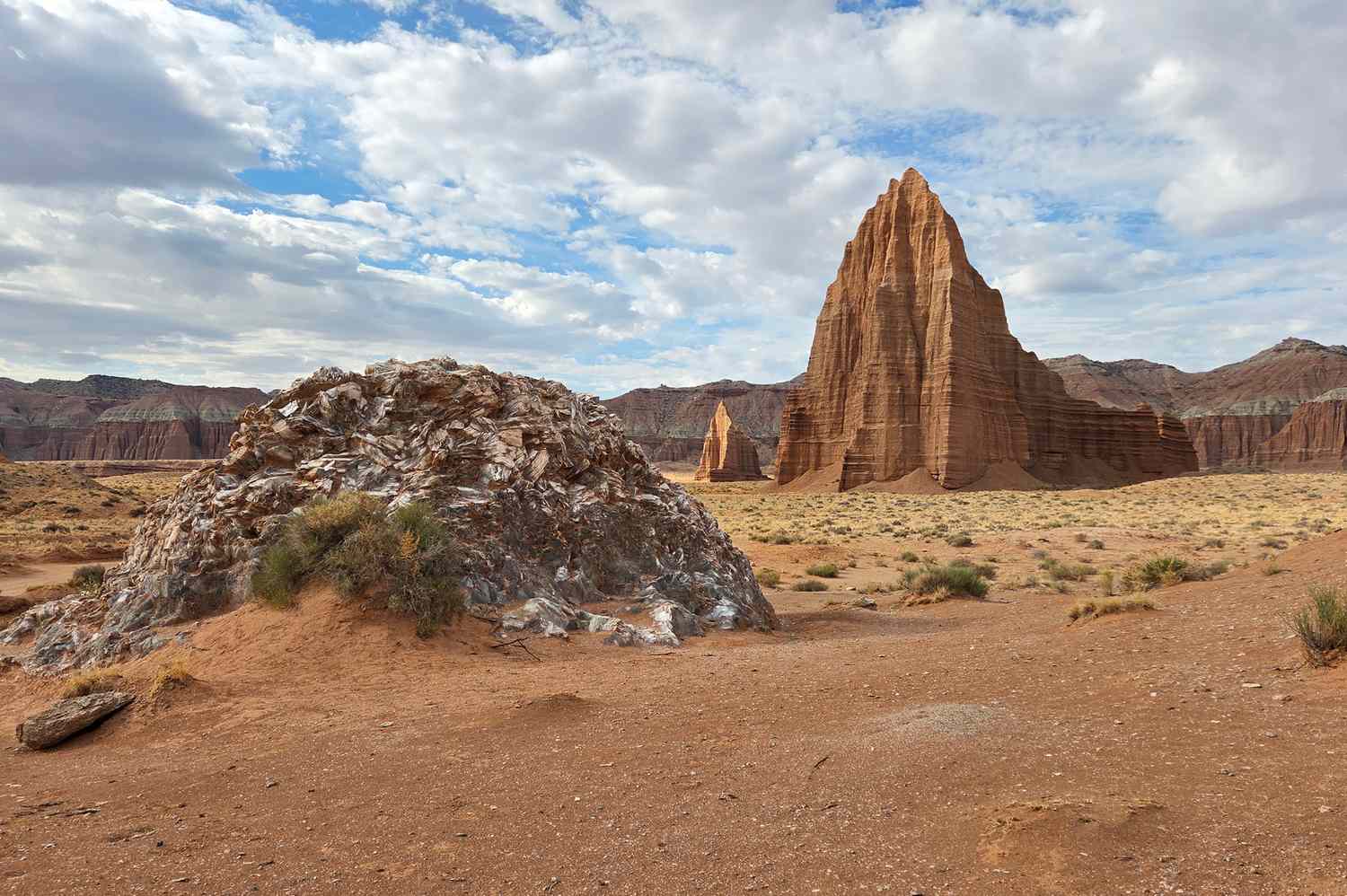
At first glance, Glass Mountain looks out of place—an irregular, pale, 15-foot mound glinting in the sunlight, as if someone dumped a pile of shiny shards in the middle of the desert. Hidden in plain sight deep within Capitol Reef National Park’s ultra-remote Cathedral Valley, the formation is made of selenite, a crystallized form of gypsum. Few visitors ever lay eyes on Glass Mountain, both because of its remote location and because Capitol Reef itself remains one of Utah’s most overlooked national parks.
Among the state’s “Mighty Five,” Capitol Reef ranks as the fourth least-visited, welcoming 1.4 million visitors in 2024—more than only Canyonlands and far fewer than Zion, which saw nearly five million. Even so, numbers don’t tell the full story. Capitol Reef is vast, uncrowded, and spectacular in a way that’s simultaneously understated and otherworldly. After visiting more than 40 U.S. national parks and spending most of my life in the Southwest, it’s one of my favorites.
Taryn Shorr-Mckee/Travel + Leisure
Even travelers who’ve never been to the park have likely seen photos of Cathedral Valley. The towering monoliths known as the Temple of the Sun and the Temple of the Moon (often shortened to Temple of the Sun and Moon) jut dramatically hundreds of feet from the desert floor, their silhouettes defining the entire valley. Glass Mountain, quite literally sitting in their shadow, is easier to miss—but is just as unusual.
Unlike the colorful, layered cliffs and domes Capitol Reef is known for, Glass Mountain feels almost metaphysical. Its origins stretch back millions of years, when mineral-rich groundwater flowed beneath the valley. As the water moved, dissolved gypsum crystallized, eventually forming the selenite mound seen today. As erosion continues to strip away the surrounding sandstone, more of the mass is exposed. While gypsum is common in sedimentary rock throughout the park, the National Park Service website explains, “The crystals of Glass Mountain are somewhat unusual in size and in the massiveness of the deposit.”
Taryn Shorr-Mckee/Travel + Leisure
Another factor that makes this geological anomaly so striking is how unmediated the experience feels—no crowds, no barriers, not a single sign. It’s less like visiting a landmark and more like stumbling upon something extraordinary in the open desert.
That remoteness is exactly what keeps Glass Mountain under the radar. From the park visitor center, travelers head east along Highway 24 toward Caineville, a dot-on-the-map town about 25 minutes away. Just before reaching it, a turn onto Cathedral Road leads north into Cathedral Valley. From that turnoff, it’s 17 miles to the Temple of the Sun and Moon—but it’s a slow-going drive, taking just over an hour.
In ideal conditions, the road is technically passable for most vehicles, but high clearance and four-wheel drive are strongly recommended. The route is washboarded and deeply rutted in several long stretches, as well as prone to washouts. Weather matters immensely: If rain is in the forecast, or if storms passed through in the previous few days, mud and flooded sections make the route impassable.
For that reason, many visitors, like myself, opt to visit with a guide rather than drive themselves. A guided tour eliminates the guesswork and risk while adding geological context to a landscape that already feels surreal. A handful of outfitters go to Cathedral Valley on half-day excursions. We went with Western Whiptail Adventures, who picked us up from our accommodation in Torrey before dawn.
Read the full article here