


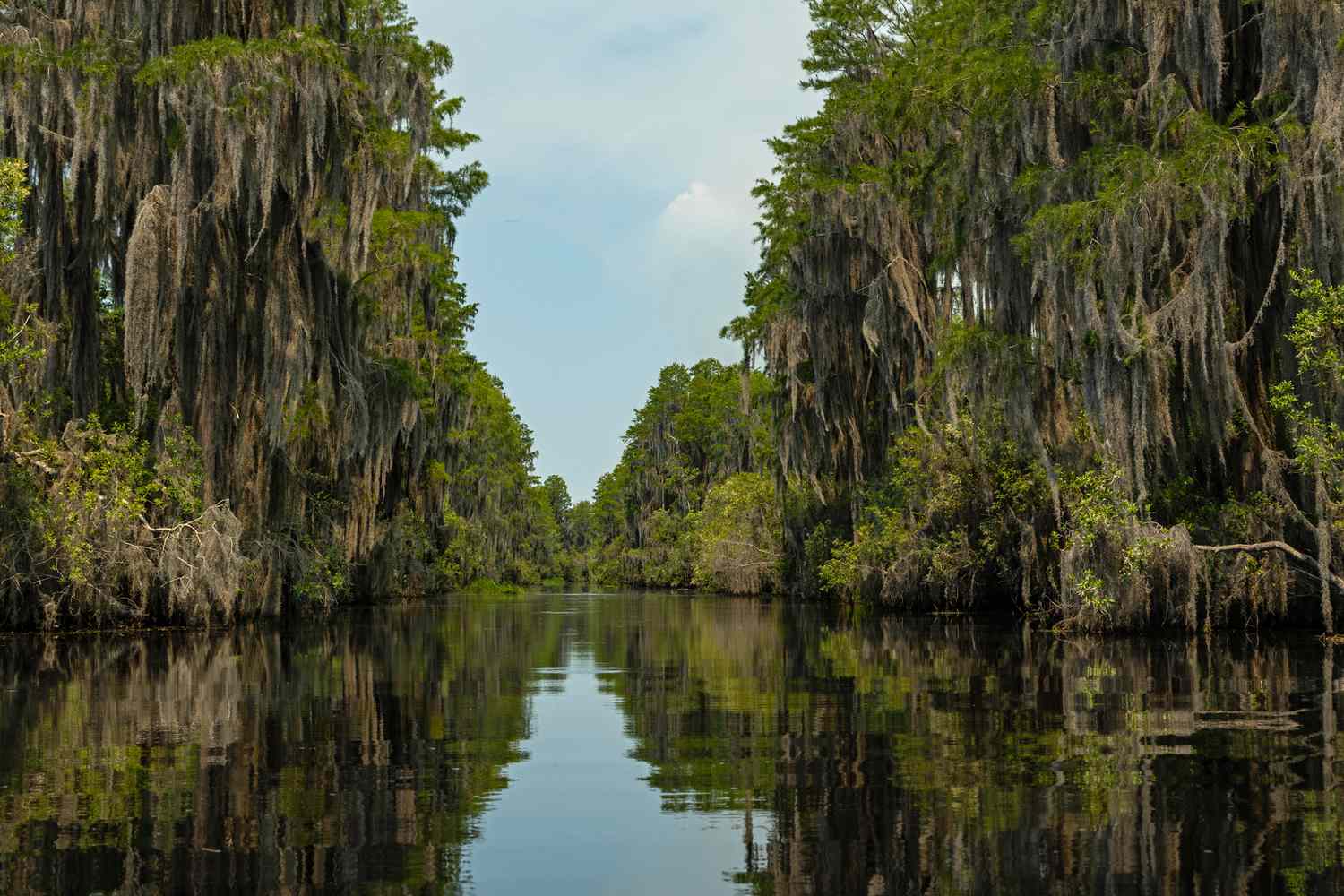
Set at the headwaters of the Suwannee and St. Marys rivers in southeastern Georgia, the Okefenokee Swamp is not only one of America’s most important ecosystems, but also the largest blackwater swamp in North America. Its vast stretches are home to several endangered species, like the indigo snake and the wood stork.
The name comes from the Muscogee word for “land of the trembling earth,” which references the movement of the peat beneath the water. The Muscogee people lived in the area before European settlement. Next came the logging industry and an ill-fated attempt to drain the Okefenokee.
In 1937, the swamp was declared a wildlife refuge by President Franklin D. Roosevelt, who spent extensive time in Georgia. The Civilian Conservation Corps—including Company 1433, an all-Black unit—was responsible for building most of the facilities you see at the refuge today. Within its 407,000 acres are wildlife habitats, a visitor center, recreation areas, and an entire state park. Entry is $5 per vehicle, and America the Beautiful interagency passes are accepted.
Since 2024, the site has been in the process of pursuing UNESCO World Heritage status. If picked, it would join 26 other heritage sites in the United States, including the Everglades and Great Smoky Mountains national parks, and would bring both increased tourism to the region and further protection. Here’s how to plan a trip to discover this wondrous ecosystem today.
Planning Your Visit
Geoff L. Johnson/Explore Georgia
There are several access points to enter the Okefenokee National Wildlife Refuge, but most travelers will use one of three: Folkston, Waycross, or Stephen C. Foster State Park. The eastern Folkston side entrance is the most popular, with access to boat tours and top landmarks.
At the swamp’s northern tip, the Waycross entrance leads to the Okefenokee Swamp Park area, which also offers boat tours, boardwalks, and wildlife encounters. This is the most developed entry point with several shops and eateries. To the west is Stephen C. Foster State Park in Fargo, a designated Dark Sky Park with kayak rentals and boat tours, a boardwalk, and nature trails.
How to Get There
Because of its remote location, transportation is fairly limited. The closest airport is Jacksonville International Airport (JAX) in Florida, about an hour away by car. You can also drive from Atlanta in about five hours. A car is essential to reach the Okefenokee Swamp and to get around inside its boundaries. But once there, you can navigate many of the park’s roads by bicycle. You can also bring or rent a kayak or canoe to explore the waterways independently.
Best Time to Visit
Geoff L. Johnson/Explore Georgia
The summer months can be very hot and humid for the uninitiated, but fall and spring are ideal for visiting the Okefenokee Swamp. The preserve also has several fee-free days throughout the year.
Stephen C. Foster State Park hosts stargazing events throughout the year. October’s Okefenokee Festival in Folkston includes talks on the region’s history and environment and the annual “Swamp Hollerin’ Contest.” In November, travel back in time with Pioneer Days. The event, held at the Chesser Island Homestead, features demonstrations, games, live music, and a sugar cane boil.
Best Things to Do
Geoff L. Johnson/Explore Georgia
Go on a boat tour of the gator-filled waters.
The best way to explore the swamp is on a one- to two-hour boat tour, where you can see the alligators peeking from beneath the water and waterfowl overhead. Tours are offered at Stephen C. Foster State Park, Okefenokee Adventures, and Okefenokee Swamp Park for a fee. These boats are not accessible to wheelchairs. Water levels can affect boat tour operations, so check before you go and book in advance during high season.
Navigate Swamp Island Drive.
If you’re short on time, Swamp Island Drive offers the best of the swamp in a short period. The seven-mile loop can be explored by car or bicycle, as many locals start their days. Grab a map from the visitor center before you go, which will point out different plant species and viewpoints along the way.
Explore the Chesser Island Homestead.
One of the most interesting landmarks in the swamp, located off Swamp Island Drive, is the preserved home of the Chesser family, who lived self-sufficiently from the 1850s until moving out in 1971. The residence includes the farm where they harvested sugar cane and a trail with a viewing platform over the swamp.
Must-see Wildlife and Natural Features
Geoff L. Johnson/Explore Georgia
The biggest reason to come to the Okefenokee Swamp is the abundant wildlife. You are almost guaranteed to see an alligator or two as the swamp is home to an estimated 15,000. Birders should keep an eye out for herons and egrets. Deeper in the swamp, you may spot deer, bobcats, and even black bears.
Best Places to Stay
Allen Allnoch/Getty Images
Most accommodations near the Okefenokee Swamp are rustic, either basic lodge rooms or campsites. Stephen C. Foster State Park has sites for tents, RVs, and trailers. Also located on the Fargo side of the swamp, the Suwannee River Eco-Lodge is great for groups. Situated to the northeast, Laura S. Walker State Park has campsites and cottages as well.
Set right outside the Folkston entrance, Okefenokee Pastimes features a stargazing field and camp store, plus campsites and cabins. Folkston and Waycross also have basic hotels and rental homes. For something more adventurous, seasonal wilderness camping is available if you book in advance, including on raised platforms accessible only by boat.
Best Places to Eat
There aren’t many places to eat in this part of the state, so your best bet is to bring groceries and a way to prepare meals. Some of the visitor centers sell snacks or operate seasonal cafes, but it’s not recommended to rely on them.
If you do want a hot meal after a few nights of camping, you should plan on driving to one of the nearby towns. Folkston has a handful of restaurants, including Thai Smile and Los 3 Mariachis. Waycross offers slightly more variety, like Sheffield Coffee Co. and the Plant Cafe, a local staple since 1921.
Read the full article here