


There was a commotion in the bushes, and then the baby elephants appeared. One by one they trotted out, moving with surprising speed and alacrity, until nine or so had gathered in a red-earth clearing ringed by acacia trees. It was breakfast time at Nairobi’s Sheldrick Wildlife Trust,
and on our first full day in Kenya, my family and I were watching the world’s most successful orphaned-elephant rescue program in action.
Crookes & Jackson/Travel + Leisure
Ooohs and aaahs resounded through the crowd as a team of rangers began feeding the elephants milk from what looked like giant baby bottles. Edwin Lusichi, the trust’s head keeper, introduced the animals by name and explained how each one had come to be orphaned—drought, poaching, and human-wildlife conflict being the most common causes. All were aged between 22 months and three years: as Lusichi put it, “the toddler phase” of an elephant’s 60- to 70-year lifespan.
My kids—eight-year-old Leo and 11-year-old Stella—jockeyed for position by the fence so they could pat the elephants as they passed by. Stella gave a yelp when she first made contact: their skin was covered in stiff, prickly hairs, and had the texture of a rubber tire. These toddlers may have been cute, we realized, but they were equipped for an environment we’d never survive in.
Crookes & Jackson/Travel + Leisure
Lusichi mentioned the adoption program, a key fundraising tool for the trust, which has successfully reared 322 African elephants since it was founded in 1977 by the late Daphne Sheldrick—the first person to successfully reintroduce the animals into the wild. Leo’s eyes widened. “You can adopt an elephant?” As my husband, Dave, explained that this was more of a sponsorship model than a “taking one home to live in our house” type of situation, Leo stopped in front of a signboard and pointed to a photo of a tiny elephant with comically large ears and a playful look in his eye.
Crookes & Jackson/Travel + Leisure
His name was Toto: “kid” or “little one” in Swahili. When he was about a week old, we read, Toto had been delivered, severely malnourished, to the trust’s unit in Tsavo East National Park by a group of former orphans that had been reintroduced into the wild. Three years later he was thriving, playing soccer with his keepers and chasing guinea fowl around a yard. There was no doubt in Leo’s mind. Toto, the little mischief-maker, was about to become part of our family.
Driving back into the center of Nairobi, Leo clutching his adoption paperwork in his lap, we all stared out of the taxi windows in silence. I don’t think any of us had been prepared for how green Kenya’s capital would be. Monster bamboo, bougainvillea, and banana plants crashed in from the roadside; a tin roof sagged under the weight of a gaggle of marabou storks; baboons plundered trash cans at a highway intersection. It felt like Kenya was trying to tell us something. It was time to get out into the wild.
Crookes & Jackson/Travel + Leisure
What’s the right age to take children on safari? Most experts will tell you eight is the minimum: any younger and you run the risk of kids disobeying instructions—“stay in the vehicle” being a key example—and having the wrong kind of interaction with an apex predator. (More likely outcomes include complaints and fidgeting in the car, where extreme temperatures, bumpy terrain, and spells of wildlife inactivity are all pretty common.)
If and when you decide to do it, my advice would be this: pick your lodge wisely. AndBeyond, a luxury tour operator that runs wilderness properties across Africa, Asia, and South America, has a reputation for hiring staff that are excellent with kids, and operates a robust activity program called WildChild. David and I asked their advisors to help plan a trip that would take us from Nairobi to the iconic Maasai Mara National Reserve in southwestern Kenya for a three-night safari. From there we’d fly back to Nairobi and on to Zanzibar off the coast of Tanzania, for three days of beach time at andBeyond’s newly renovated Mnemba Island resort.
Crookes & Jackson/Travel + Leisure
And so, the day after our elephant orphanage visit, we found ourselves flying over the Maasai Mara’s never-ending carpet of green in a little twin-prop plane and bumping down on an airstrip at the foot of the Oloololo Escarpment, which forms the northwestern edge of this 580-square-mile park. A gleaming andBeyond vehicle pulled up next to the plane, and out jumped Isaac Kimani, our safari guide for the next three days. With a megawatt smile and a karibu sana (“You’re very welcome”), he threw our bags in the back of the jeep, and off we went to Bateleur Camp.
Crookes & Jackson/Travel + Leisure
Bateleur is a relatively small, simple place: just one modest main building and 18 guest tents. Much of the camp is open to the elements, and natural materials abound. Yet in 2025, Travel + Leisure readers voted it not only the best safari lodge in Africa, but also the best hotel in the entire world in our annual World’s Best Awards survey. We didn’t actually know that when we stayed, but looking back at our time there, the accolade makes perfect sense.
Because from the moment we stepped onto the wooden deck of the main guest area and were met by Grace Mwaisaka, the unflappable guest relations manager; chef “Magic” Jackson Mutuku in his tall white hat; and the unfailingly gracious waiter, Joel Kariuki, the service we received was so warm and genuine, it felt as if we were staying in their actual home. What would we like for dinner? When did we want to go on safari? There were no schedules, no menus, just conversations—almost all of which seemed to end in another karibu sana or a hakuna matata (no worries).
Crookes & Jackson/Travel + Leisure
Then there was our family tent, which was like something from Out of Africa: two big, interconnected canvas structures with 180-degree views of the tree-dotted Mara. Each had campaign-style furniture, a deep copper tub, and a deck where we could laze around watching wildlife pass by. (Were those giraffes bobbing across our field of vision, a couple of hundred yards away? Yes they were.)
When you hear the name Maasai Mara, you probably picture those mind-blowing nature documentaries of the Great Migration: that time of year when over 2 million zebras, wildebeests, and other herbivores make their way from the Serengeti, in northern Tanzania, across the border into this part of Kenya, attracting droves of hungry predators in their wake. It’s one of the greatest wildlife spectacles on the planet, and as a result, many safari lodges in the area sell out between July and October years in advance.
Crookes & Jackson/Travel + Leisure
Well, I’m here to tell you that visiting the Mara outside of the Great Migration might just be Africa’s best-kept travel secret. Our March trip coincided with the birthing season, and as a result the place was crawling with baby animals. Before we’d even left the grounds of the lodge that first afternoon, we’d spotted a mother elephant with her calf, zebras with their foals, and a hyena with a litter of nuzzling cubs. Not only that, but the savanna was lush and green and, perhaps most important, it felt like we had the entire park to ourselves.
Crookes & Jackson/Travel + Leisure
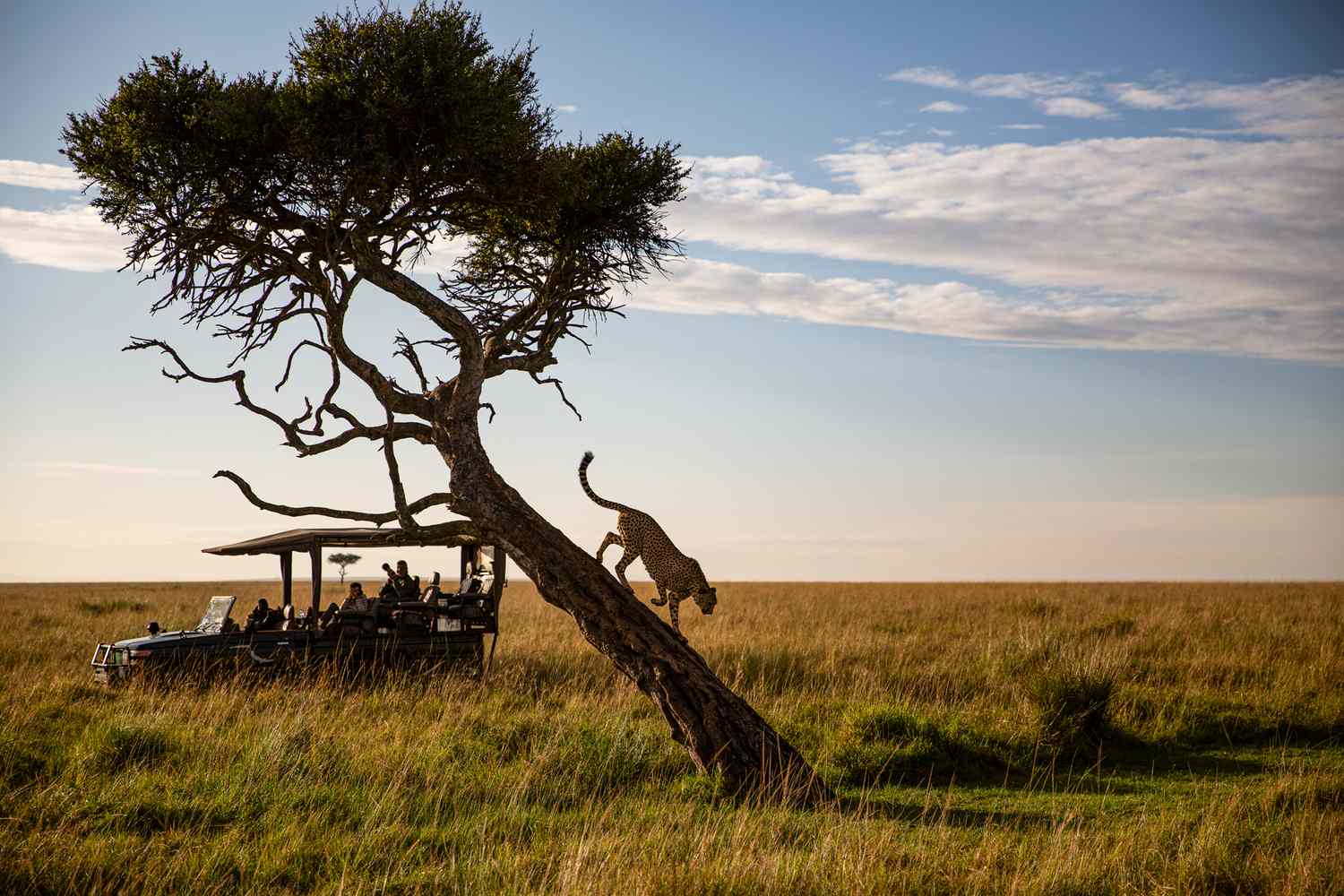
“What do you want to see today?” Kimani asked as we drove down the dirt road into the park. “A cheetah!” came Leo’s response. Miraculously, within an hour or so, Kimani managed to track down not one but two of these critically endangered, highly elusive creatures, sitting about 100 yards apart in a patch of gold-tipped grass. The pair were brothers, he said. “When a mother cheetah has two boys, they form a coalition for life.” (“Coalition,” we learned, is the cheetah’s collective noun—not one I imagined we’d have the chance to use again anytime soon.) The kids, of course, wanted to see the fastest creature on earth running; okay, we all did. But after 20 minutes of watching the brothers travel zero miles per hour instead of the advertised 75, our coalition decided it was time for snacks and sundowners.
Here we were in for a surprise. Kimani parked beside a clearing where chairs had been arranged around a fire. Dave and I ordered Amarula, the classic African cream liqueur. Just as we were taking our first sips, we heard a deep, rhythmic sound, the kind that makes the hairs on the back of your neck stand up. A procession of Maasai villagers in traditional red clothing and feathered headdresses appeared, chanting and ululating. The sound was unlike anything we’d heard before: it seemed to resonate through our bodies and back into the ground where we sat, in a kind of feedback loop.
Crookes & Jackson/Travel + Leisure
Wearing the biggest, most resplendent headwear of all was Alex Oloonkishu, Bateleur’s camp naturalist. He introduced the performers, all of whom were from the village nearest the lodge. Then he announced a round of adumu, the famous Maasai jumping competition. Did anyone want to come up and take part? “If you jump very high, you can attract beautiful girlfriends,” Oloonkishu said with a grin. To my amazement, up shot Leo’s hand. Seconds later, there was our reserved little boy, jumping his heart out next to a group of six-foot-something Maasai warriors. Rarely have we been more proud.
Back at the lodge that evening I asked Oloonkishu about the performance, half expecting him to say it was put on just for tourists like us. On the contrary, he said. “Every evening, Maasai people sing and dance in the village. Then they feel happy.” The community guards its way of life closely, he added. “If we allow people to come and change our culture, our traditions will be lost.”
Crookes & Jackson/Travel + Leisure
AndBeyond has played a key role in supporting the Maasai in the 25 years since Bateleur opened. Its nonprofit arm, Wild Impact, runs a boarding school for Maasai families that educates close to 600 children. The year before our visit, Wild Impact helped fund a new maternity wing for a nearby hospital where, in the nine months since opening, no fewer than 61 babies had been delivered. To combat deforestation, in 2024 it established a tree nursery with some 35,000 seedlings. All these efforts, and many more, are funded by lodge fees and donations from Bateleur guests.
Crookes & Jackson/Travel + Leisure
Maasai culture was the basis for some of Stella and Leo’s favorite experiences at the lodge. As Dave and I took a much-needed nap one afternoon, Oloonkishu showed them how to start a fire with two pieces of wood, the way his people have for centuries. Another day they tried archery, and were thrilled to be given wooden arrows with, yes, potentially harmful sharp metal tips and shoot them not at a target, but straight out into the savanna. They took bushwalks to learn about medicinal plants, and made beaded bracelets in Maasai colors—which continue to brighten their wrists, months after our return to New York City.
Lion numbers are on the rise in the Maasai Mara, thanks to strictly enforced anti-poaching laws and programs to further educate the Maasai community on the value of wildlife conservation. During dinner at Bateleur one evening, we overheard another guest saying they’d seen a pair of the animals mating on safari earlier that day. The kids froze mid-mouthful, eyes bulging in horror at the thought of having to witness such a thing in the company of their parents. But we did all want to see a lion, just preferably not a copulating one. And on our last day, we did.
Crookes & Jackson/Travel + Leisure
The sunrise that morning had been incredible: an orange lava-lamp orb, levitating up through the skeins of mist rising off the savanna. The grass was still covered in morning dew when, after an hour or so spent spotting hippos and crocodiles in the Mara River, we drove around a corner and came upon a male lion sleeping under an acacia tree.
It was one of a pride of five that had killed a baby buffalo earlier that morning, Kimani said, pointing out the flesh and bones strewn across the ground. The lion’s belly heaved up and down as it slept, grotesquely inflated by its buffalo breakfast. After about 10 minutes, it gave a satisfied sigh and rolled over, all four legs swinging in the air as it went. We watched in silence as the animal padded across to a nearby pond and flopped down, both enormous front paws dangling over the grassy edge. Here it proceeded to lap away at the water for, no joke, three straight minutes—I know because I recorded it on my phone. “They can drink up to ten liters at one time,” Kimani said in a low voice. Thirst finally quenched, the animal stood up, took a suitably epic pee, then walked toward the spot where our vehicle was parked.
Crookes & Jackson/Travel + Leisure
It had been a long morning, and Leo had become wracked with wriggles in the back of the car, twisting and squirming under his plaid wool blanket. Suddenly the lion turned and paced along the open side of the jeep, about three feet from where Leo and I were sitting. “Keep still! ” said Kimani in the faintest, but most urgent, of whispers. Dave and I froze, Stella froze, and—thank the good Lord—so did Leo. The king of the jungle passed us by, and our own little lion lived to tell the tale.
Crookes & Jackson/Travel + Leisure
If the Maasai Mara was our African adventure, then Zanzibar was our African vacation. This archipelago just off the coast of Tanzania, Kenya’s neighbor to the south, is known for its coral reefs, crystal waters, and bright white sand: classic paradise island material, basically. Here we traded predawn wake-up calls for lazy lie-ins, and swapped the constant movement of the jeep for hours lying motionless on the beach, content to do nothing at all.
AndBeyond has owned Mnemba Island Lodge, a mile-wide private island ringed by a coral reef, since 1997. From the get-go, the resort was a study in what’s known as barefoot luxury: no roads or vehicles, no air-conditioning, no fancy amenities, just a place to immerse yourself in a spectacular marine environment, and leave the lightest of footprints behind.
Crookes & Jackson/Travel + Leisure
A few months before our visit, Mnemba had been completely rebuilt. The 12 new, thatched-roof bandas have spiral floor plans inspired by nautilus shells—imagine a beach hut designed by Zaha Hadid, and you get the idea. The look is bold and ambitious, but the lo-fi ethos remains. Instead of windows, the rooms have floor-to-ceiling shutters to let in the ocean breezes. There’s still no AC, but fans are everywhere, even inside the mosquito-proof canopies over the beds.
Each banda comes with its own butler; ours, Kundi Haji, has worked at Mnemba Island for 27 years. He had a rakish moustache and the kind of loose, comfortable manner of a man who knows he’s excellent at his job. At mealtimes in the airy, elegant main building, he’d appear bearing a brass tray of food over one shoulder—a whole lobster served with saffron rice and garlic butter, say, or a tikka masala kingfish—and put it down with a flourish as if to say, We all know this is going to be incredible. And you know what? It was.
Crookes & Jackson/Travel + Leisure
One of the best things about staying on an island the size of a postage stamp is that you’re rarely more than a few steps from the ocean. From our banda, the kids could just wander down to the water—which, by the way, was so calm and clear they barely needed a mask to see under it—and take a look at what was happening on the House Reef, just a few yards off the shore. But to see the Mnemba Island Marine Conservation Area, or MIMCA, in all its glory, we needed to work a bit harder. So after breakfast one morning, we took a boat out to Small Wall, a quiet spot on the outer reef, with the resort’s dive master, Rashid Baya.
Crookes & Jackson/Travel + Leisure
Plunging our masked faces under for the first time, we entered a parallel universe. Sunrays strobed down through the water, illuminating layer upon layer of marine life, falling away to the ocean floor some 15 feet below. Schools of fish drifted one above the other in a shifting, shimmering mesh, as neon-bright parrotfish, damselfish, and Moorish idols darted by. Down on the reef, orange-and-white clown fish circled a massive sea anemone, perfectly camouflaged against its apricot-colored tentacles. Every few minutes Baya would dive down to point out a foot-long sea cucumber, or a cluster of blue, black, and yellow sea stars scattered on the seabed. By the time we returned to the boat, we were all in a state of sensory overload—and that was before we encountered a pod of bottlenose dolphins on the ride home.
Schools of fish drifted one above the other in a shifting, shimmering mesh, as neon-bright parrotfish, damselfish, and Moorish idols darted by.
But this fantastic, kaleidoscopic world is under serious threat. Back at Mnemba I met Camilla Floros, program manager for Oceans Without Borders, the marine arm of andBeyond’s nonprofit efforts. She said rising ocean temperatures had triggered multiple bleaching events in recent years. These have seriously undermined reef restoration efforts, which involve seeding less heat-vulnerable species in coral “nurseries.” On the positive side, efforts to introduce sustainable seafood consumption, limit visitor numbers, and minimize damage from boat anchors have seen measurable success. “The reefs need to be in a functional state for everybody,” she said. “For the community, so that they can harvest from them. For tourists, so that they can still enjoy them, and for tourist operators, so they can get revenue.”
Crookes & Jackson/Travel + Leisure
Floros’s words came back to me the following day, when I lay reading on the beach as Stella snorkeled around the House Reef. Suddenly she came running up the sand, dripping with water. “I could hear the fish eating the coral! I heard them munching it,” she said. I fetched a mask, swam out, and stuck my head under: sure enough, when the parrotfish took a nibble, we heard a delicate crunching, the sound carrying on the water, loud and clear.
Back in our beach banda, we looked it up on my phone: parrotfish eat the algae that lives on coral, then excrete it as the fine, white sand that makes up as much as 70 percent of beaches like this one. We looked at the island around us, the palm trees blowing in the breeze, the glassy, turquoise water. Without the coral out on the reef, it dawned on us, Mnemba wouldn’t exist. In that moment the frailty of it all, and the beauty, was almost too much to bear. But whatever the future, Stella and I told ourselves, the present was exquisite. We resolved to drink in every last minute.
Crookes & Jackson/Travel + Leisure
You know how, at the end of a big trip, the night before you fly home can feel like a bit of a letdown—like the vacation is essentially over and you’re just counting down the hours till you head to the airport? Let it be known that an antidote to that sensation exists, and its name is Giraffe Manor. Booking a room at this hotel in the Nairobi suburbs at the end of a safari is the travel equivalent of leaving yourself a gift under the tree to open at the end of Christmas Day. We didn’t even realize how special it would be until we landed back in the city, behind schedule as always, and checked in to the hotel just as the afternoon giraffe interaction was getting started.
Crookes & Jackson/Travel + Leisure
Giraffe Manor’s suave assistant general manager, Tony Levi, quickly ushered us through the vine-covered 1930s manor building and out onto a patio overlooking a large lawn. Our fellow guests were all seated at garden tables, nibbling sandwiches cut into little triangles and sipping from fancy teacups. Lumbering up to a low wall in front of them was a group of seven giraffes of varying sizes, each in search of its own version of afternoon tea.
Levi hovered a foot or two behind us, giving a half-whispered commentary. How were the giraffes summoned from the sanctuary next door at 4 p.m. sharp each day, Dave asked. “Animals of habit, sir,” Levi responded. “No food, no friendship.” Then came the instructions. Never approach the giraffes from behind or from the side, Levi said: they can kick, or use their powerful necks to knock you over. “And whatever you do,” he added ominously, “don’t go outside after dark.”
Crookes & Jackson/Travel + Leisure
With some trepidation, the four of us approached the animals with handfuls of giraffe food. Down swooped Salma, a 14-year-old female, far and away the biggest giraffe we’d encountered on this trip. Probably the biggest animal I’ve ever seen, actually—she must have easily been 15 feet tall.
I took about a thousand photos of Stella and Leo feeding her, but I’d still remember their expressions if I hadn’t. There was surprise, of course (huge abrasive tongue!), and shock (abundant giraffe saliva!). But most of all, there was sheer, unadulterated delight. I think it struck Dave and me then, just hours before we were due to fly home, that this had, in fact, been the perfect time to take the kids to Africa; that of all the gifts we’d given them as children, they would keep this one the longest.
A version of this story first appeared in the March 2026 issue of Travel + Leisure under the headline “My Family & Other Animals.”
Read the full article here