


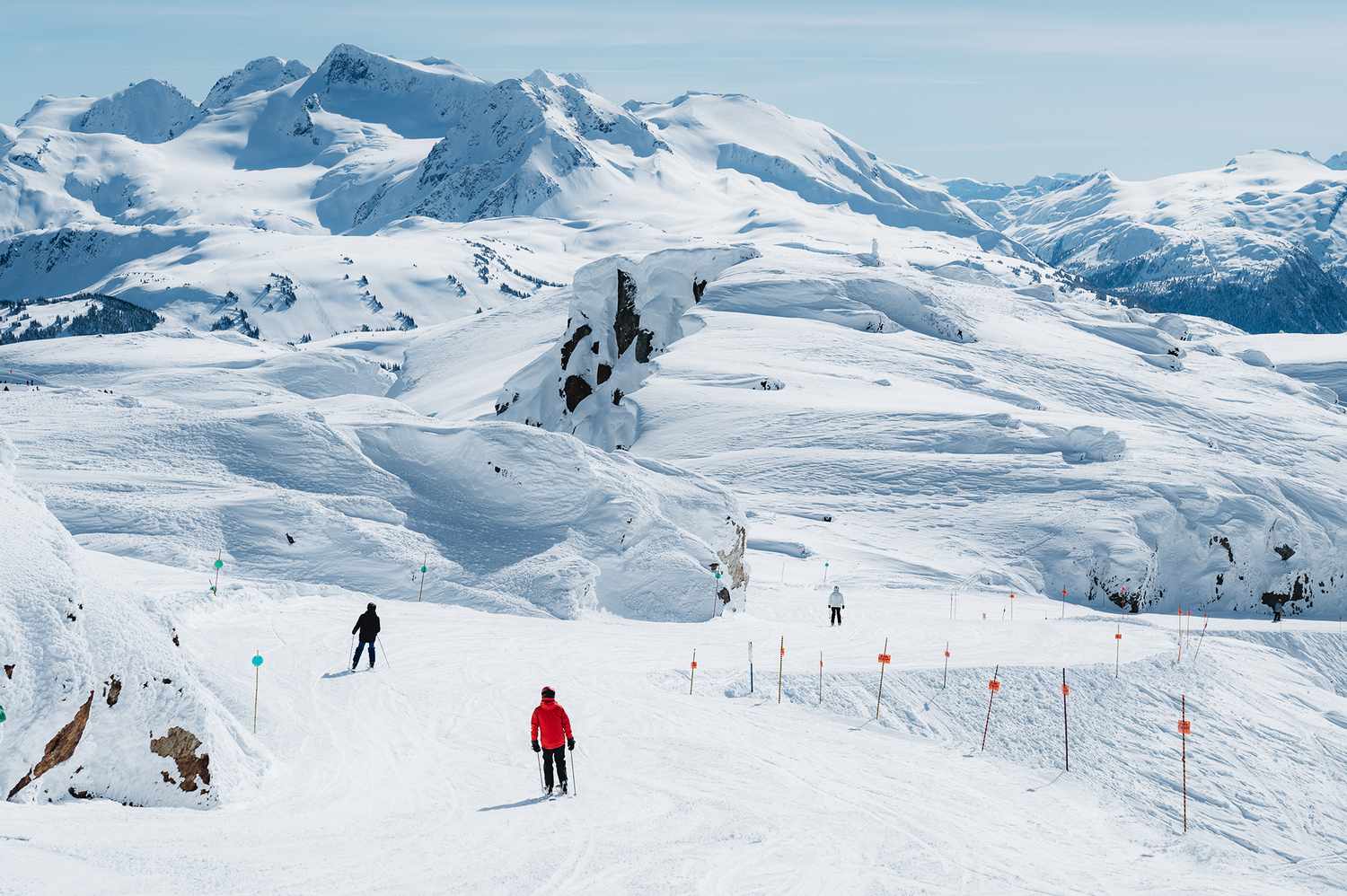
Whenever I told fellow skiers I was headed to Whistler, British Columbia, the reaction was always tinged with either awe or jealousy. Often referenced as the largest ski resort in North America—a title Utah’s Powder Mountain also lays claim to—Whistler Blackcomb is a destination known for its extensive terrain, glade skiing, and mountain views. The latter are best witnessed from the Peak 2 Peak Gondola, the 2.7-mile-long lift between the resort’s two mountains, Whistler and Blackcomb.
“There are so many amazing off-piste runs (many not even named), so once a skier or rider gets good enough on-piste to venture further, a world even larger than they imagined opens up,” says Paul Sauvé, manager of the resort’s Adult Snow School. “You can ski here for years and still be discovering new runs and new lines.”
With 8,171 acres of terrain and more than 200 marked runs—plus 16 alpine bowls and three glaciers—Whistler Blackcomb is hard to wrap your head around, even when you’re there, suited up and carving through fresh powder. I found myself repeatedly asking ski instructors and anyone else intimately familiar with the resort: What is the defining difference between Whistler and Blackcomb? Everyone’s response was slightly different, demonstrating the sheer dynamism and depth of the resort. But Sauvé’s answers to the poised question echo my own sentiments after visiting in early February.
“Blackcomb has its reputation as the hardcore locals’ favorite for a reason: fewer crowds, a faster upload via the Blackcomb Gondola, and alpine terrain that almost always opens earlier than Whistler. Blackcomb is hard to beat if you love charging and off-piste laps earlier in the day,” he explains. “However, Whistler gets the sun earlier and has a much greater variety of easy runs at midmountain. For a more leisurely morning or for the more novice skier, pick Whistler.”
Like many resorts in North America this year, Whistler Blackcomb experienced a challenging start to the season with low snowfall and above-normal temperatures, but fresh snow is still in the forecast. For a last-minute spring skiing trip, it’s tough to beat a place named one of the “most beautiful ski spots across the U.S. and Canada.”
- The extensive terrain has something for everyone—whether you prefer challenging off-piste descents or cruising the groomers.
- With a winter season that typically extends into May, Whistler Blackcomb is one of the best places on the West Coast for spring skiing adventures.
- Whistler is home to Canada’s two best resorts, as determined by T+L’s 2025 World’s Best Awards: Four Seasons Resort & Residences Whistler and Fairmont Château Whistler.
Where to Stay
Mitchell Winton/Whistler Blackcomb/Vail Resorts
Four Seasons Resort & Residences Whistler
Four Seasons Resort & Residences Whistler may not be a ski-in/ski-out, but don’t let that dissuade you from booking a room or suite at this T+L reader favorite hotel. The 273-key property is outfitted with all the necessary amenities for a seamless, luxe ski trip—cozy fireplaces, the famously plush Four Seasons beds, complimentary shuttle rides to the mountains, a dedicated ski concierge right at the base of Blackcomb, and a spa that specializes in relaxation and post-adventure recovery.
Fairmont Chateau Whistler
If you’re not willing to budge on ski-in/ski-out access or an overall luxury experience, Fairmont Chateau Whistler is your spot. Rated the No. 2 best Canadian resort in the 2025 World’s Best Awards, the hotel and its 519 rooms and suites are located at the foot of Blackcomb Mountain, giving guests a spacious, convenient home base for all kinds of winter adventures.
Where to Eat
Matthew Sylvestre/Whistler Blackcomb/Vail Resorts
Chic Pea
While a gluten allergy didn’t allow me to visit Chic Pea during my trip, I couldn’t help but dream about its world-famous, incredibly indulgent cinnamon buns. The Whistler Mountain hut serves up the type of cinnamon buns that will power you through a long day of challenging skiing or snowboarding. They’re huge, gooey, and, allegedly, melt in your mouth.
Christine’s on Blackcomb
As its name suggests, Christine’s on Blackcomb sits at the very top of Blackcomb Gondola, making it a popular, highly convenient stop for lunch. Reservations are key, and you’ll have the best experience if you visit on a bluebird day; the views are hard to beat. Even if visibility is tough, you’ll still leave full and satisfied after ordering Christine’s Salad (topped with pickled blueberries, halloumi, pecans, and fresh vegetables) or the smash burger.
Wild Blue
The award-winning Wild Blue is a true standout in Whistler—and the hype is well-deserved. Billed as an “upscale, seafood-forward, and locally-inspired dining experience,” the restaurant takes its menu seriously; this is not your mediocre resort town cafeteria. Expect towers of wild seafood, housemade sourdough, and an inventive cocktail list. Even the zero-proof options are thoughtful, creative, and served in glassware that best matches the drink.
Lorette Brasserie
Lorette is another fine-dining experience, albeit one with a French twist. While the restaurant has quickly become a go-to spot for a leisurely breakfast—the “Hangover Sandwich” is perfect after a particularly lively après-ski afternoon the day before—the dinner menu is just as appealing. Baked oysters, the beef cheek bourguignon, and the crème brûlée (or the profiteroles) are the dream lineup.
Where to Après Ski
Matthew Sylvestre/Whistler Blackcomb/Vail Resorts
The Garibaldi Lift Company (GLC) Bar & Grill
“The GLC at Whistler wins après if you go hungry,” says Sauvé. “They also have the most comfortable outdoor seating if you choose the patio instead of sitting indoors.” A butterscotch hot chocolate, made with Baileys and Butter Ripple Schnapps, and a hearty plate of Canadian poutine—plus a seat around a fire pit—is an undefeated way to warm up after a particularly chilly day on the slopes.
Merlin’s Bar and Grill
“Merlin’s at Blackcomb wins après if your goal is dancing and singing along with some live music,” says Sauvé, who recommends looking for dates that feature The Hairfarmers. If you’re feeling particularly festive, a classic shot ski at Merlin’s might be your move.
Off-mountain Activities
Whistler Blackcomb/Vail Resorts
Explore the Village
“If you are here when the valley is dry, the Valley Trail that goes throughout Whistler has so many good walks that you can tailor to how much time you have,” says Sauvé. “For winter runners and joggers, it’s fantastic.” It connects all of Whistler’s neighborhoods, even the historic Creekside, a quieter, more relaxed base area.
Go on a Night Walk
“If you are less active but want an incredible night walk, Vallea Lumina is a great way to see the forests north of Whistler in a new light,” says Sauvé. The immersive year-round experience begins after sunset and features lights, sounds, and storytelling, and the winter course covers a little over half a mile, usually taking visitors between 30 and 45 minutes from start to finish.
Try Snowmobiling
Take a break from your skis or board and opt for a snowmobile. The Adventure Company offers various snowmobiling experiences catering to all levels of comfort. Daredevils can head into the backcountry with their guide, zooming through deep powder and heading up steep climbs.
Learn About Local Culture
Not all of Whistler’s activities are meant to be heart-pounding and adrenaline-inducing. Case in point: the Squamish Lil’wat Cultural Centre, a museum, gallery, and gift shop designed to showcase the culture of the Indigenous Sḵwx̱wú7mesh and Lil̓wat7úl people.
How to Ride
Matthew Sylvestre/Whistler Blackcomb/Vail Resorts
Tickets
Owned by Vail Resorts, Whistler Blackcomb is on the Epic Pass, which allows for unlimited and unrestricted access to both mountains. Not an Epic Pass holder? An off-peak day pass starts at about $110. For midweek skiing in April, one-day lift tickets are closer to $150.
Rentals
You can rent your gear—from brands like Salomon, Atomic, and Rossignol—directly from the mountain, although you’ll want to reserve ahead online for the best prices. There are 20 different locations for pickup throughout Whistler, so you likely won’t have to lug your equipment very far.
Skiing and Snowboarding Information
Whistler Blackcomb isn’t a mountain you can traverse in a weekend—and that’s the beauty of it. To access the 8,171 acres of skiable terrain, 200-plus trails, and three terrain parks, there are 36 different lifts (including the aforementioned Peak 2 Peak Gondola, a highlight of the experience). The terrain can be broken down into 20 percent easy, 35 percent more difficult, 25 percent most difficult, and 20 percent expert only.
“Beginners should be at the Olympic learning area on Whistler. With four magic carpets (of varying slope), and an amazing bunny slope (Fantastic), there are great options for progression in anyone’s first four days of skiing,” says Sauvé. If you’re more of an intermediate, head to the Crystal Chair zone on Blackcomb, which he says offers “the best long cruiser in ‘Ridge Runner’ while also offering a really easy introduction to off-piste with ‘Log Jam.’” Blackcomb is also where you’ll find Sauvé’s favorite bowls. “Climb two minutes at Spanky’s Ladder to get to Ruby, Diamond, and Sapphire bowls,” he recommends.
When to Go
While the 2025-26 season was plagued by higher-than-average temperatures and a thin base—most notably, at lower elevations—Whistler Blackcomb is a resort known for its spring skiing. Sauvé recommends mid to late April, as that’s when “most leisure skiers have dusted off their golf clubs at this point,” but the area may also be hit with “a lot of surprise mini storms.”
“It’s not uncommon to get regular 5- to 10-centimeter (about 2 to 4 inch) powder days in the spring,” he says. “And when those aren’t happening, it’s because the weather is sunny. Never heard a skier complain about weather conducive to Coronas on a patio at 2,200 meters.”
But if you’ve hung up your boots and packed away your base layers for the year—and you’re thinking ahead to next ski season—Sauvé also recommends Jan. 15 to Feb. 15, which he says coincides with fewer visitors and “amazing” skiing. “Usually, late December and January bring good storms, and I like tree skiing. So by this time, the snow base is reliable for skiing off-piste, and the Christmas traffic is in the rearview mirror,” he explains.
Read the full article here