


Sure, space travel is all the rage these days, but there’s a quicker—and significantly more cost-effective—way to find an out-of-this-world experience: visit Death Valley National Park.
No matter the month, Death Valley is otherworldly, with salt flats, sand dunes, sherbet-tinged hills, and some of America’s inkiest nightscapes. Yet that beauty comes with its challenges. For starters, it’s hot. The park’s summer temperatures soar beyond 100 degrees Fahrenheit, making daytime adventures largely unbearable.
In early spring, though, the park is quite pleasant. This time of year gets busy, but it’s well worth it for the all-day (and night) adventures in store. Here’s why Death Valley is my favorite national park to visit during the springtime, and how to get the most out of your trip.
Things to Do
Jordan/Adobe Stock
See surreal stars.
Death Valley isn’t just dark; global light pollution authority DarkSky International certified it as a gold-tier (the highest class) dark-sky park in 2013. During these jet-black nights, you can spy galaxies, nebulae, meteors, and planets, including the Milky Way.
Spring is an especially good time to stargaze here because the glittery center of the Milky Way, known as the galactic core, returns to view for Northern Hemisphere stargazers around early March. Admire our spiral galaxy and the stars surrounding it all over the park, with top-notch viewpoints including Mesquite Flat Sand Dunes, Badwater Basin, and Zabriskie Point.
Watch for wildflowers.
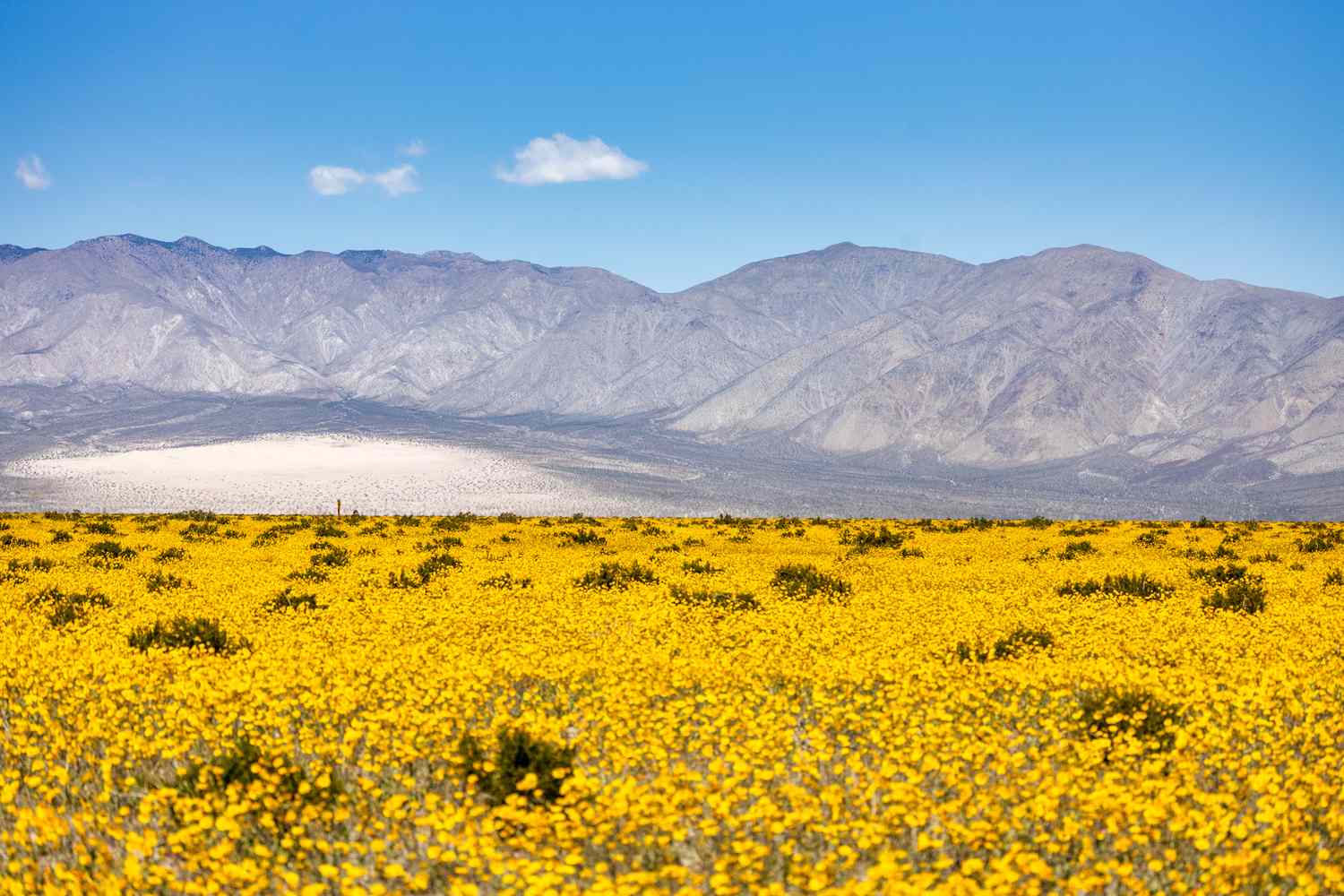
One of the best parts about spring in Death Valley National Park? The chance to see a superbloom. When winter brings adequate rain, it can trigger an impressive spring display of gold wildflowers on the desert floor. According to the National Park Service, this typically peaks in late March or early April. Monitor the park website for updates on wildflower potential.
Go hiking.
Spring’s moderate temperatures make for pleasant hiking at all hours—and you’ll want that time with all the park has to explore. Take a long walk on the soaring Mesquite Flat Sand Dunes, which become even more marvelous with green and yellow foliage from the surrounding trees each spring. There are no set trails in this natural sandbox, so it’s a choose-your-own-adventure kind of hike. Just know that, even after a few miles, you’ll be feeling it with the natural resistance training courtesy of thick sand. Visit at sunrise and sunset for an extra-dramatic scene.
Another showstopper is Artists Palette, a collection of hills that look painted orange, pink, blue, and yellow—a natural rainbow created by volcanic deposits like iron oxides and chlorite. The hillside is part of the scenic Artists Drive loop, but you can take a quick and scenic stroll through it on the short loop trail for a closer view.
For a longer jaunt, try the six-mile Fall Canyon trek, which weaves through a less-trodden corner of the park, via Titus Canyon, en route to the Fall Canyon Narrows, where towering striated walls of black dolomite and limestone surround you. It’s a prime spot to see wildlife like bighorn sheep.
Walk Badwater Basin.
No trip to Death Valley National Park is complete without a visit to Badwater Basin, a vast expanse of sparkly salt flats that marks the lowest point in North America. This field of calcite, gypsum, and borax—once a large ancient lake—covers close to 200 square miles. You’ll nab the best views after around two miles out on the flats. Sunrise and sunset are spectacular times to see it, as the white floor picks up that orange, golden-hour glow.
Take a backcountry drive.
Go off the beaten path, and away from spring crowds, with a drive through Death Valley’s backcountry—an amalgam of dramatic canyons and desert scrub with soaring vistas. The park offers nearly 1,000 miles of paved and dirt roads through the wilderness for recreation and exploring, but you’ll have to come prepared with supplies for surviving the backcountry. You’ll also need an adequate ride, as most rental companies don’t allow backcountry driving.
Farabee’s Jeep Rentals in Furnace Creek offers cars primed for this style of adventure. Either rent one yourself or book one of the company’s backcountry driving tours to enjoy a wilderness excursion with a guide who’s trained in this rugged terrain.
Rory Fuller/Travel + Leisure
Where to Stay
For a remote national park, Death Valley has quite an array of accommodation options. Overnight at The Oasis at Death Valley, a getaway in the park’s Furnace Creek area with two hotels. There’s the four-diamond Inn at Death Valley, a century-old hideaway with a spring-fed pool and stylish casitas; or the relaxed Ranch at Death Valley, a family-friendly escape built along an 18-hole golf course.
To stay closer to the sand dunes, book a night at the laid-back Stovepipe Wells Village, where a newly renovated hotel welcomes guests with a swimming pool, on-site dining, and RV hookups.
For camping, try Furnace Creek, which is open for reservations from Oct. 15 to April 15 (no reservations are required outside of these months). This is among the most popular camping spots, with quick access to Death Valley’s attractions. Sunset, the park’s biggest campground, is another option that usually has ample room, even during the prime spring season.
Read the full article here